
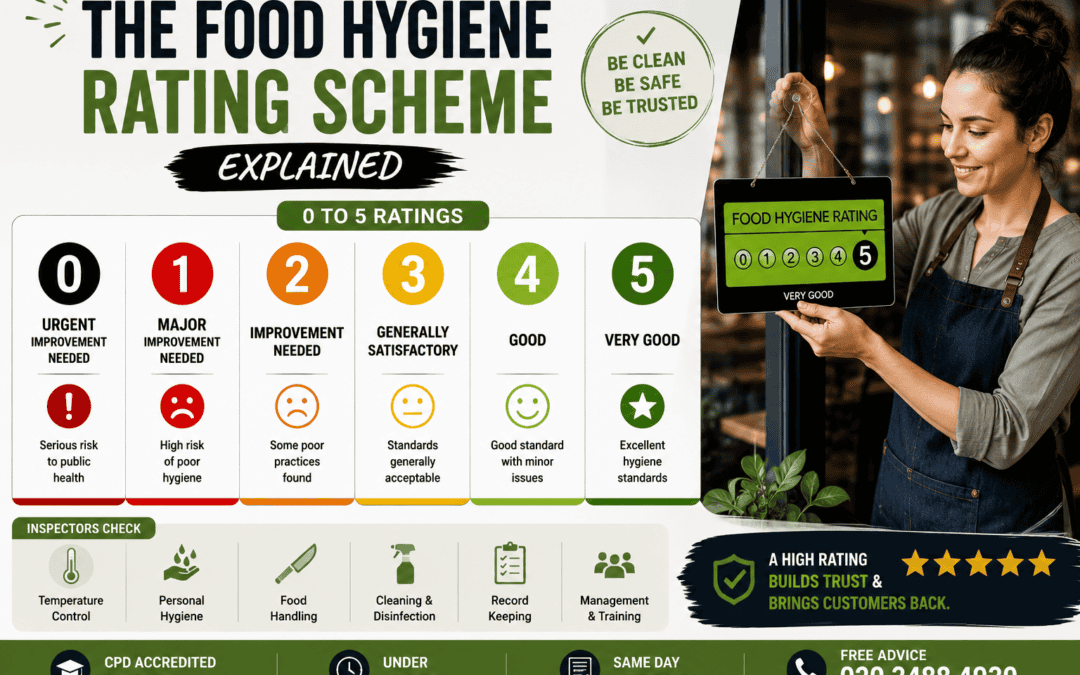
The Food Hygiene Rating Scheme Explained (0 to 5 Ratings)
Most business owners meet the food hygiene rating scheme twice. Once when the sticker goes up in the window, and once when the number on it is lower than they expected.
The scheme is not mysterious, though. There is a published method, three scored elements, and a threshold table. Once you understand how the arithmetic works, you can see exactly where your points went and what to fix.
This guide walks through the whole thing, from what the numbers mean to how to get yours moved.
What the scheme is and who runs it
The Food Standards Agency launched the scheme in November 2010. It now covers well over 400,000 food businesses across England, Wales and Northern Ireland.
Your local council carries out the inspections and awards the rating. The FSA publishes the results on a national website, so anyone can look you up before they decide where to eat.
Scotland works differently. It runs the Food Hygiene Information Scheme, which gives a pass or an improvement required result rather than a number. If you trade in both, you deal with both.
What each number actually means
The scale runs from 0 to 5, and the wording matters because customers read it.
A 5 means hygiene standards are very good. A 4 means good. A 3 means generally satisfactory, which sounds acceptable and reads to a customer as mediocre. A 2 means improvement is necessary. A 1 means major improvement is necessary. A 0 means urgent improvement is required.
The gap between a 3 and a 5 is not really about food. It is usually about paperwork and consistency.
The three things an officer scores
At the inspection, the officer scores three separate elements. Understanding them separately is the key to fixing a poor result.
Food hygiene and safety procedures. How the food is actually handled. Preparation, cooking, reheating, cooling, chilling, temperature control, cross-contamination.
Structural requirements. The condition of the premises. Cleanliness, layout, lighting, ventilation, pest control, equipment, handwashing facilities, drainage.
Confidence in management. How well you run and evidence the whole system. Your documented procedures, your records, your training, your track record, and how much the officer believes standards will hold up after they leave.
The GOV.UK guidance on the rating scheme sets these out and confirms the point every operator should hear: all businesses should be able to achieve a 5.
The scoring runs backwards, and that confuses people
Here is the part that catches everybody out. Low scores are good.
Each element is scored upwards from 0, where 0 means full compliance. Hygiene and structure can each score 0, 5, 10, 15, 20 or 25. Confidence in management scores 0, 5, 10, 20 or 30, with no 15 or 25 available.
The three are added together into a total. The lower your total, the higher your rating. A business scoring 0, 0, and 0 has a total of 0 and receives a 5.
So when an officer says you scored 15, that is not a mark out of anything. It is fifteen points of noncompliance.
The rule that quietly caps your rating
This is the single most useful thing in this article, so it gets its own section.
Your total is not the only test. There is also a limit on the highest individual score, sometimes called the additional scoring factor. If one element scores above the permitted maximum for a given rating, your rating drops regardless of how good the total looks.
For a 5, you must score no more than 5 in every one of the three elements. Not on average. In each one.
That is why a spotless kitchen with immaculate handling can still land a 3. The food was fine, the building was fine, and confidence in management scored 20 because the food safety management system was not written up. One weak element pulls everything down with it.
It also explains why some businesses feel hard done by. Nothing on the plate was wrong. The evidence was.
Confidence in management is where ratings are won and lost
Look again at the available scores. Hygiene and structure top out at 25 each. Confidence in management goes to 30.
It is weighted highest deliberately, because it is the best predictor of whether standards will still be there in six months. An officer visiting on a quiet Tuesday cannot see how you cope on a Saturday night. Your systems and records tell them.
What lands in this element:
- A documented food safety management system, kept current and actually completed
- Temperature records for fridges, freezers, cooking and hot holding
- Cleaning schedules that match what the premises looks like
- Allergen information that is accurate and matches this week’s menu
- Staff training certificates with dates, covering everyone who handles food
- Supplier records and traceability
- Your track record, including how you responded to previous advice
Two businesses can look identical during a walkthrough. The one with a completed diary and a training folder scores 0 or 5. The one with good intentions scores 20.
Where your rating shows up
The published rating reaches further than most owners realise.
It sits on the FSA’s public database at ratings.food.gov.uk, which anyone can search. Review sites and map listings pull from it. Delivery platforms display it, and some set a minimum before they will list you at all.
Corporate clients, event organisers, wedding venues and market operators increasingly ask for it before awarding work. Insurers take an interest. Landlords ask about it at lease renewal.
In Wales and Northern Ireland, displaying the sticker is a legal requirement. In England it is voluntary, which fools nobody, because a missing sticker is read as a bad rating.
How often will you be inspected?
There is no fixed timetable. Frequency is risk-based.
A high-risk business with a poor track record might be revisited within months. A low risk business with a strong rating might not see an officer for two years.
Inspections are unannounced. That is the whole point. Your rating reflects standards on an ordinary working day, not standards on a day you prepared for.
What happens if you disagree with your rating
You have options, and they are separate things, so do not mix them up.
The right to appeal applies if you believe the rating does not reflect what the officer found. There is a deadline, usually 21 days, so act quickly.
The right to reply lets you publish a short statement alongside your rating explaining what has changed. It does not raise the score, but customers can see it.
The right to a revisit lets you request a re-inspection once you have made the improvements, and there may be a fee. This is the one that actually changes the number.
Before requesting a revisit, be sure the work is done. A second disappointing result is worse than the first.
Practical steps that move a rating up
If you are sitting on a 3 and want a 5, work in this order.
Start with the documentation, because that is usually the biggest single score against you. Get your food safety management system written, and complete the daily diary properly rather than filling in a fortnight of entries the night before.
Then get everyone trained and keep the certificates together with dates. Training evidence feeds directly into confidence in management, and it is the cheapest fix available. Our Level 2 Food Hygiene and Safety course covers everyone handling food, and Level 3 Food Safety for Supervisors covers whoever runs the kitchen and builds the systems.
Then deal with the structural items you have been putting off. Sealing a gap under a door, replacing a cracked worktop, fixing the extractor. These are visible, cheap and easy points.
Finally, make the records habitual rather than occasional. Twice daily fridge checks written down beat a perfect system nobody uses.
If you would rather not assemble all of that from scratch, our Food Hygiene 5 Star Pack brings the equipment, documentation and record keeping together in one kit, built around the three elements an officer scores.
Not sure where your points are going? Ask us; it is free
Plenty of businesses know their rating and have no idea which element cost them.
Tell us what you were scored and what your setup looks like, and we will talk you through where the gap probably sits and which training your team needs. There is no charge for the conversation.
Call our landline on 02034884930 for free advice, or email info@gvec.co.uk. We can also quote for training a whole team, with tracking so you can see completions before your next inspection.
Questions owners ask about the scheme
Can I get a 5 with an old building?
Yes. The officer judges condition and cleanliness, not age or budget. Well-maintained old premises score well.
Does a new business start at 5?
No. You are rated at your first inspection like everyone else, so be ready from day one.
How long does a rating last?
Until your next inspection, there is no expiry date, which is why a poor rating can sit online for a long time.
Does staff training really affect the score?
Yes, directly. It is part of confidence in management, the highest weighted element.
Is the rating about food quality?
No. It covers hygiene and safety only. A takeaway can hold a 5 and a fine dining restaurant can hold a 2.
The short version
Three elements, scored upwards from zero, added together, with a cap on your worst single score. Documentation and training carry the most weight, and they are the parts you can fix this month without spending much.
Look up your own rating, work out which element cost you, and start there.
Browse our food hygiene courses, or call 02034884930 and we will help you build a plan before your next visit.