
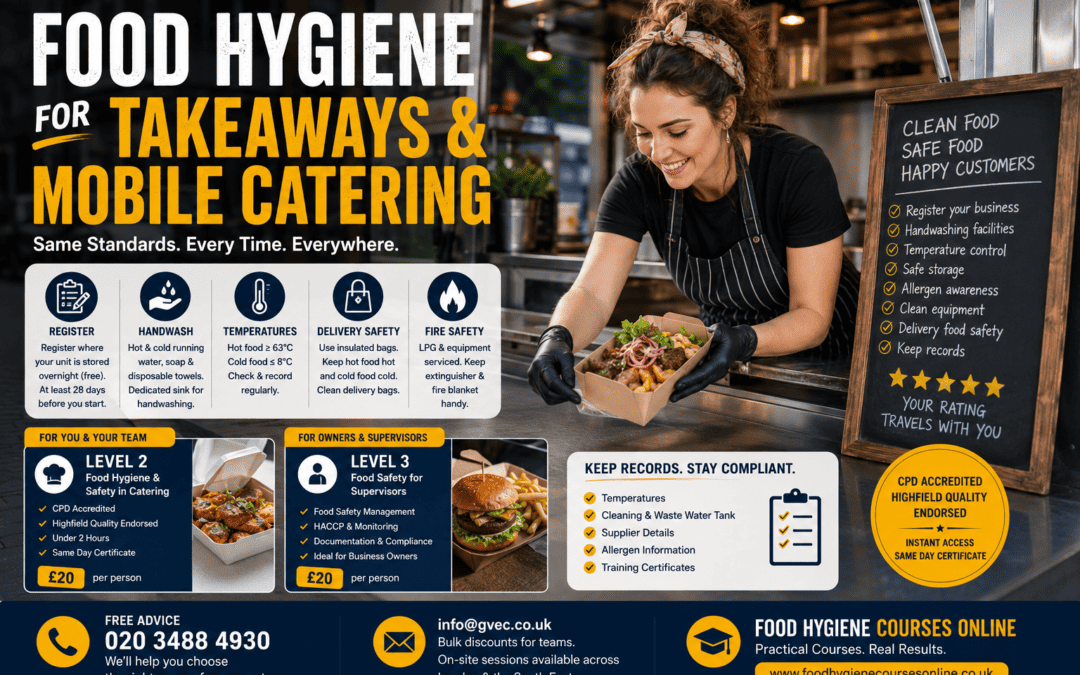
Food Hygiene for Takeaways and Mobile Catering Units
Takeaways and food vans get held to the same standard as a restaurant kitchen. The difference is that they have to hit it with less space, less water, less storage, and often one pair of hands.
That is not a complaint; it is just the job. Once you know which parts inspectors actually focus on, it becomes much easier to run cleanly.
Here is what applies to takeaways, burger vans, street food stalls and market pitches.
Small unit, same rules
There is no lighter version of food law for mobile traders. Regulation 852/2004 applies to a horsebox conversion the same way it applies to a hotel.
What changes is the difficulty. A restaurant has three sinks and a walk-in fridge. A van has a metre of worktop, a leisure battery and a water tank that runs out at four o’clock on a busy Saturday.
Inspectors know this. They are not looking for a professional kitchen. They are looking for evidence that you have thought about the risks your setup creates.
Registering a business that does not stay still
This catches people out constantly, so read this bit twice.
You register your food business with the council where your unit is stored overnight, not where you trade. If your van sleeps in Dagenham and you trade in Camden, Barking and Dagenham is your registering authority.
Registration is free and should be done at least 28 days before you start trading. It applies to vans, trailers, stalls, gazebos and home-based operations alike, as the GOV.UK food business registration guidance sets out.
Trading somewhere else still means getting permission from the landowner or market operator, and some councils want notice too. That is separate from food registration.
The FSA’s guidance on businesses that supply or produce food on the move covers the transport and storage side in more detail.
The handwashing question every inspector asks
If there is one thing that sinks mobile units at inspection, it is this.
You need a dedicated hand wash basin with a constant supply of hot and cold water, permanently fitted, with soap and disposable towels. Not a bottle of water and a bit of blue roll.
You also need a separate sink for washing equipment. Hands and pans do not share.
Waste water goes into a proper tank and gets emptied at your base. Tipping it into a gutter or onto grass is an offence, and it is the kind of thing that gets photographed.
Delivery is where takeaway food goes wrong
Restaurant food is eaten within minutes. Takeaway food sits in a bag on a scooter for half an hour.
Hot food must leave at 63°C or above and needs insulated bags to hold that on the way. Cold items need to stay cold, and stacking a chilled dessert on top of a hot curry ruins both.
Delivery bags need cleaning. They rarely get it. Have a schedule and stick to it, because a bag that has carried spilled sauce for three weeks is a genuine contamination route.
If you use third-party riders, remember the food is still your responsibility until it reaches the customer.
The risks that are not bacteria
Mobile catering carries hazards a fixed kitchen does not.
LPG cylinders, generators and deep fat fryers sit within a couple of metres of each other in a metal box. Gas installations need servicing by a qualified engineer, and you need an appropriate extinguisher plus a fire blanket if you fry.
Keep the exit clear. In a van fire, you have seconds, not minutes.
If your team has not covered this properly, our Fire Safety Level 2 course is a sensible companion to food hygiene training for anyone running a unit with gas and fryers.
Allergens when you pack on the pitch
If you make food and pack it before the customer orders- sandwiches wrapped in advance, salad boxes made up at the start of service- that is prepacked for direct sale. Full ingredient labelling with allergens emphasised applies.
Food cooked to order and handed over is different, but you still need accurate allergen information available and staff who can answer confidently.
Street food menus change often, and that is exactly when allergen information goes stale. Update it every time a recipe or supplier changes.
Your rating travels with you
Takeaways and mobile units get a food hygiene rating like everyone else, and it is published online.
For a takeaway, that rating sits next to you on delivery platforms. Customers see it before they see your menu. For a street food trader, event organisers and market operators increasingly ask for it before they will give you a pitch.
A low score is not just a compliance problem. It closes doors.
The training your team needs
Anyone preparing, cooking or handling open food needs Level 2. That means you, your kitchen staff and anyone helping at weekends.
Our Level 2 Food Hygiene and Safety in Catering course covers temperature control, cross-contamination, cleaning, allergens and the law. It is CPD accredited, Highfield quality endorsed, costs £20 and takes under two hours. The certificate is issued the same day, which suits seasonal hiring.
If you own the business or supervise other people, go to Level 3 Food Safety for Supervisors. Most single unit operators are the supervisor by default, even if nobody has ever called them that.
Paperwork that fits in a glovebox
Your food safety management system has to be written down, but it does not need to be heavy.
Keep temperature checks for your fridge and your hot holding, cleaning records including the waste water tank and delivery bags, supplier details, and your training certificates with dates.
Keep it in the unit. Inspectors turn up while you are trading, and a folder sitting at home is no use to anyone.
Not sure what you need? Give us a ring; it is free
Mobile operators often have an unusual mix of staff. An owner, a full-timer, and three people who only work festivals.
Tell us how your business runs and we will tell you which course each person needs. If your weekend helpers only need Level 2 and you need Level 3, that is what we will say.
Call our landline on 02034884930 for free advice, or email info@gvec.co.uk. Bulk pricing is available if you are training a crew, with tracking so you can see who has finished before the season starts.
What traders ask us
Do I need a licence as well as registration?
Registration is separate from street trading consent. Check with the council where you trade about pitch permissions.
Do casual festival staff need certificates?
Yes, if they handle open food. Book them before the event, not after.
Can I run a food van from my home kitchen prep?
Only if that kitchen is registered and inspected as part of the business. Many traders use a commercial prep unit instead.
Does my rating transfer between councils?
Your rating comes from your registering authority and follows the business.
Before your next trading day
Check your handwash basin runs hot. Check your certificates are up to date and in the unit. Check your allergen list matches this week’s menu.
Three things, twenty minutes, and most inspection findings disappear.
See our full range of food hygiene courses, or call 02034884930 and we will sort the right course for your setup.