
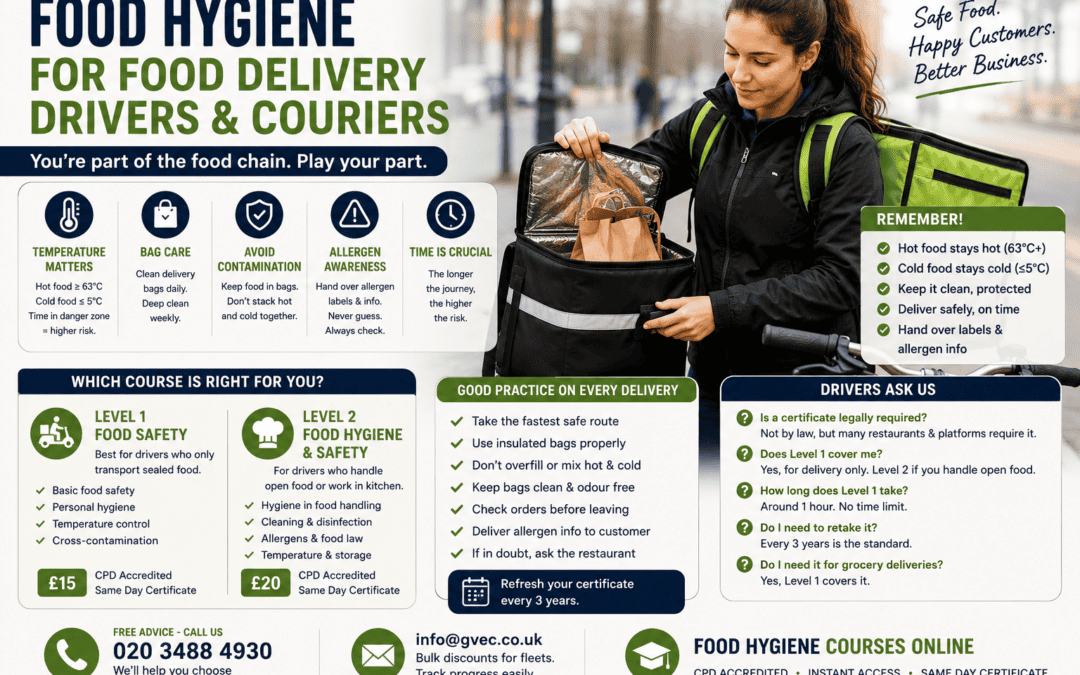
Food Hygiene for Food Delivery Drivers and Couriers
Delivery drivers rarely think of themselves as part of the food industry. You pick up a sealed bag and you drop it off. The cooking was somebody else’s job.
Food law sees it differently. The moment you take custody of that food, you are part of the chain that keeps it safe, and what happens in your car or on your bike matters.
Here is what actually applies to drivers and riders, without the lecture.
You are handling food, even sealed food
You do not have to touch the food itself to be a food handler in the legal sense. Transporting it counts.
That means the same broad duties apply. Keep the food protected from contamination. Keep it at a safe temperature. Keep your equipment clean. Do not deliver food you know is unsafe.
Nobody expects you to run a kitchen from a scooter. They do expect you to understand why a lukewarm curry that has been in a hot bag for forty minutes is a problem.
The thirty-minute problem
Temperature is the single biggest risk in delivery, and time is what drives it.
Hot food should leave the kitchen at 63°C or above, and your job is to slow the drop. Cold items need to stay properly chilled. The zone in between is where bacteria multiply fastest, and every extra minute in that zone adds risk.
Practical habits make the difference. Take the most direct route. Do not stack a chilled dessert against a hot main. Keep the bag zipped rather than sitting open on the passenger seat. Do not stockpile several orders and deliver them in a loop if it stretches the last one out.
If a restaurant hands you food that is already lukewarm, say so at the counter. That is a kitchen problem, and it becomes your problem the second you drive off with it.
Bags nobody ever washes
Insulated bags are the most neglected item in the whole delivery chain.
Sauce leaks. Rice spills. It dries in the seams and stays there for months. That bag then carries somebody’s food home.
Wipe it out after every shift and give it a proper clean weekly. Keep a spare so one can dry. If the lining is torn and cannot be cleaned properly, replace it rather than working around it.
Your car boot counts too. A boot that carries shopping, sports kit and a dog is not a food transport space unless the bag is doing real work.
The allergen job that lands on you
This is the part most drivers have never been told.
For food ordered online or by phone, allergen information has to reach the customer twice. Once before they order, and again when the food is delivered. That second point is where you come in.
In practice, it means the allergen stickers, labels or menu the restaurant attaches must actually reach the customer. Do not swap lids between orders. Do not consolidate two orders into one bag. Do not remove a label because it is stuck on awkwardly.
If a customer asks you directly whether something contains an allergen, do not guess. Point them to the labelling or ring the restaurant. A polite “I cannot confirm that, let me check” is always the right answer. The GOV.UK allergen guidance for food businesses sets out the full picture.
Self-employed riders and where responsibility sits
Most riders are self-employed, which raises a fair question about who carries the duty.
The restaurant remains responsible for the food it sends out. The platform sets standards for its couriers. You are responsible for what happens while the food is with you.
None of those cancel the others out. In practice, a certificate is the simplest way to show you understand your part, and it takes an afternoon.
Which course does a driver need?
For most drivers and riders, Level 1 Food Safety is the right fit. It covers personal hygiene, contamination, temperature basics and safe handling. It costs £15, it is CPD accredited, and the certificate is issued the same day you pass.
Go up to Level 2 Food Hygiene and Safety if your job involves more than transport. That includes drivers who plate up, bag orders in the kitchen, portion food, or work shifts behind the counter between deliveries. Plenty of takeaway drivers do exactly that without thinking of it as food preparation.
If you are unsure which side of the line you sit on, Level 2 covers you either way for £20.
Why more drivers are being asked for one
Certificates used to be rare in delivery. That is changing.
Restaurants running their own drivers increasingly train them, because the food is still theirs until it arrives. Courier firms and catering delivery contracts often ask for proof. Corporate and event catering clients ask as standard.
It is also a differentiator if you are self-employed and pitching for regular work. A certificate costs less than a tank of fuel, and it lasts three years.
Not sure what you need? Ring us; the advice is free
It takes two minutes on the phone to work out whether Level 1 or Level 2 fits what you actually do.
Call our landline on 02034884930 for free advice, or email info@gvec.co.uk. If you run a fleet of drivers, ask about bulk pricing and tracking so you can see who has completed the course.
Straight answers for drivers
Is a food hygiene certificate legally required to deliver food?
No specific certificate is named in law, but appropriate training is required, and many restaurants and platforms now ask for one.
Does Level 1 cover me for delivery work?
For transport only, yes. If you also handle open food, take Level 2.
How long does Level 1 take?
Around an hour. There is no time limit, and the certificate arrives the same day.
How often do I need to retake it?
Every three years is the standard.
Do I need one for grocery or shopping deliveries?
The same principles apply, and Level 1 covers it comfortably.
Sorted in an afternoon
Take Level 1 tonight, clean your bag properly, and stop stacking hot and cold together. That is most of the job done.
Browse our food hygiene courses, or call 02034884930 and we will tell you which one you need.