
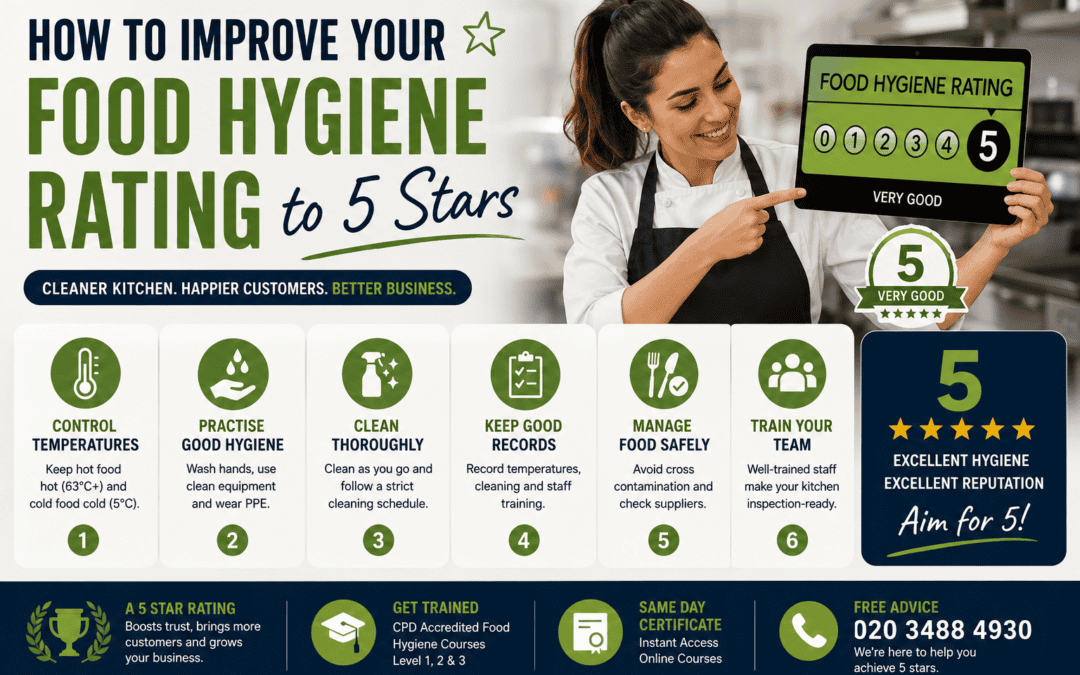
How to Improve Your Food Hygiene Rating to 5 Stars
A 3 stings more than a 1 in some ways. A 1 tells you something is badly wrong, and you know where to start. A 3 tells you that you are nearly there, which leaves most owners guessing about what nearly means.
The good news is that moving up is usually cheaper and quicker than people expect. Very few businesses need a refit. Most need paperwork, habits and evidence.
Here is how to work out where your points went, and a plan to get them back.
First, find out what you were scored.
Your rating is a summary. Underneath it sit three separate scores, and you cannot fix anything until you know which one hurt you.
Ask your local authority for the breakdown if you do not already have it. You are entitled to know how each of the three elements was scored, and the officer’s report should spell out what was found.
The three elements are food hygiene and safety procedures, structural requirements, and confidence in management. Scores run upwards from zero, and zero is perfect. If you want the full mechanics of how the numbers convert into a rating, our guide to the food hygiene rating scheme walks through it.
One rule is worth repeating here, because it explains most disappointing results. To reach a 5, you must score no worse than 5 in every single element. One weak area caps the whole rating no matter how strong the other two are.
The element that stops most businesses reaching 5
Nine times out of ten, it is confidence in management.
It carries the heaviest weighting of the three, and it is the one that has nothing to do with how clean your kitchen looked on the day. It is about whether the officer believes your standards will still be there next month.
That belief is built from evidence. Written procedures, completed records, trained staff, and a track record of acting on advice. A kitchen can be spotless and still score badly here if none of it is documented.
It is also the cheapest element to fix. Cleaning up a structural problem might mean a contractor. Fixing your documentation means a folder and a fortnight of consistency.
A four-week plan that actually works
Do these in order. The sequence matters, because early wins make the later ones easier.
Week one, get your system on paper.
Your food safety management system must be written down and based on HACCP principles. For most small businesses, the FSA’s Safer Food, Better Business pack is the accepted route, and it is free.
Do not fill it in retrospectively the night before an inspection. Officers spot that instantly, and it damages confidence in management more than leaving it blank.
Set it up properly, then start the daily diary today.
Week two, train everyone and file the certificates
Training evidence feeds directly into your highest weighted element, and it is the single fastest score you can move.
Put every member of staff who handles food through Level 2 Food Hygiene and Safety. It takes around four to five hours as a guide, costs £20, and the certificate arrives the same day.
Put whoever supervises the kitchen through Level 3 Food Safety for Supervisors. Officers look for someone who understands the system, not just the practice, and Level 3 is how you evidence that.
Then keep every certificate in one folder with dates and renewal reminders.
Week three: make records a habit
Temperature checks twice a day, written down. Cooking and hot holding temperatures for high-risk items. Cleaning schedules signed off. Delivery checks recorded.
A modest system used consistently beats an elaborate one used occasionally. Officers can tell the difference between records written daily and records written in one sitting.
Week four, deal with the physical jobs
Walk the premises with fresh eyes, or better still ask someone else to. Look at the gap under the back door, the cracked worktop, the tile that came loose, the extractor filter, the sealant behind the sink.
These are usually small, cheap and visible. They also signal that the place is being maintained, which feeds back into confidence in management.
Check your handwash basin has hot water, soap and disposable towels, and that nothing is stacked in it.
The mistakes that keep businesses stuck
Some patterns come up repeatedly.
Deep cleaning before an inspection but not maintaining it afterwards. Officers arrive unannounced, so the standard that matters is your ordinary Tuesday.
Assuming a good rating from three years ago still reflects your setup. Staff has changed since then.
Leaving allergen information to memory. If it is not written and current, it counts against you.
Training the chef but not the servers, the kitchen porter or the weekend staff. Anyone handling food needs covering.
Arguing with the officer on the day. Ask questions, take notes, and be the business that clearly wants to improve. That impression genuinely feeds into the confidence element.
Getting re-inspected once the work is done.
Improving is only half of it. The published rating will not change until you are inspected again.
You can request a revisit, sometimes called a re-score, once you have made the improvements. There is often a fee, and there is usually a waiting period of around three months from the original inspection.
Before you request one, be honest with yourself about whether the work is finished and embedded. A second poor result is worse than the first, because it suggests the problem is not a one-off.
You also have a right to appeal if you believe the rating was wrong, usually within 21 days, and a right to reply if you want a short statement published alongside your score. Those are separate from a revisit and neither of them raises the number on their own.
Why the effort is worth it commercially.
A 5 is not just compliance theatre.
Delivery platforms display your rating, and some set a minimum before listing you. Customers check it on their phone before booking. Corporate clients, wedding venues, event organisers and market operators increasingly ask for it before awarding work.
In Wales and Northern Ireland, the sticker must be displayed by law. In England it is voluntary, which means a missing sticker is read as a bad rating anyway.
Put simply, moving from a 3 to 5 changes who is willing to do business with you.
If you would rather not build it all from scratch
Assembling the documentation, the records and the equipment yourself is entirely possible. It just takes time you may not have.
Our Food Hygiene 5 Star Pack brings the compliance kit together in one place, built around the three elements an officer scores, so you are not guessing what belongs in the folder.
If your situation is more complicated, or you have already had a poor result and want someone to look at it properly, our food hygiene consultancy service works through the premises and the paperwork with you and tells you exactly what needs to change before you request a revisit.
Tell us your score, and we will tell you where the gap is
This is free, and it takes about ten minutes on the phone.
Tell us your current rating, what the officer flagged, and how your business is set up. We will talk you through which element is most likely costing you and what to tackle first. If all you need is staff training, we will say that rather than sell you a pack.
Call our landline on 02034884930 for free advice, or email info@gvec.co.uk. We offer bulk training rates with tracking so you can see who has completed what before your next visit.
Questions we hear from owners chasing a 5
How quickly can a rating be improved?
The work can often be done in a month. The published rating changes only at your next inspection or revisit.
Does a revisit cost money?
Usually yes, and the fee varies by council. Ask yours for the current amount and waiting time.
Can an older building reach 5?
Yes. Condition and cleanliness are judged, not age. Well-maintained older premises score well every day.
Will training alone lift my rating?
It lifts confidence in management, which is the heaviest weighted element. Combined with records, it is the biggest single lever most businesses have.
Is the rating about the quality of the food?
No. It covers hygiene and safety only.
Start with the folder.
If you take one thing from this, make it the paperwork. Get the system written, get the team trained, get the certificates filed, and write down your temperatures twice a day.
That is where most of the missing points live, and none of it needs a builder.
See our food hygiene courses, or ring 02034884930, and we will help you plan the route from where you are to a 5.