
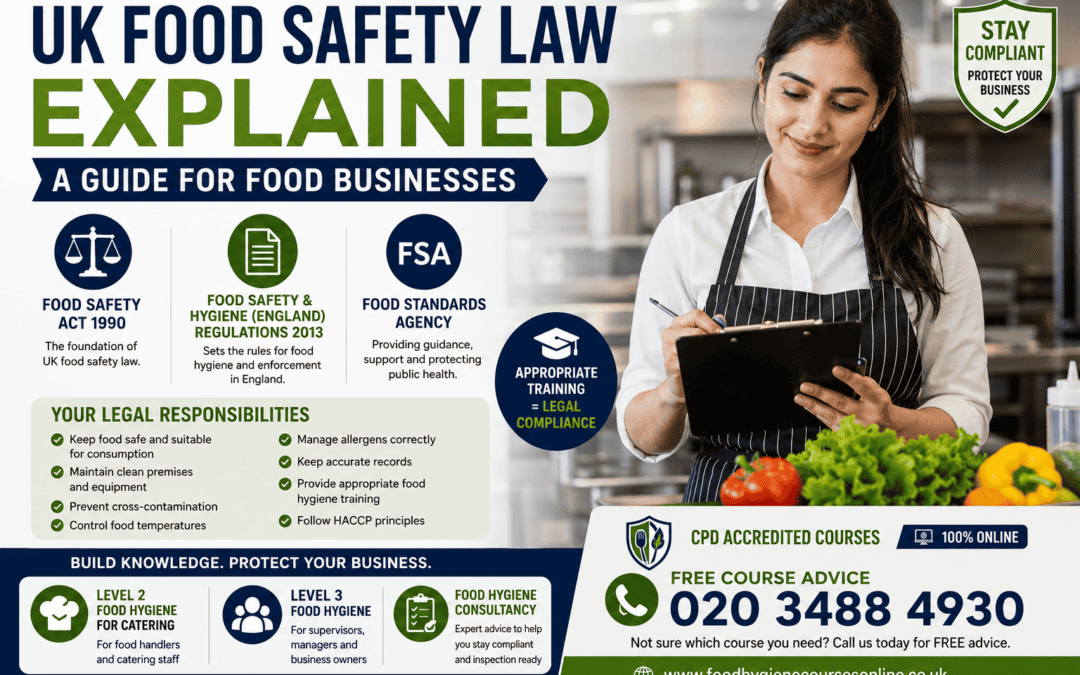
UK Food Safety Law Explained: A Guide for Food Businesses
If you run a restaurant, café, takeaway, food shop, catering business or home-based food business, understanding UK food safety law is essential. Food safety legislation exists to protect consumers, maintain high hygiene standards, and ensure that food sold in the UK is safe to eat.
Many business owners ask questions such as:
- What is the Food Safety Act 1990?
- What are my legal responsibilities?
- Do my staff need food hygiene training?
- What happens if my business does not comply with food safety law?
- Which food hygiene course is suitable for my team?
The answers are important because every food business, regardless of its size, has legal responsibilities. Whether you employ one person or manage a large catering operation, understanding the law helps protect your customers, your reputation, and your business.
At Food Hygiene Courses Online (https://www.foodhygienecoursesonline.co.uk/), we provide CPD-accredited online food hygiene courses for food handlers, supervisors and food business owners across the UK.
If you’re unsure which course is appropriate for you or your employees, our experienced team offers FREE course selection advice before you enroll.
What Is UK Food Safety Law?
UK food safety law is a collection of laws and regulations designed to ensure that food supplied to consumers is safe, hygienic, and accurately described.
These laws cover every stage of the food chain, including:
- Food preparation
- Food storage
- Food handling
- Food transportation
- Food labelling
- Food hygiene
- Food safety management
- Staff training
The legislation applies to almost every type of food business, including:
- Restaurants
- Cafés
- Takeaways
- Hotels
- Bakeries
- Supermarkets
- Food manufacturers
- Mobile catering units
- Home bakeries
- Market stalls
- Schools
- Nurseries
- Care homes
Whether you operate from commercial premises or your own kitchen, you have a legal responsibility to ensure that the food you provide is safe for consumers.
Why Is Food Safety Law Important?
Food safety legislation protects public health.
Without proper hygiene standards, harmful bacteria, viruses and allergens could place customers at serious risk.
Poor food safety practices can lead to:
- Food poisoning outbreaks
- Cross-contamination
- Allergen incidents
- Customer complaints
- Loss of business reputation
- Enforcement action
- Financial penalties
Following food safety laws helps businesses reduce these risks while building customer confidence.
Consumers are far more likely to trust businesses that demonstrate good hygiene standards and take food safety seriously.
The Food Safety Act 1990 Explained
One of the most important pieces of legislation affecting food businesses is the Food Safety Act 1990.
This Act provides the legal framework for food safety throughout the UK and remains one of the foundations of food law.
Its purpose is to protect consumers by ensuring that food sold to the public is:
- Safe to eat.
- Of the nature, substance and quality expected.
- Properly described and labelled.
The Act also gives enforcement authorities powers to investigate food businesses where necessary.
Although many additional regulations have been introduced since 1990, this legislation continues to play a central role in UK food law.
What Does the Food Safety Act 1990 Require?
The Act places important responsibilities on food businesses.
In simple terms, businesses must ensure they do not:
Sell Unsafe Food
Food must not be harmful to health.
Businesses should have procedures in place to reduce contamination risks and maintain safe food handling practices.
Sell Food That Is Not What It Claims to Be
Customers should receive food that matches its description.
Food must not be falsely labelled or misleadingly presented.
Follow Safe Food Handling Practices
Businesses should implement appropriate hygiene procedures covering:
- Cleaning
- Personal hygiene
- Food storage
- Temperature control
- Pest control
- Cross-contamination prevention
Safe food handling protects both customers and the business itself.
Who Enforces UK Food Safety Law?
Food safety law is enforced primarily by local authorities through Environmental Health Officers (EHOs) and other authorised officers.
They may inspect businesses to assess:
- Food hygiene standards
- Food safety management
- Staff knowledge
- Cleaning procedures
- Premises condition
- Temperature controls
- Record keeping
Inspectors are not simply looking for paperwork—they want to see that food is handled safely on a day-to-day basis.
Well-trained staff play an important role in demonstrating compliance.
The Role of the Food Standards Agency (FSA)
The Food Standards Agency (FSA) is the independent government department responsible for food safety and food hygiene across England, Wales and Northern Ireland.
The FSA provides guidance for:
- Food businesses
- Local authorities
- Consumers
- Food handlers
Its work includes:
- Publishing food safety guidance
- Promoting safe food practices
- Supporting food businesses
- Providing information about allergens
- Managing food incidents
- Developing food hygiene guidance
If you operate a food business, the FSA website is one of the most reliable sources of information available.
Food Standards Agency
What Responsibilities Do Food Business Owners Have?
Every food business owner has a legal duty to manage food safely.
Your responsibilities include ensuring that:
- Food is safe for consumption.
- Staff understand food hygiene principles.
- Premises are kept clean.
- Food is stored at safe temperatures.
- Cross-contamination is prevented.
- Allergens are managed correctly.
- Food safety procedures are followed consistently.
These responsibilities apply regardless of the size of your business.
Whether you operate a small café or a large catering company, the law expects you to maintain appropriate food safety standards.
Why Food Hygiene Training Is So Important
One of the simplest ways to support compliance with UK food safety law is by ensuring that employees receive appropriate food hygiene training.
Training helps food handlers understand:
- Personal hygiene
- Food contamination
- Cleaning procedures
- Temperature control
- Safe food storage
- Allergen management
- Legal responsibilities
Well-trained employees are more likely to identify hazards before they become serious problems.
Training also helps businesses demonstrate that they take food safety seriously.
Although UK law generally requires appropriate food hygiene training rather than a specific certificate, many employers choose recognised courses because certificates provide evidence that training has been completed.
Choosing the Right Food Hygiene Course
Different roles require different levels of food hygiene training.
For most food handlers working in catering, hospitality and food retail, Level 2 Food Hygiene for Catering is the recommended starting point.
Supervisors and managers who oversee food safety systems often benefit from Level 3 Food Hygiene.
Explore our Level 2 Food Hygiene Course for Catering:
https://www.foodhygienecoursesonline.co.uk/product/food-hygiene-safety-level-2/
Our online courses are CPD-accredited, flexible, and designed to help learners develop practical food safety knowledge that can be applied in the workplace.
Why Choose Food Hygiene Courses Online?
At Food Hygiene Courses Online, we help individuals and businesses across the UK access professional food hygiene training.
Our courses offer:
- CPD Accredited training
- 100% online learning
- Study at your own pace
- Instant course access
- Certificates upon successful completion
- Suitable training for individuals and businesses
- Friendly UK-based support
- FREE course selection advice
Whether you’re starting a new food business or updating your team’s knowledge, we’re here to help you choose the right course with confidence.
The Food Safety and Hygiene (England) Regulations 2013 Explained
While the Food Safety Act 1990 provides the overall legal framework for food safety in the UK, businesses in England must also comply with the Food Safety and Hygiene (England) Regulations 2013.
These regulations support and enforce retained food hygiene legislation and set out how food businesses should operate to protect public health.
The regulations cover a wide range of food safety responsibilities, including:
- Food hygiene standards
- Food premises requirements
- Food handling procedures
- Food safety management
- Staff training
- Enforcement powers
- Offences and penalties
Although the legislation can appear complex, its purpose is straightforward: to ensure that food businesses operate safely and consistently.
Understanding these regulations helps food business owners reduce risks and maintain legal compliance.
Regulation (EC) No. 852/2004 and Retained UK Law
Many people researching UK food safety law come across Regulation (EC) No. 852/2004 on the Hygiene of Foodstuffs.
Although the UK has left the European Union, many of its food hygiene provisions continue to apply through retained UK legislation.
This regulation forms the foundation of modern food hygiene requirements and focuses on preventing food safety risks rather than simply reacting to problems after they occur.
It places responsibility on food business operators to ensure that food is prepared, stored, transported and served hygienically.
Key principles include:
- Maintaining clean food premises
- Preventing contamination
- Managing food temperatures
- Ensuring staff receive appropriate food hygiene training.
- Implementing food safety management procedures
These principles apply to businesses of all sizes, from independent cafés to national catering companies.
What Are the Legal Responsibilities of a Food Business?
Every food business operator has a legal responsibility to ensure that food placed on the market is safe.
This includes taking reasonable steps to identify risks and implementing systems to manage them.
Some of the key responsibilities include:
Maintaining Clean Premises
Food preparation areas should be kept clean, well maintained and suitable for food production.
Regular cleaning schedules help reduce the risk of harmful bacteria and contamination.
Preventing Cross-Contamination
Raw and ready-to-eat foods should be handled carefully to reduce contamination risks.
Businesses should use appropriate cleaning procedures, colour-coded equipment where appropriate, and safe storage practices.
Temperature Control
Correct temperature control is essential for preventing harmful bacterial growth.
Businesses should monitor:
- Refrigeration temperatures
- Freezer temperatures
- Cooking temperatures
- Hot holding temperatures
- Cooling procedures
Accurate temperature monitoring forms an important part of food safety management.
Managing Food Allergens
Food businesses must provide accurate allergen information where required and take reasonable steps to prevent allergen cross-contact.
Good allergen management protects customers and helps businesses comply with food safety legislation.
What Is HACCP?
One of the most important concepts in food safety law is HACCP, which stands for Hazard Analysis and Critical Control Points.
HACCP is a systematic approach to identifying, assessing, and controlling food safety hazards.
Rather than waiting for problems to occur, HACCP encourages businesses to identify risks before they become serious.
Typical hazards include:
- Biological hazards (such as bacteria)
- Chemical hazards
- Physical contamination
- Allergen risks
Many food businesses use HACCP principles as part of their everyday food safety management systems.
Why Is HACCP Important?
A properly implemented HACCP system can help businesses:
- Reduce food safety risks.
- Improve consistency.
- Protect customers.
- Support legal compliance.
- Prepare for inspections.
- Improve staff confidence.
Even small food businesses benefit from understanding HACCP principles.
For many businesses, the Safer Food Better Business (SFBB) pack provided by the Food Standards Agency is a practical way to manage food safety.
Safer Food Better Business (Food Standards Agency)
https://www.food.gov.uk/business-guidance/safer-food-better-business-sfbb
Food Hygiene Training Requirements
One of the most common questions from employers is whether staff must hold food hygiene certificates.
As explained in our previous article, appropriate food hygiene training is the legal requirement—not necessarily a specific certificate.
Food businesses should ensure employees receive training that is appropriate for:
- Their job role
- Their level of responsibility
- The type of food they handle.
- The risks involved in their work.
Providing suitable training helps staff understand how to work safely while reducing the likelihood of food safety incidents.
Which Food Hygiene Course Should Your Staff Take?
Choosing the correct course depends on the employee’s responsibilities.
Level 2 Food Hygiene for Catering
Level 2 is recommended for most food handlers working in:
- Restaurants
- Cafés
- Takeaways
- Hotels
- Bakeries
- Schools
- Care homes
- Home food businesses
This course covers practical food safety knowledge that staff can apply in their daily work.
Explore our Level 2 Food Hygiene Course for Catering:
https://www.foodhygienecoursesonline.co.uk/product/food-hygiene-safety-level-2/
Level 3 Food Hygiene
Level 3 is designed for:
- Supervisors
- Managers
- Team leaders
- Business owners
People responsible for supervising food handlers or implementing food safety procedures should consider Level 3 training.
Learn more about our Level 3 Food Hygiene Training:
https://www.foodhygienecoursesonline.co.uk/product/food-safety-level-3/
Food Safety Consultancy for Businesses
Food safety training is only one part of maintaining compliance.
Many businesses also benefit from professional food safety consultancy.
Consultancy services may include:
- Food safety management advice
- HACCP guidance
- Documentation support
- Hygiene audits
- Staff training recommendations
- Preparation for Environmental Health inspections
Whether you are launching a new food business or reviewing existing procedures, professional advice can help reduce risks and improve confidence.
Explore our Food Hygiene Consultancy Services:
https://www.foodhygienecoursesonline.co.uk/
Our experienced team can help you understand your responsibilities and recommend suitable training for your staff.
Why CPD Accredited Training Matters
Choosing a trusted training provider is just as important as selecting the right course.
At Food Hygiene Courses Online, our courses are CPD Accredited, giving learners confidence that the training supports recognised Continuing Professional Development standards.
Benefits include:
- Flexible online learning
- Practical food safety knowledge
- Certificates upon successful completion
- Suitable training for individuals and businesses
- Easy access from anywhere in the UK
If you’re unsure whether your employees require Level 2, Level 3 or additional food safety support, our friendly team is always happy to help.
We offer FREE course selection advice to individuals and businesses before they enrol.
🌐 Website
https://www.foodhygienecoursesonline.co.uk/
📞 Free Advice
020 3488 4930
Whether you’re training one employee or an entire workforce, we’ll recommend the most suitable course for your business and help you stay compliant with UK food safety law.
What Happens During a Food Hygiene Inspection?
Most food businesses in the UK will be inspected by an Environmental Health Officer (EHO) from their local authority.
The purpose of the inspection is to assess whether your business is complying with UK food safety law and following good food hygiene practices.
During an inspection, an EHO may assess:
- Food handling practices
- Cleanliness of the premises
- Personal hygiene of staff
- Food storage and temperature control
- Cleaning schedules
- Pest control measures
- Food safety management procedures
- Staff food hygiene knowledge
- Training records
- Allergen management
The inspector may also ask questions to ensure that staff understand the procedures they follow every day.
Businesses that maintain good food safety systems and regularly train their employees are generally better prepared for inspections.
The Food Hygiene Rating Scheme
Following an inspection, many food businesses in England, Wales, and Northern Ireland receive a rating under the Food Hygiene Rating Scheme (FHRS).
Ratings range from:
- 5 – Very Good
- 4 – Good
- 3 – Generally Satisfactory
- 2 – Improvement Necessary
- 1 – Major Improvement Necessary
- 0 – Urgent Improvement Necessary
A high food hygiene rating can increase customer confidence and demonstrate that your business takes food safety seriously.
Although staff training alone does not guarantee a 5-star rating, knowledgeable employees are much more likely to follow safe working practices consistently.
What Happens If a Food Business Does Not Comply?
Failure to comply with UK food safety law can have serious consequences.
Depending on the circumstances, enforcement action may include:
- Written advice.
- Hygiene Improvement Notices
- Hygiene Emergency Prohibition Notices
- Seizure or detention of unsafe food
- Prosecution
- Fines
- Temporary or permanent closure of a business
The type of enforcement depends on the seriousness of the issue and the level of risk to public health.
Maintaining high standards of food safety helps reduce these risks and protects both your customers and your reputation.
Practical Steps to Stay Compliant
Every food business should have clear procedures to help maintain food safety standards.
Good practice includes:
✓ Keep food premises clean and well maintained.
✓ Wash hands thoroughly and regularly.
✓ Prevent cross-contamination between raw and ready-to-eat foods.
✓ Store food at safe temperatures.
✓ Monitor refrigerators and freezers.
✓ Cook food thoroughly.
✓ Keep accurate cleaning schedules.
✓ Manage food allergens carefully.
✓ Maintain food safety records.
✓ Ensure employees receive appropriate food hygiene training.
✓ Refresh staff training when necessary.
Following these steps can help create a safer working environment and reduce the likelihood of food safety incidents.
Why Ongoing Food Hygiene Training Matters
Food safety is not a one-time responsibility.
New employees join businesses, procedures change, and legislation evolves.
Providing regular refresher training helps staff:
- Maintain good hygiene habits.
- Understand current best practice.
- Improve confidence.
- Reduce mistakes.
- Protect customers.
Many employers choose to refresh food hygiene training approximately every three years to help ensure staff knowledge remains current.
Investing in training is often far less costly than dealing with the consequences of poor food safety practices.
Why Choose Food Hygiene Courses Online?
At Food Hygiene Courses Online, we help individuals and businesses throughout the UK gain practical food safety knowledge through flexible online learning.
Our courses are suitable for:
- Restaurants
- Cafés
- Takeaways
- Hotels
- Schools
- Nurseries
- Care homes
- Home food businesses
- Retail food businesses
- Catering companies
Our learners benefit from:
✓ CPD Accredited Training
✓ 100% Online Learning
✓ Study at Your Own Pace
✓ Instant Course Access
✓ Certificates on Successful Completion
✓ Flexible Learning for Individuals and Teams
✓ Affordable Course Options
✓ Friendly UK-Based Support
✓ FREE Course Selection Advice
Whether you’re starting a new food business, training existing staff or refreshing your knowledge, we’re here to help.
Frequently Asked Questions
What is UK food safety law?
UK food safety law is a combination of legislation and regulations that help ensure food sold to consumers is safe, hygienic and accurately described.
What is the Food Safety Act 1990?
The Food Safety Act 1990 is one of the main pieces of legislation governing food safety in the UK. It requires food businesses to ensure that food is safe, properly described and suitable for consumers.
What are the Food Safety and Hygiene (England) Regulations 2013?
These regulations support food hygiene legislation in England and set out practical legal requirements covering food hygiene, enforcement and food business responsibilities.
Does every food handler need food hygiene training?
Yes. Food businesses must ensure that food handlers receive appropriate supervision, instruction and/or food hygiene training relevant to the work they carry out.
Which food hygiene course should I take?
For most food handlers, Level 2 Food Hygiene for Catering is the recommended course.
Managers, supervisors, and business owners who oversee food safety procedures should normally consider Level 3 Food Hygiene.
Can I complete food hygiene training online?
Yes. Online food hygiene training allows learners to study at their own pace while gaining essential food safety knowledge from a trusted training provider.
Stay Compliant with UK Food Safety Law
Understanding your legal responsibilities is one of the most important steps in protecting your customers and your business.
By following UK food safety law, maintaining effective food safety procedures and ensuring your staff receive appropriate training, you can create a safer working environment and demonstrate your commitment to high standards.
At Food Hygiene Courses Online, we offer CPD-accredited online food hygiene courses designed for food handlers, supervisors and food business owners across the UK.
Whether you need Level 2 Food Hygiene for Catering, Level 3 Food Hygiene, or professional food hygiene consultancy, our experienced team is here to help.
🌐 Website
https://www.foodhygienecoursesonline.co.uk/
📞 Free Course Advice
020 3488 4930
Not sure which course is right for you or your team?
Call us today for FREE advice, and we’ll recommend the most suitable training based on your role, your business, and your legal responsibilities.
Stay compliant and explore CPD-accredited food hygiene training with confidence.
Authoritative External References
- Food Standards Agency (FSA): https://www.food.gov.uk
- UK Government – Food Safety for Businesses: https://www.gov.uk/food-safety-your-responsibilities