
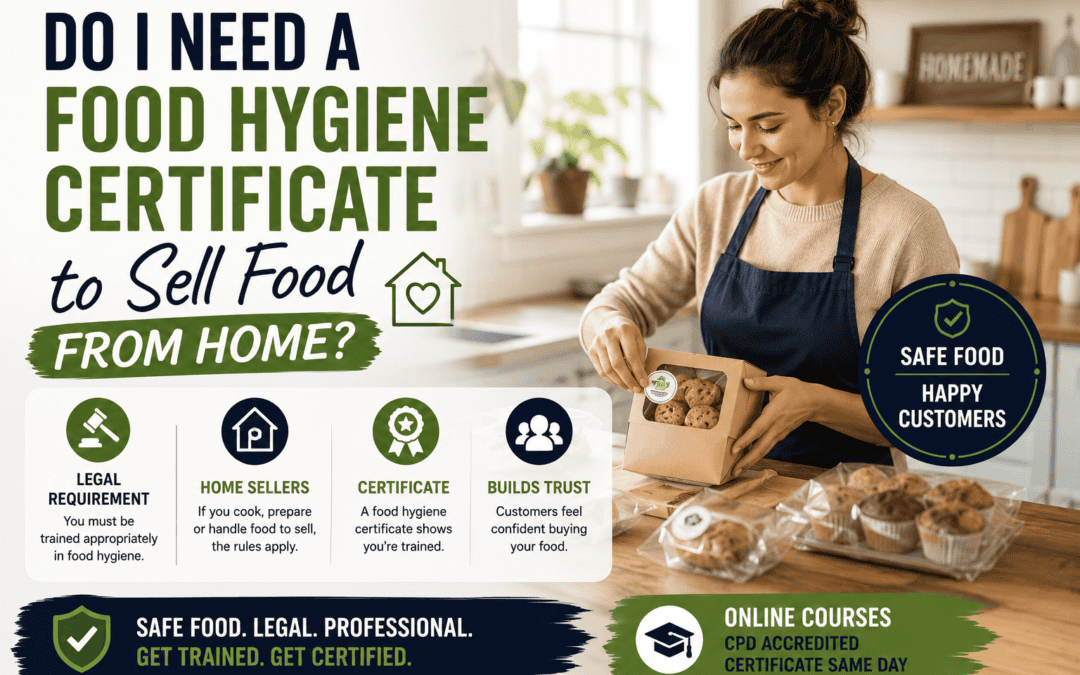
Do I Need a Food Hygiene Certificate to Sell Food from Home?
Someone tastes your brownies, tells you that you should sell them, and suddenly you are wondering what the rules actually are.
The honest answer has two halves. No law names a certificate you must hold. However, that is far less of a loophole than it sounds, and something else in this article genuinely is compulsory.
So here is the full picture, in the order you will need it.
First, you probably are a food business
People assume a business means premises, staff and a sign above a door. Food law takes a broader view.
If you provide food on a regular and organised basis, you count as a food business. That covers home bakers, supper clubs, meal prep sellers, jam and chutney makers, caterers working from a domestic kitchen, and people selling through Facebook groups or Instagram.
Occasional charity bake sales sit outside this. Meanwhile, a weekly stall or a steady flow of orders puts you firmly inside it, even without a shop and even part-time.
What the law genuinely demands
Regulation 852/2004, retained in UK law, requires food handlers to receive supervision, instruction or training in food hygiene appropriate to their work.
Notice the wording. It does not say certificate. Instead, it says trained appropriately.
In practice, though, that distinction matters very little. When an environmental health officer stands in your kitchen and asks how you know what you are doing, a Level 2 certificate answers the question in three seconds. Nothing else answers it as cleanly.
As a sole trader, you also carry a second duty. You are responsible for your food safety management system, so the training is not a mere formality. You need it to run the business properly.
Our guide to what training food handlers legally need breaks the legal position down further.
Registration is the part you cannot skip
Here is the compulsory bit, and plenty of home sellers miss it entirely.
You must register your food business with your local council at least 28 days before you start trading. Registration costs nothing, takes about ten minutes, and the council cannot refuse it.
Trading without registering is a criminal offence. Therefore, this is the one item on the list with no room for interpretation.
Register through your council or via the FSA food business registration service. The GOV.UK guidance on food business registration explains what details you will need to hand.
Register with HMRC as self-employed too, since that is a separate obligation and people often assume one covers the other.
Then the council visits your kitchen
Once you register, expect a visit. An officer will arrange to inspect your home kitchen, usually within the first few weeks.
Do not panic about this. Officers know they are looking at a domestic kitchen rather than a stainless steel production unit, so they judge it on whether you can produce food safely rather than on whether it looks industrial.
Afterwards you receive a food hygiene rating from 0 to 5, and that rating gets published online exactly like a restaurant’s. Customers can look you up. Our guide to how the rating scheme works explains how officers arrive at the score.
What needs to change in a home kitchen
You almost certainly do not need a separate kitchen. Still, a few things need thought.
Pets come first. Keep animals out while you prepare food, and never wash pet bowls alongside food equipment.
Next, storage. Your business ingredients need separating from the family shopping, and raw meat goes at the bottom of the fridge so nothing drips below it. A dedicated cupboard or shelf makes this easy.
Then handwashing. Officers will ask where you wash your hands, so make sure soap and a clean towel sit at the sink rather than appearing when you need them.
Also think about the ordinary chaos of home. Children, laundry, a phone answered mid-mixing. Officers understand family life, but they do want to see that you work around it deliberately.
Finally, keep cleaning products away from ingredients, check your fridge runs at 5°C, and buy a probe thermometer if you cook rather than bake.
Allergens matter more than most home sellers expect
If you sell food that you packed before the customer ordered it, PPDS rules apply. That means a full ingredients list on the label with the fourteen allergens emphasised.
A cake boxed up in advance for a market stall falls under this. Meanwhile, a cake made to order and handed over does not, although you still must give accurate allergen information when asked.
Never guess. Read labels, keep packaging, and update your information whenever you change a supplier or a recipe.
Writing your system down
The law expects a written food safety management system based on HACCP principles. That sounds heavier than it is.
For a small home business, the FSA’s free Safer Food, Better Business pack does the job, and our guide to HACCP principles explains the thinking behind it.
Alongside the pack, keep your certificate, your allergen information, and a note of your fridge temperature. Above all, fill it in as you go rather than the night before an inspection, because officers spot retrospective paperwork immediately.
Which certificate should you take?
For anyone cooking, baking or preparing open food at home, Level 2 Food Hygiene and Safety is the right answer. It covers the 4 Cs, temperature control, allergens, storage and the law.
The course carries CPD accreditation and Highfield quality endorsement, costs £20, and takes around four to five hours as a guide. Your licence lasts twelve months, the exam has no time limit, and you receive the certificate the same day you pass.
If you genuinely only sell sealed and pre-packed items that you did not make, Level 1 Food Safety at £15 covers the basics in around two to three hours. Very few home sellers fall into that category, though.
The bits nobody mentions
Check your home insurance, because a standard policy rarely covers commercial activity. Public liability cover is worth pricing up as well.
Check your mortgage or tenancy agreement for restrictions on running a business from home.
Look at waste too. Cooking oil and food waste from a business cannot simply go in the household bin in every area, so ask your council.
Finally, if you deliver, remember that hot food should leave at 63°C or above and reach the customer safely.
Markets, online sales and delivery
Selling at a market usually needs the stallholder’s permission plus, in some areas, council notice. Your food registration stays with your home address, since that is where you prepare and store.
Selling online brings allergen duties at two points. Customers need the information before they order, and again when the food arrives.
What a certificate does beyond compliance
Plenty of home sellers treat training as a hurdle. In reality, it sells.
Customers ask. Market organisers ask. School fairs, corporate orders and wedding clients often ask before booking. A line on your page saying Level 2 certified and council registered converts browsers who are quietly wondering whether you are legitimate.
For £20, that is a cheap piece of credibility.
Not sure where you stand? Ring us; the advice is free
Home food businesses vary enormously, so a short conversation usually clears things up faster than reading another article.
Tell us what you make and how you sell it. Then we will tell you honestly whether you need Level 2 or whether Level 1 covers you, and what else to sort before your first sale.
Call our landline on 02034884930 for free advice, or email info@gvec.co.uk.
Common questions from home food sellers
Is a food hygiene certificate legally required to sell food from home?
No law names a certificate. However, training appropriate to your role is required, and Level 2 is the evidence officers expect.
Do I have to register if I only sell occasionally?
If you sell on a regular and organised basis, yes. One charity bake sale does not count.
Does registering cost anything?
No. Registration is free, and the council cannot refuse it.
Will my home get a food hygiene rating?
Yes, and it appears on the public FSA database alongside restaurants.
Do I need a separate kitchen?
Rarely. You do need to keep business food separate and the kitchen properly clean.
How long does my certificate last?
Refresh every three years, which is the accepted standard across the industry.
Your first week, in order
Register with your council, because the 28-day clock starts then. Book Level 2 while you wait. Download the SFBB pack and start filling it in. Sort your allergen information. Then check your insurance.
Do those five things, and you can trade with confidence rather than hoping nobody asks.
Browse our food hygiene courses, or call 02034884930 and we will point you to the right level.