
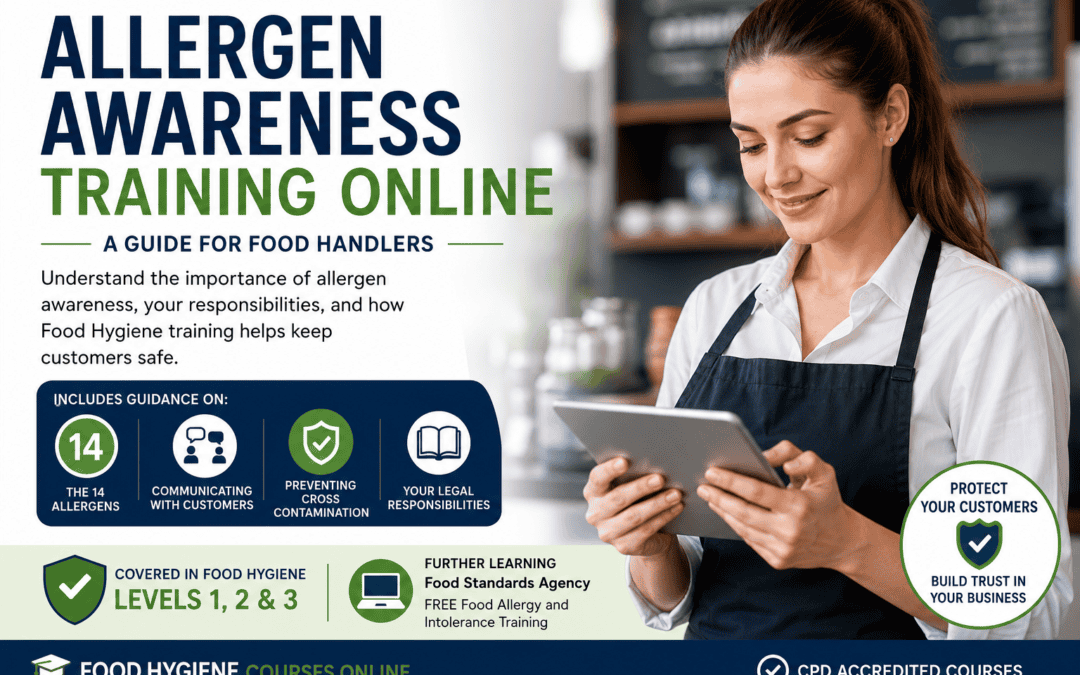
Allergen Awareness Training Online: A Guide for Food Handlers
One Conversation Could Save a Customer’s Life
A family visits a local restaurant to celebrate a birthday.
Before ordering, one guest quietly tells the waiter that she has a severe peanut allergy. She asks whether the chicken curry is safe to eat.
The waiter does not guess. Instead, he checks the allergen information, speaks to the chef, and returns with the correct answer.
The customer smiles with relief and enjoys her meal with confidence.
This simple conversation may only take a few minutes, but it could prevent a life-threatening allergic reaction.
Every day, thousands of food businesses across the UK serve customers with food allergies. For these customers, accurate allergen information is just as important as good food and excellent service.
That is why every food handler should understand the basics of allergen awareness.
Whether you work in a café, takeaway, restaurant, bakery, school kitchen, care home or catering company, knowing how to manage allergen risks is an essential part of food safety.
In this guide, you’ll learn why allergen awareness matters, how it is included within Food Hygiene training, and where to find additional official training if you need more specialist knowledge.
Why Allergen Awareness Is Essential
Food allergies affect millions of people across the UK.
For some people, eating the wrong ingredient may cause mild symptoms.
For others, even a tiny amount of an allergen can trigger a severe allergic reaction called anaphylaxis. This is a medical emergency that requires immediate treatment.
Because of this risk, food businesses have a legal and moral responsibility to provide accurate allergen information.
Customers rely on food handlers to answer questions honestly and correctly.
A careless guess can have serious consequences.
A well-trained member of staff knows that if they are unsure, they should always check before answering.
That simple habit helps protect customers and builds trust in your business.
Understanding Food Allergies and Food Intolerances
Many people use the words “allergy” and “intolerance” as if they mean the same thing.
They do not.
A food allergy involves the body’s immune system. Even a very small amount of the allergen can cause a serious reaction in some people.
A food intolerance usually affects the digestive system. Although it can make someone feel very unwell, it is generally different from an allergic reaction.
Food handlers are not expected to diagnose medical conditions.
However, they should understand that customers take these issues seriously and deserve accurate information about the food they are buying.
Every Food Handler Has a Role to Play
Some people think allergen awareness only matters for chefs.
In reality, everyone involved in food service has a responsibility.
This includes:
- Kitchen assistants.
- Chefs.
- Café staff.
- Restaurant servers.
- Bakery employees.
- Takeaway staff.
- Catering assistants.
- Food delivery teams.
- Supervisors.
- Managers.
- Food business owners.
Imagine a customer asking whether a sandwich contains sesame.
The person serving at the counter may not have prepared the food, but they still need to know how to find the correct information.
Good communication between the front of house and the kitchen is one of the most effective ways to reduce allergen risks.
Is Allergen Awareness Included in Food Hygiene Training?
Yes.
This is something many people do not realise.
A good Food Hygiene Level 1, Level 2 or Level 3 course includes important guidance on allergen awareness because allergens are a key part of food safety.
Food Hygiene training does much more than explain hand washing and cleaning.
It also teaches learners about:
- The importance of the 14 regulated allergens.
- Preventing cross-contamination.
- Safe food preparation.
- Accurate communication with customers.
- Good kitchen practices.
- Following food safety procedures.
These subjects help food handlers understand how everyday working practices can affect customers with food allergies.
While Food Hygiene courses provide an excellent foundation, some people may also benefit from additional allergen-specific learning, particularly if they manage allergen procedures within a food business.
We’ll look at that later in this guide.
Why Good Food Safety Training Matters
Food safety is about much more than passing an inspection.
It is about protecting people every single day.
A well-trained team is more confident when answering customer questions.
They understand why recipes should never be changed without updating allergen information.
They know the importance of checking labels whenever new ingredients arrive.
Most importantly, they understand that guessing is never acceptable.
These simple habits help reduce mistakes and create a safer environment for customers.
Everyday Examples from the Workplace
Consider these common situations.
A café introduces a new cake from a different supplier.
Before serving it, the team checks the ingredient label and updates the allergen information.
A takeaway receives a customer request for a meal without dairy products.
Instead of making assumptions, the chef prepares the order carefully and follows the business’s allergen procedures.
A bakery changes its recipe to include sesame seeds.
The staff updates the allergen information before the product goes on sale.
These may seem like small tasks, but they show how allergen awareness becomes part of everyday food safety.
Businesses that train their staff well are more likely to avoid mistakes and provide better customer service.
Building Confidence Through Learning
Knowledge gives food handlers confidence.
Confidence helps them answer questions accurately.
Accurate information helps customers make safe choices.
That is why allergen awareness should never be treated as an afterthought.
It is an important part of working responsibly in any food business.
When Should You Take Additional Allergen Training?
For many people working in the food industry, a recognised Food Hygiene Level 1, Level 2 or Level 3 course provides the essential knowledge needed to handle food safely, including the basics of allergen awareness.
However, some roles require a deeper understanding.
For example, you may benefit from additional allergen training if you:
- Manage a restaurant, café or takeaway.
- Develop menus or recipes.
- Create allergen policies for your business.
- Train new members of staff.
- Are responsible for food safety management.
If you need more detailed allergen-specific learning, the Food Standards Agency offers a free Food Allergy and Intolerance Training programme. It is designed to help food businesses understand allergen management in greater depth and includes learning modules with a CPD certificate on successful completion.
This makes it an excellent resource to complement your Food Hygiene qualification.
Common Mistakes That Every Food Business Should Avoid
Many allergen incidents happen because of simple mistakes that could have been prevented.
Some of the most common include:
- Guessing instead of checking ingredient information.
- Using an old recipe after ingredients have changed.
- Forgetting to update allergen records.
- Using the same utensils for foods containing different allergens without proper cleaning.
- Giving customers information from memory.
- Failing to communicate ingredient changes between the kitchen and front of house staff.
These mistakes are rarely intentional.
They usually happen because procedures are not followed consistently.
Good food hygiene training helps staff develop safe habits that become part of their daily routine.
Simple Steps That Make a Big Difference
Every food business can improve allergen management by following a few basic principles.
Always keep ingredient information up to date.
Check food labels whenever deliveries arrive.
Train staff to ask if they are unsure.
Never guess when answering customer questions.
Keep allergen information where staff can access it quickly.
Communicate recipe changes to the whole team.
Review your food safety procedures regularly.
These simple actions help reduce risks and improve customer confidence.
Food Hygiene and Allergen Awareness Go Hand in Hand
Food safety is made up of many different responsibilities.
Personal hygiene, temperature control, cleaning, preventing cross-contamination and allergen awareness all work together.
That is why allergen awareness forms part of good quality Food Hygiene training.
At Food Hygiene Courses Online, our Food Hygiene Level 1, Level 2 and Level 3 courses include essential information about allergens because every food handler should understand the importance of protecting customers with food allergies.
If your role requires more detailed allergen-specific knowledge, the official Food Standards Agency Food Allergy and Intolerance Training is an excellent next step.
Together, these learning resources help build a safer workplace.
Frequently Asked Questions
Do Food Hygiene courses include allergen awareness?
Yes.
Food Hygiene Level 1, Level 2 and Level 3 include essential allergen awareness as part of wider food safety training. Learners are introduced to allergen risks, cross-contamination and the importance of providing accurate information to customers.
Do I need a separate allergen course?
Not always.
Many food handlers only need the allergen awareness included within their Food Hygiene training.
If your job involves managing allergen procedures or developing food safety systems, you may also benefit from the Food Standards Agency’s free Food Allergy and Intolerance Training.
Is the Food Standards Agency training free?
Yes.
The Food Standards Agency currently provides its online Food Allergy and Intolerance Training free of charge through its official training website.
Which Food Hygiene course should I choose?
It depends on your role.
Level 1 is suitable for people handling low-risk food.
Level 2 is recommended for most food handlers working in catering, hospitality and retail.
Level 3 is designed for supervisors, managers and business owners with greater food safety responsibilities.
If you are unsure, ask for advice before enrolling.
To continue building your food safety knowledge, you may also find these guides useful.
Food Hygiene Level 2 for Catering
Learn the essential principles of food safety for anyone preparing or serving food in the catering industry.
Ideal for supervisors, managers and business owners who are responsible for maintaining high food safety standards and supporting their teams.
Helpful External Resources
For official guidance and additional learning, visit:
Food Standards Agency
Official advice on food safety, allergens and UK food legislation.
Food Allergy and Intolerance Training
https://allergytraining.food.gov.uk/
Free online training provided by the Food Standards Agency for anyone who wants to develop a deeper understanding of food allergy management.
Final Summary:
Food allergies are a serious issue for both customers and food businesses.
Every conversation about ingredients matters.
Every label matters.
Every member of staff has an important role to play.
Good Food Hygiene training gives food handlers the knowledge to work safely and confidently. It also helps businesses create a positive food safety culture where customers feel informed and protected.
If your role requires more advanced allergen knowledge, the Food Standards Agency’s free online training is an excellent resource that complements your Food Hygiene qualification.
Learning never stops in the food industry.
The more knowledge your team has, the safer your customers will be.
Learn With Confidence
At Food Hygiene Courses Online, we provide CPD Accredited Food Hygiene Level 1, Level 2 and Level 3 courses for individuals and businesses across the UK.
Our training is written in clear UK English, easy to follow and designed to help food handlers build practical knowledge that can be used every day.
Every Food Hygiene course includes essential allergen awareness because protecting customers is an important part of food safety.
If you are unsure which course is most suitable for your role, we are happy to help.
Why Choose Food Hygiene Courses Online?
- CPD Accredited courses.
- Study online at your own pace.
- Instant access to learning materials.
- Suitable for individuals and businesses.
- Essential allergen awareness included.
- Friendly UK-based support.
- Free advice before you enrol.
Website
https://www.foodhygienecoursesonline.co.uk/
Free Course Advice
020 3488 4930
Call Us for Free Advice
Not sure whether you need Food Hygiene Level 1, Level 2 or Level 3?
Call 020 3488 4930 for free advice. We’ll help you choose the right Food Hygiene course for your role and explain how allergen awareness forms an important part of your food safety training.