
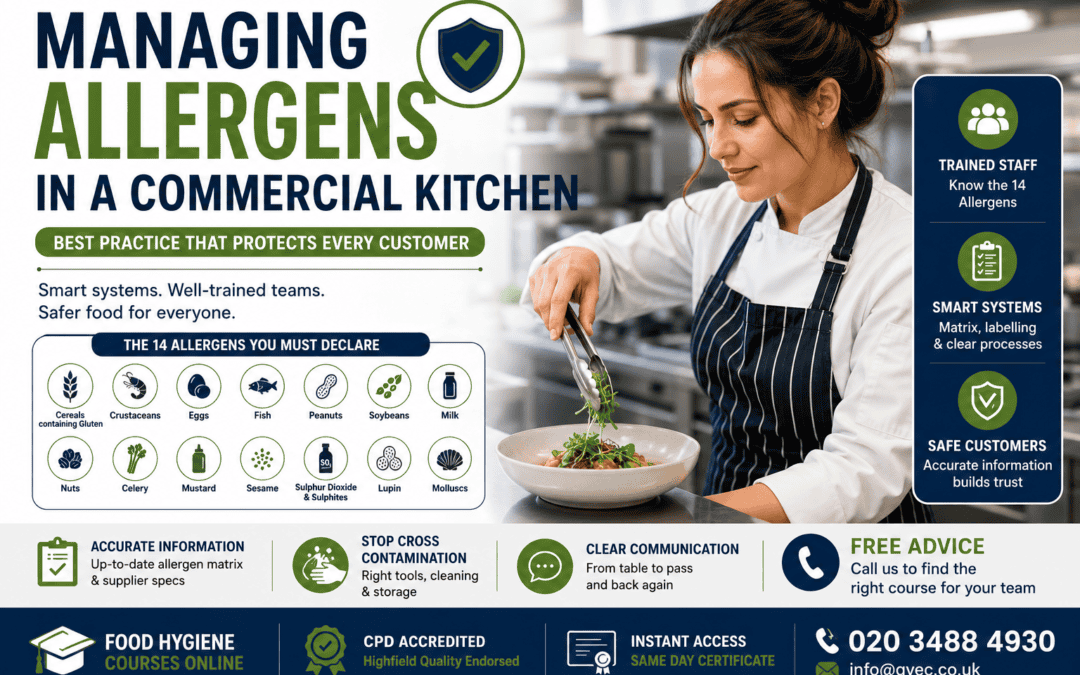
Managing Allergens in a Commercial Kitchen: Best Practice
Ask any head chef about their worst shift, and allergens usually come up somewhere in the story. A ticket gets misread. A tub goes back on the wrong shelf. Someone grabs the nearest tongs. Nothing looks wrong from the pass, and yet a customer could end up in an ambulance.
Managing allergens in a kitchen is not really about paperwork. It is about habits that hold up when the room is full, and everyone is behind. This guide walks through what good practice looks like in a working commercial kitchen, not in theory.
Why one careless minute costs so much
Around two million people in the UK live with a diagnosed food allergy. For some of them, a trace amount is enough to trigger a reaction. That is the part new starters often struggle to believe.
There is a legal side too. Under UK food law, allergen information must be accurate, available and consistent. Get it wrong, and you are looking at enforcement action, a damaged hygiene rating, and a story you really do not want in the local paper.
There is also a quieter cost. Allergy customers are loyal. Feed them safely once, and they come back with the whole family. Fumble it,t and they never risk you again.
The fourteen you cannot afford to guess
Every person handling food should be able to name the fourteen allergens that must be declared in the UK. No prompting, no glancing at a poster.
They are cereals containing gluten, crustaceans, eggs, fish, peanuts, soybeans, milk, nuts, celery, mustard, sesame, sulphur dioxide and sulphites, lupin, and molluscs.
Two of them trip up British kitchens more than the rest. Celery hides in stock cubes, gravy granules and mixed herbs. Mustard turns up in mayonnaise, salad dressings, curry pastes and processed meats. If your team only recognises the obvious ones, you have a gap.
Worth bookmarking: the Food Standards Agency allergen guidance for food businesses is the reference your local enforcement officer will be working from.
Where cross-contamination really begins
Most allergen incidents are not caused by an ingredient going in on purpose. They are caused by an allergen travelling somewhere it was never meant to go. Here is where it usually happens.
Deliveries and the store cupboard
Allergen control starts at the back door, not the stove. Check labels on arrival, because suppliers reformulate products without warning. A sauce that was nut-free last month may not be nut-free today.
Store high-risk allergens low down and sealed. Flour on a high shelf above open prep is a dust cloud waiting to happen. Decant into labelled containers and never reuse a tub without cleaning it and relabelling it.
Shared boards, blades and tongs
Colour coding boards is standard practice, yet knives, tongs, whisks and blenders often get ignored. A food processor bowl that has held a nut pesto will pass on protein even after a quick rinse.
Where you can, keep a dedicated set of small equipment for allergen-free orders. Store it separately so it does not drift back into general use.
Fryers, grills and shared oil
One fryer cannot serve battered fish and gluten-free chips. The oil carries the protein and heat does not destroy it. The same goes for a grill that has just seared a buttered steak before a dairy-free order lands.
Hands, cloths and aprons
Alcohol gel does very little against allergen proteins. Proper handwashing with soap and warm water is the control that works.
Cloths are the other quiet culprit. A cloth used to wipe down a bakery bench will spread flour across every surface it touches. Use disposable blue roll for allergen prep areas.
The plate on its way to the table
Garnishes, sauces on the side, a shared serving spoon, a stray crouton. Plenty of allergen incidents happen after the food leaves the kitchen. The order is only safe when it reaches the customer safely.
Building an allergen matrix people actually use
An allergen matrix is simply a grid. Dishes run down one side, the fourteen allergens run across the top. Each box gets marked yes or no.
Most kitchens have one. Far fewer have one anybody trusts, because it was built two menu changes ago and nobody updated it.
A few things make the difference:
- Base it on supplier specifications, not on memory or a quick look at the tub
- Review it every time a recipe, a garnish, or a supplier changes
- Date every version and bin the old copies straight away
- Keep it somewhere both the kitchen and the front of house can reach in seconds
- Give one named person ownership, ideally your supervisor or manager
Say what you know, not what you hope. If a dish cannot be made safely for a nut allergy customer in your kitchen, say so plainly. Honesty is a better answer than a guess.
Closing the gap between the pass and the table
Almost every serious allergen failure traces back to a broken message. Waiting staff take a request, and it never reaches the person cooking, or it reaches the wrong person.
Fix it with one clear route and no shortcuts. The allergy is written on the ticket, not remembered. The chef reads it back out loud. The plate is marked or flagged so it is obvious. The server confirms with the customer at the table before setting it down.
Ask every customer whether anyone at the table has an allergy. Do not wait to be told. The FSA allergen resources hub has free posters and prompt cards you can put straight up in the kitchen.
Proving it, not just doing it
An environmental health officer will not take your word for it. They will ask what you can show them.
Keep your allergen matrix current and accessible. Keep supplier specification sheets and ingredient labels on file. Keep cleaning records for allergen changeovers. Keep training certificates for every member of staff, with dates.
Those records also give you a due diligence defence if a complaint ever lands. Written evidence protects the business in a way that good intentions never will.
Training is what everything else rests on
Every control above depends on one thing. Your team needs to understand why it matters.
Staff who know how an allergic reaction actually unfolds do not cut corners with tongs. Staff who have only been shown a laminated sheet will, eventually, on a busy Saturday.
Our Level 2 Food Hygiene and Safety in Catering course is the right starting point for anyone preparing or serving food. It is CPD accredited, it costs £20, and the certificate is issued the same day you finish.
If you are the person carrying responsibility for the kitchen, go further. The Level 3 Food Safety for Supervisors course covers how to build and audit the systems your staff follows, including allergen management and food safety documentation.
Not sure which course your team needs? Ask us; it is free
Choosing between levels can be confusing, especially if you are training a mixed team of kitchen porters, chefs and floor staff.
We are happy to talk it through with you at no cost. Tell us what your business does and who does what, and we will tell you honestly which course each person needs. No pressure, no sales script.
Call our landline on 02034884930 for free advice on the right course, or email info@gvec.co.uk. Bulk discounts are available if you are booking for a whole team, and we can set you up so you can track who has completed what.
All our courses are CPD accredited and Highfield quality endorsed, with instant access and a same-day certificate.
Common questions from kitchen managers
Is allergen training a legal requirement in the UK?
Food handlers must be supervised, instructed or trained in food hygiene matters appropriate to their role. In practice, allergen awareness is part of that, and it is exactly what an inspector will ask about.
Can a kitchen ever promise a dish is completely allergen-free?
In a shared kitchen, no. You can control the risk and describe it accurately. Never promise more than your setup can deliver.
How often should allergen training be refreshed?
Every three years is the accepted benchmark, and sooner if your menu, your suppliers or your team change significantly.
Does our allergen matrix need to be in writing?
Yes. Written allergen information should always be available, supported by a conversation with the customer.
The short version
Managing allergens in a kitchen comes down to three things. Know what is in your food. Stop it moving where it should not go. Make sure the message travels from the table to the pass and back again without breaking.
Systems help. Trained people are what make them work.
Ready to sort your team out? Browse our food hygiene courses, or call 02034884930 and we will point you to the right one.