
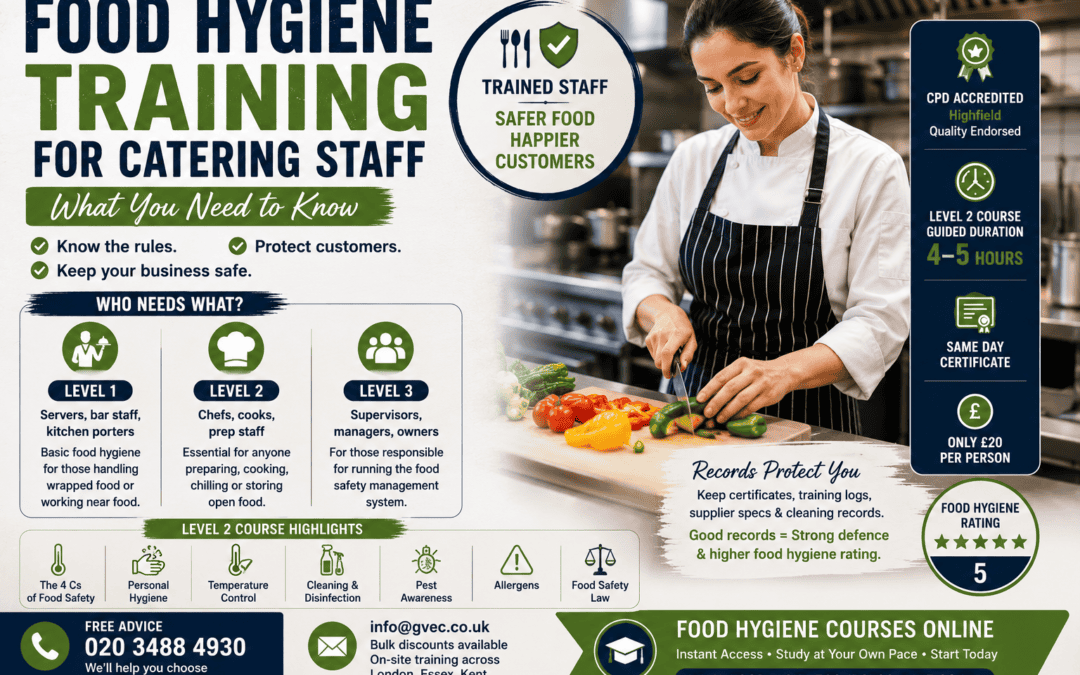
Food Hygiene Training for Catering Staff: What You Need
You have hired a new chef de partie and two floor staff. Somebody asks whether they need a food hygiene certificate before Friday. Half the team says yes, half says only the kitchen needs one, and nobody is completely sure.
It is a common muddle. The rules are not complicated once you see them laid out, but they are rarely explained clearly. Here is what a catering business actually needs, who needs it, and what it costs.
What the law expects from a catering business
UK food law does not say every food handler must hold a certificate. What it says is that food handlers must be supervised, instructed or trained in food hygiene to a level appropriate to their job.
That sounds vague, and in practice it is not. When an environmental health officer visits your restaurant, café or takeaway, they will want evidence. A certificate is the simplest, cleanest evidence there is.
This is why almost every catering business in the country trains to Level 2 as standard. It is not a legal box on a form. It is the answer to the question you will definitely be asked.
Sorting your team by role
Not everyone needs the same thing. Work through your rota and split people into three groups.
Servers, bar staff and kitchen porters
Anyone handling wrapped food, clearing plates, washing up or working near food preparation needs a basic grounding. Level 1 covers personal hygiene, contamination and safe practices.
Bear in mind that roles blur in hospitality. A server who plates a dessert or handles garnish is doing more than serving. In most restaurants it is simpler to put everyone on Level 2 and stop worrying about where the line sits.
Chefs, cooks and prep staff
Anyone who prepares, cooks, chills or stores open food needs Level 2. No exceptions and no debate.
This is the standard qualification for catering and hospitality across the UK. If you hire a chef who cannot produce a valid certificate, book them on before their first shift.
Head chefs, supervisors, managers and owners
If you are responsible for other people’s practice, Level 2 is not sufficient on its own. Level 3 is written for supervisors and covers how to build, run and check a food safety management system.
That includes HACCP, monitoring, record keeping and staff supervision. It is also what inspectors expect to see behind a strong hygiene rating.
Does Level 2 really cover a busy kitchen?
Yes, for the people doing the cooking. It is a proper qualification, not a token.
Our Level 2 Food Hygiene and Safety in Catering course covers the four Cs of food safety, temperature control, personal hygiene, cleaning, pest awareness, allergens and food safety law. It is CPD accredited, Highfield quality endorsed, and costs £20.
Where Level 2 stops is at the management layer. It teaches a cook to work safely. It does not teach a supervisor to design the system everyone else follows. That is the gap Level 3 Food Safety for Supervisors fills.
Time and money, the honest numbers
Level 2 takes most people between one and two hours. There is no time limit, so staff can pause and come back.
The assessment is a multiple-choice test taken online at the end. Pass it and the certificate is issued the same day, which matters when someone starts on Monday.
At £20 per person, training a team of eight costs less than a single quiet evening’s takings. Bulk discounts bring that down further, and we can set you up with tracking so you can see who has finished and who has not.
Online courses or a trainer in your kitchen?
Both work. The right answer depends on your team.
Online suits businesses with staff turnover, split shifts, and people who need training fast. Everyone learns at their own pace, on their own phone, without closing the kitchen.
In person suits larger teams training together, staff who prefer a classroom, and anyone who struggles with written English. We deliver on-site sessions across London, Essex, Kent, Surrey and the Portsmouth region if that suits you better.
One myth worth killing off. Online food hygiene certificates are accepted by environmental health officers and by employers, provided the course is properly accredited. Ours is.
Records are what protect you later.
Training your staff is only half the job. Being able to prove it is the other half.
Keep a certificate on file for every member of staff, with the date. Keep a simple training log showing who has been trained and when refreshers fall due. Add induction notes for new starters.
That paperwork sits alongside your Safer Food, Better Business pack and forms part of your due diligence defence. If a complaint ever lands, written evidence is what stands up.
It also feeds your rating. Inspectors score confidence in management as one of three elements, and documented training pushes that score up. You can see how the scoring works on the GOV.UK food hygiene ratings guide.
Train new starters before the first shift, not after
This is the single habit that separates well-run kitchens from stressed ones.
A new starter can complete Level 2 the evening before they begin. The certificate lands the same day. They walk in on day one already covered, and you never have that awkward conversation with an inspector about the person who started three weeks ago.
Certificates should be refreshed every three years. Diarise it now rather than discovering an expired certificate during an inspection.
Not sure what your team needs? Ask us; there is no charge.
Every catering business is set up differently. A twelve-cover bistro is not a hotel banqueting kitchen, and a coffee shop is not a takeaway.
Tell us what you do and who does what, and we will tell you honestly which course each person needs. If someone only needs Level 1, we will say so. We would rather you bought the right thing.
Call our landline on 02034884930 for free advice on choosing the right course, or email info@gvec.co.uk. We can also quote for bulk bookings and on-site sessions.
What do catering employers ask us most?
Can one certificate cover the whole team?
No. Food hygiene certificates are issued to individuals, so every member of staff needs their own.
Is a certificate from a previous employer still valid?
Yes, if it is from an accredited provider and less than three years old. Ask for a copy and keep it on file.
Do part-time and seasonal staff need training?
Yes. The law does not distinguish between a full-time chef and a Saturday casual who handles open food.
What about agency staff?
Check their certificates before they start. The responsibility for who works in your kitchen sits with you, not the agency.
Is Level 3 worth it for a small independent?
If one person supervises the kitchen, yes. It is often the difference between a rating of four and a rating of five.
Where to start this week
Put your kitchen team on Level 2. Put whoever runs the kitchen on Level 3. Keep the certificates in one folder with the dates written down.
That is genuinely most of it. The rest is habit.
Browse our food hygiene courses online, or ring 02034884930 and we will sort it out with you in five minutes.