
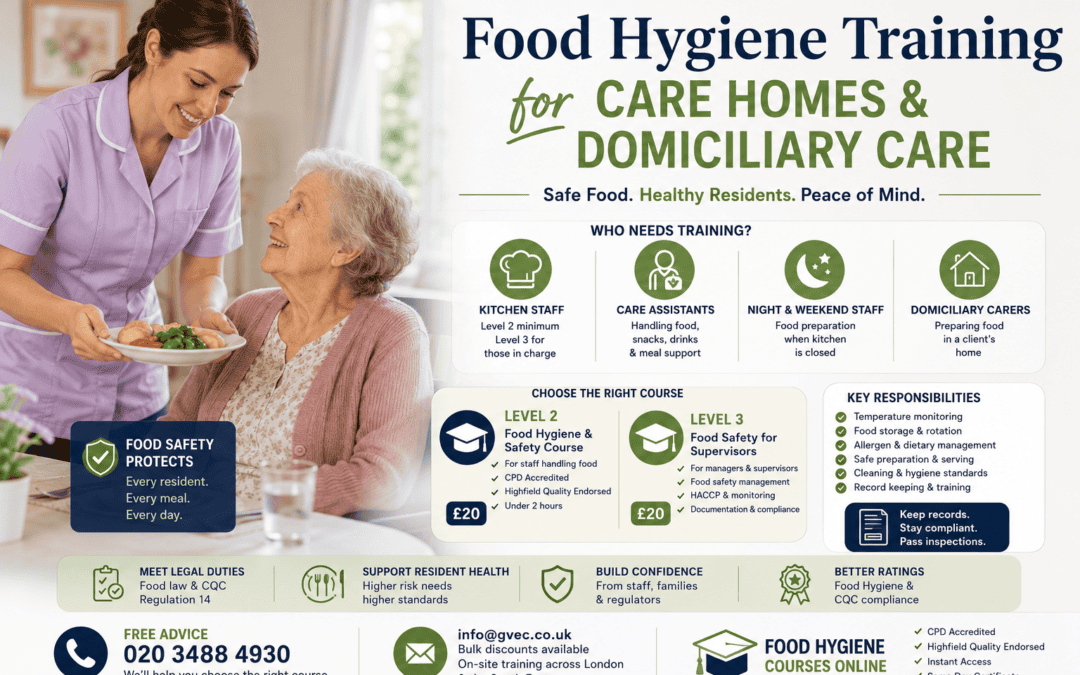
Food Hygiene Training for Care Homes and Domiciliary Care
Care providers already carry more compliance than almost any other sector. Medication, safeguarding, moving and handling, infection control, staffing ratios. Food hygiene often slides down the list.
Then an environmental health officer arrives, or a resident gets ill, and it moves straight to the top.
This guide sets out what care homes and domiciliary services need in place, who needs training, and where care settings differ from ordinary catering.
You answer to two regulators, not one.
Here is the point many providers miss. A care home is a food business.
That means it registers with the local council, it gets inspected by environmental health, and it receives a food hygiene rating in the same way a restaurant does. Food law applies in full.
Separately, CQC assesses how you meet residents’ nutritional needs under Regulation 14. The two overlap, but they are not the same thing, and passing one does not cover you for the other.
Residents are not average customers.
A healthy adult who eats something dodgy usually has a rough day. An eighty-five-year-old resident can end up in hospital.
Immune response weakens with age. Add medication, existing conditions, reduced appetite and lower body weight, and the margin for error narrows sharply. Listeria in particular is a serious risk in care settings, and it grows at fridge temperatures.
That is why the same practice which passes in a café can fail badly in a care home. The food has not changed. The people eating it have.
Working out who needs training.
Care settings spread food handling across far more people than employers expect.
Cooks and kitchen staff
Anyone in the main kitchen needs Level 2 as an absolute minimum, and whoever runs that kitchen needs Level 3.
Care assistants and support workers
This is the group most often missed. Care staff make toast, warm soup, prepare snacks, decant drinks, help with feeding and clear plates. All of that is food handling and all of it needs training.
Night staff and weekend cover
The kitchen is closed, so care staff prepare food themselves. Overnight is when practice slips furthest, because no supervision and no chef is watching.
Domiciliary carers
Anyone preparing food in a client’s home is handling food, even though the setting is domestic. More on that below.
Problems you will never meet in a restaurant.
Care settings throw up food safety issues that catering courses barely touch.
Mini kitchens and lounge pantries
Small kitchenettes on units and floors often have no temperature records, no cleaning schedule, and no clear owner. They still need both.
Gift food from families
Relatives bring cakes, biscuits, home-cooked meals and takeaways. It is kind, and it is completely outside your control.
You need a policy. Label it, date it, store it correctly, and be clear about what can be shared with other residents and what cannot.
Fridges in residents’ rooms
Personal fridges accumulate out-of-date food. Somebody needs to check them on a schedule, and staff need to handle that conversation with dignity.
Long service times
Food held hot for a long spread of mealtimes drifts below 63°C. Plated meals sitting while staff assist other residents cool fast. Both are common inspection findings.
The FSA publishes a free Safer Food, Better Business supplement for residential care homes which covers exactly these issues alongside the main caterers pack.
Domiciliary care means somebody else’s kitchen
Home care staff face a harder version of the same job. You cannot control the environment, and it is not yours to control.
The fridge may be running warm. There may be food months past its date. The kitchen may be genuinely dirty. Your carer has fifteen minutes and no authority to throw anything away.
Train staff to check dates before they cook, to recognise when a fridge is too warm, to wash hands properly in an unfamiliar kitchen, and to record and escalate concerns rather than quietly working around them. Respecting a client’s autonomy matters, and so does not serving them something unsafe.
Special diets deserve their own attention.
Allergens apply in care exactly as they do anywhere else, and the consequences are worse.
Care adds layers on top. Texture-modified diets, diabetic requirements, religious and cultural needs, thickened fluids, and residents who cannot tell you what is wrong. Information has to travel reliably from the care plan to the kitchen to the plate, every single meal.
If your allergen and dietary information lives in somebody’s head, you have a problem waiting to happen.
Matching the course to the role
Kitchen staff and care assistants who handle food should take our Level 2 Food Hygiene and Safety course. It is CPD accredited, Highfield quality endorsed, costs £20 and takes under two hours.
Cooks, chefs, registered managers and anyone supervising food practice should take Level 3 Food Safety for Supervisors. That is the course covering food safety management systems, monitoring and staff supervision.
New care workers should also be working through the Care Certificate, which includes nutrition and hydration as one of its standards. It sits alongside food hygiene training rather than replacing it.
The records both inspectors will ask for
Keep one training file with a certificate and date for every member of staff, including bank and agency workers.
Keep fridge and freezer temperature logs, hot holding records, cleaning schedules, and your food safety management system with the daily diary completed.
Keep allergen and dietary information linked to care plans, reviewed when needs change.
That folder answers environmental health and supports your CQC evidence at the same time. Build it once and use it twice.
Talk it through with us first; there is no charge
Care rotas are complicated. Kitchen staff, care assistants, bank staff, night cover and agency workers all need something slightly different.
Tell us how your service is set up and we will tell you honestly which course each group needs. No pressure and no upselling.
Call our landline on 02034884930 for free advice, or email info@gvec.co.uk. We offer bulk pricing for whole staff teams, with tracking so you can see completions at a glance, and on-site sessions across London and the South East.
What registered managers ask us
Do care assistants really need food hygiene training?
Yes, if they handle food at all. Making a resident’s breakfast counts.
Does our care home get a food hygiene rating?
Yes. Care homes are food businesses and are inspected and rated like any other.
Do domiciliary carers need certificates?
Yes. Preparing food in a client’s home is food handling, and commissioners increasingly ask to see the certificates.
How often should care staff retrain?
Every three years is standard, and sooner if roles or procedures change.
Is online training accepted by CQC and environmental health?
Yes, where the course is properly accredited. Ours are CPD accredited with certificates issued the same day.
Where to begin
Print your staff list. Mark everyone who touches food and be generous about it. Put that group on Level 2, put your cook and your manager on Level 3, and put the certificates in one dated folder.
You can do the whole thing this week.
Browse our food hygiene courses, or ring 02034884930, and we will help you work out who needs what.