
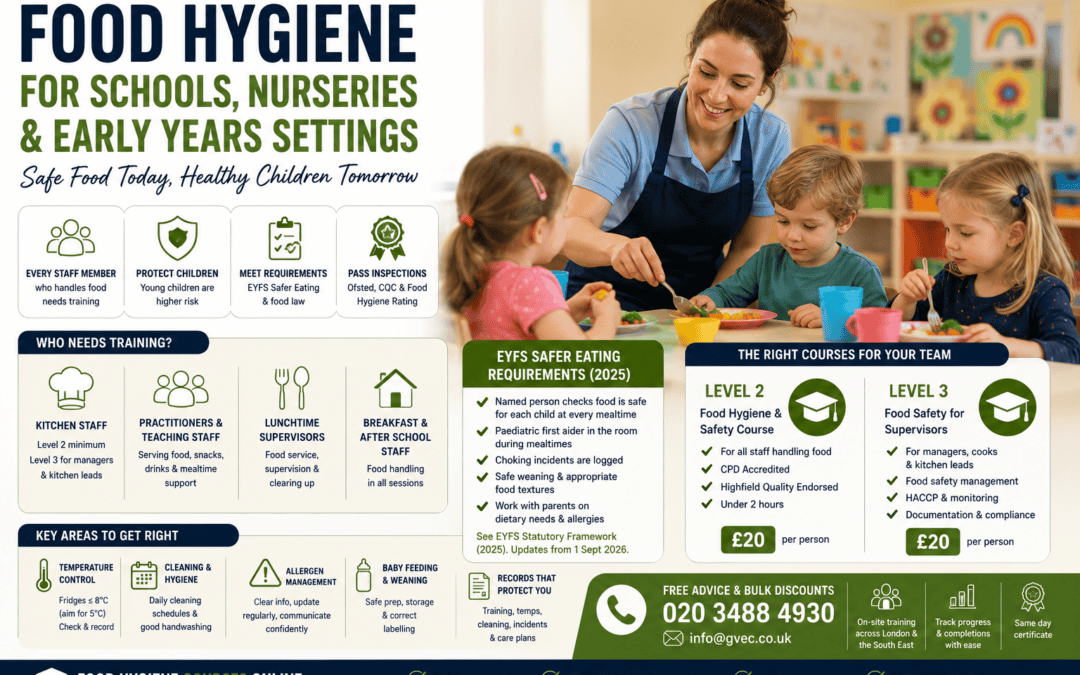
Food Hygiene for Schools, Nurseries and Early Years Settings
Feeding a room full of children is not the same job as feeding a room full of adults. The margin for error is thinner, the consequences are worse, and the number of staff involved is far higher than most settings realise.
A nursery might have two people in the kitchen and fifteen practitioners handing out snacks. All seventeen are food handlers.
Here is what schools, nurseries and early years providers need in place, and which training actually covers it.
Why young children sit in the higher risk group
Children under five are more vulnerable to foodborne illness than healthy adults. Their immune systems are still developing, and a smaller body reacts harder to the same dose of bacteria.
- coli O157 is the clearest example. It takes very few organisms to cause serious illness in a young child, and outcomes can be severe.
None of that is meant to alarm anyone. It is simply why practice that would pass in a pub kitchen is not good enough in a nursery.
Safer Eating changed what settings must do
The EYFS statutory framework picked up a set of Safer Eating requirements which took effect in September 2025. If your policies have not been reviewed since then, they are out of date.
The headline points are practical. A named person must be responsible at each mealtime and snack time for checking that the food is safe for the child eating it. A paediatric first aider must be in the room while children are eating. Choking incidents must be logged. There are expectations around safe weaning, appropriate food textures, and working with parents on dietary needs.
You can read the current requirements in the EYFS statutory framework on GOV.UK. Note that updated versions take effect from 1 September 2026, though those changes centre on safer sleep, screen use and safeguarding rather than food.
Your setting is also a food business.
Schools and nurseries register with the local council as food businesses. Environmental health inspects them, and they receive a food hygiene rating.
So you have Ofsted looking at welfare and safeguarding, and environmental health looking at food safety. Two inspectors, two frameworks, one kitchen and one snack trolley.
Working out who actually handles food.
Split your staff list into groups and be generous about who counts.
Kitchen and catering staff
Cooks, kitchen assistants and anyone in the main kitchen need Level 2 as standard. Whoever manages that kitchen needs Level 3.
Practitioners, teaching assistants and lunchtime supervisors
This is the biggest group and the one most often left untrained. Anyone who sets out snacks, pours drinks, cuts fruit, plates lunch, helps children eat or clears away is handling food.
Lunchtime supervisors in particular tend to fall through the gap between the kitchen team and the teaching team. Do not let them.
Breakfast clubs, after school clubs and holiday provision
Same rules. The setting looks informal, and the toaster is small, but the law does not care.
Preparing food to reduce choking risk.
Choking is the risk that worries early years staff most, and rightly so.
Standard practice matters here. Grapes, cherry tomatoes and similar round foods should be quartered lengthways rather than sliced across. Whole nuts are not given to under fives. Hard raw items like carrot sticks and apples should be cooked, grated or cut thin depending on age. Sausages and similar foods are cut lengthways, not into coins.
Children should sit down while eating, always within sight, never walking or running with food in their mouths. The DfE’s food safety guidance for early years providers sets this out in more detail alongside its choking hazard resources.
Because a paediatric first aider must be present at mealtimes, our Paediatric First Aid course is worth booking alongside food hygiene training rather than treating as a separate job.
Allergies in a building full of children
Children cannot always tell you what they are allergic to, and other children share food constantly.
Get the basics tight. Record allergies and intolerances at registration and update them when parents tell you something new. Make the information visible to whoever serves the food, not buried in an office file. Use photo boards or coloured plates where that suits your setting.
Think about food brought in from home too. Birthday cakes, party bags, packed lunches and food activities in the classroom all bring allergens past your controls. A clear policy is easier than a difficult conversation afterwards.
Bottles, weaning and baby rooms
Baby rooms carry their own set of controls. Sterilising equipment, correct preparation and storage of formula, labelling expressed breast milk with the child’s name and date, and cooling and reheating purees safely.
Weaning brings texture judgements that vary child by child. That is exactly why the EYFS now asks for a named person checking each child’s food at each mealtime.
The courses your team should be holding
Practitioners, teaching assistants, lunchtime supervisors and anyone handling food should take our Level 2 Food Hygiene and Safety course. It is CPD accredited, Highfield quality endorsed, costs £20 and takes under two hours.
Cooks, kitchen managers, nursery managers and heads of school catering should take Level 3 Food Safety for Supervisors, which covers building and monitoring the systems everyone else follows.
Food safety also sits close to welfare, so it is worth reviewing your safeguarding training at the same time. Ofsted tends to look at these together.
What both inspectors will ask to see
Keep a training matrix showing every member of staff, which food hygiene course they hold, the date, and when it is due for renewal.
Keep fridge and freezer temperature records, cleaning schedules, your food safety management system with the daily diary, allergy records linked to individual children, and your choking incident log.
Keep it in one place. Half the stress of an inspection is hunting for paperwork you know exists somewhere.
Training a whole team? Speak to us first.
Schools and nurseries usually need to train a lot of people at once, often around term dates or an inspection window.
Tell us how many staff you have and what they do, and we will tell you which course each group needs. If your lunchtime supervisors only need Level 2 and your kitchen lead needs Level 3, that is exactly what we will say.
Call our landline on 02034884930 for free advice and a bulk quote, or email info@gvec.co.uk. We offer discounts for whole teams, tracking so you can see who has completed what, and on-site sessions across London and the South East.
Questions we get from nursery managers and school business managers.
Do teaching assistants need food hygiene training?
If they handle food at all, yes. Cutting up fruit for snack time counts.
Does the school kitchen contractor cover our staff?
It covers their own employees. Your directly employed staff who handle food are your responsibility.
Do nurseries get a food hygiene rating?
Yes. Settings are registered food businesses and are inspected and rated.
Is online food hygiene training accepted by Ofsted?
Yes, where the course is properly accredited. Ours are CPD accredited with same day certificates.
How often does training need refreshing?
Every three years is the accepted standard, and sooner if your provision or procedures change.
A checklist to work through this term
Review your Safer Eating policy against the current EYFS wording. Mark every member of staff who touches food and book them onto Level 2. Put your cook and your manager on Level 3. Check a paediatric first aider is rostered into every mealtime. Then put all the certificates in one dated folder.
See our full range of food hygiene courses, or ring 02034884930, and we will build a package around your staff list.