
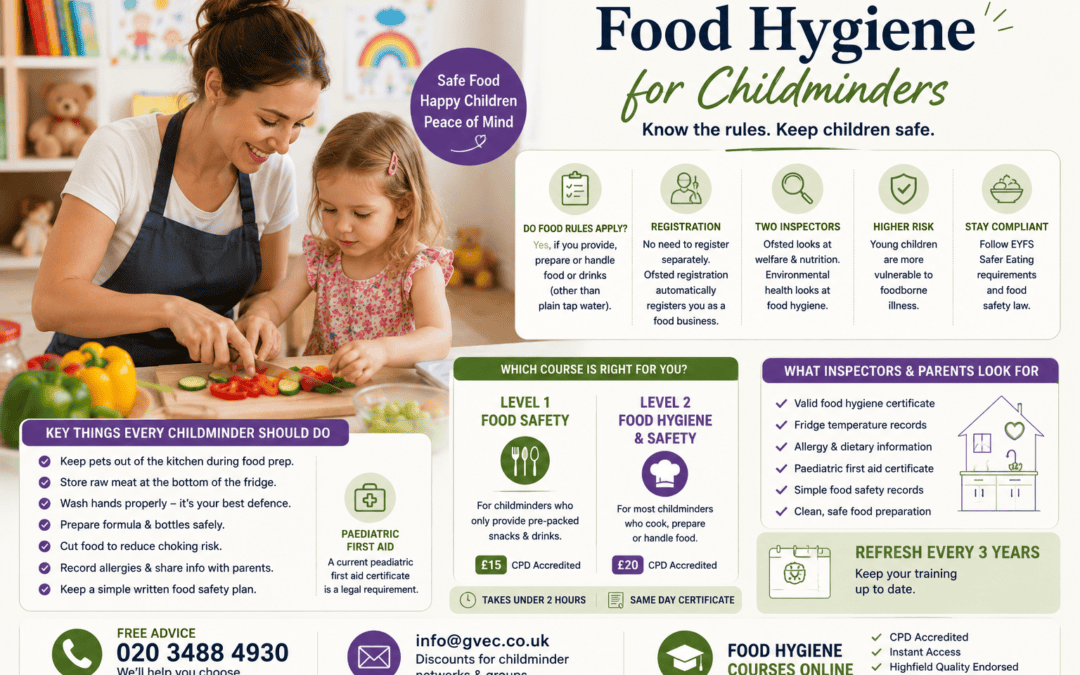
Food Hygiene for Childminders: What the Rules Require
Childminders get a lot of conflicting advice about food. One person says you need a certificate, another says you do not, and a third says you have to register with the council on top of Ofsted.
The rules are actually fairly clear once somebody lays them out. Here they are, without the guesswork.
Do the food rules even apply to you?
Ask yourself two questions.
Do you usually provide meals, snacks or drinks for the children in your care, beyond plain tap water? Do you prepare, reheat or cut up food that a parent has sent in?
If the answer to either is yes, food safety and hygiene regulations apply to you. That covers almost every working childminder, including the ones who think of themselves as barely cooking at all. Warming a parent’s leftovers and cutting a sandwich into quarters both count.
The rules do not apply if you genuinely provide nothing but mains tap water, or if you only ever care for children in the child’s own home.
The registration question, answered properly
This is where most of the confusion sits, so here is the clean version for England.
You do not need to register separately as a food business with your local council. When you register with Ofsted or a childminder agency, those details are used to register you as a food business too. It happens automatically and you do not have to do anything extra.
That does not mean nobody checks. A food safety officer from the council may still contact you and arrange a visit to look at how you store, prepare and handle food.
Wales and Northern Ireland work differently. If you are minding there, ring your local authority and ask directly.
Two sets of eyes on the same kitchen
Ofsted looks at food through the EYFS statutory framework, which covers welfare, nutrition and safer eating. The current framework brought in stronger expectations around mealtimes, choking and dietary needs, and you can read it on the GOV.UK Early Years Foundation Stage page.
Environmental health looks at the same food through food hygiene law. Storage, temperatures, cleaning, cross-contamination.
They are different frameworks asking about the same kitchen. Good practice satisfies both.
Working from a home kitchen
Your kitchen is a family kitchen, and that brings issues a nursery never faces.
Pets are the obvious one. Animals should be kept out while food is being prepared, and bowls should not be washed alongside food dishes.
Your own family’s food shares the fridge with the children’s food, so raw meat needs to be sealed and stored at the bottom, away from anything ready to eat. Household cleaning products need to be locked away, not sitting under the sink at toddler height.
Then there is the ordinary chaos of a home. Somebody’s toy on the worktop, a nappy change before lunch, a phone answered mid preparation. Handwashing is the control that carries most of the load here, and it needs to be genuine rather than a quick rinse.
Babies, bottles and weaning
If you care for babies, you take on a whole extra layer.
Formula needs preparing correctly and fresh, not made in advance and left standing. Expressed breast milk needs labelling with the child’s name and date, and storing properly. Sterilising equipment needs a routine.
Weaning brings texture decisions that change month by month, and you should be agreeing them with parents rather than judging alone.
Allergies and what parents are entitled to know
You must be able to tell a parent accurately what is in the food you serve. That means reading labels, not guessing, and keeping the packaging when you are unsure.
Record every allergy and intolerance at the point a child starts, and update it when parents tell you something has changed. Keep that information somewhere you actually look, not filed in a folder you open once a year.
Be careful around shared snacks and food brought in for birthdays. That is where most near misses happen in home settings.
Choking, and why first aid sits next to this
Food preparation and choking risk are the same conversation for under fives.
Grapes and cherry tomatoes get quartered lengthways. Whole nuts are off the menu. Hard raw items are cooked, grated or cut thin. Children sit down to eat, in sight, every time.
Childminders are also required to hold a current paediatric first aid certificate. If yours is approaching three years old, our Paediatric First Aid course will bring it back into date.
Which certificate does a childminder need?
There is no law naming a specific certificate. What the law says is that you must be trained appropriately for what you do.
In practice, Ofsted inspectors and parents both expect to see one, and Level 2 is the sensible answer. Our Level 2 Food Hygiene and Safety course covers cooking, chilling, cleaning, cross-contamination, allergens and the law. It is CPD accredited, costs £20, takes under two hours, and the certificate arrives the same day.
If you truly only serve pre-packed snacks and drinks, Level 1 Food Safety at £15 covers the basics. Most childminders cook, though, so most need Level 2.
Any assistant working with you needs their own certificate as well.
Keep the paperwork light
You are legally expected to write down what you do to keep food safe. That does not mean a filing cabinet.
The FSA publishes free Safer Food, Better Business packs, including a version written specifically for childminders. It is deliberately short and works on the principle that you only write something down when there is a problem or something changes.
Alongside it, keep your certificate, your allergy records and a note of your fridge temperature. That is genuinely enough.
Not sure which one you need? Ring us; it costs nothing
Childminders often only need one course, and it is silly to buy the wrong one.
Tell us what food you provide and how many children you mind, and we will tell you honestly whether Level 1 or Level 2 fits. If you also have an assistant, we can sort both at once.
Call our landline on 02034884930 for free advice, or email info@gvec.co.uk. If you are part of a childminding network or group, ask about discounted rates for booking together.
Questions childminders send us
Is a food hygiene certificate a legal requirement for childminders?
No specific certificate is named in law, but appropriate training is required. Level 2 is what inspectors and parents expect to see.
Does my certificate expire?
Refresh every three years. Diarise it now.
Will Ofsted ask for it?
Very often, yes, and parents ask more than they used to.
Is an online certificate accepted?
Yes, where the course is properly accredited. Ours is CPD accredited with a same-day certificate.
Your next step
If you cook for the children you mind, book Level 2 this week. Check your paediatric first aid is still in date. Download the childminders pack and spend an hour filling it in.
That is the whole job done properly.
Browse our food hygiene courses, or call 02034884930 and we will point you to the right one in five minutes.