
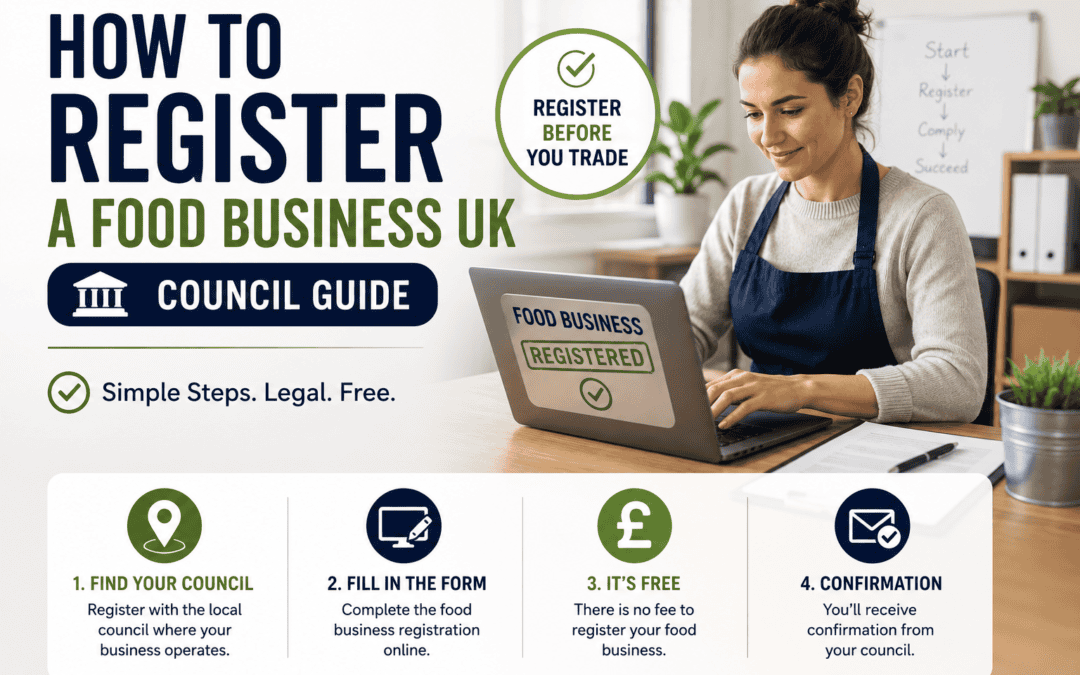
How to Register a Food Business with Your Local Council
Most people starting a food business worry about the wrong things first. They worry about inspections, ratings, and whether their kitchen is good enough.
Registration comes before any of that, though. It costs nothing, it takes ten minutes, and skipping it turns a legitimate business into a criminal offence overnight.
So here is exactly how it works, who it applies to, and the one distinction that catches people out.
Who counts as a food business operator
The definition is wider than most new traders expect.
You need to register if you prepare, cook, store, handle, distribute, supply or sell food. That covers restaurants, cafés, takeaways and shops, obviously. However, it also covers home bakers, supper clubs, market stalls, food vans, catering trailers, online sellers, mobile coffee carts, meal prep businesses and people selling through social media.
Even a business that never touches food directly may need to register, such as a distributor storing packaged goods.
The test is whether you operate on a regular and organised basis. Occasional charity events sit outside it. Meanwhile, a weekly stall or steady online orders sit firmly inside.
The 28-day rule
Register at least 28 days before you start trading. That is the legal requirement, and it applies whether you open a restaurant or take your first cake order.
Do not misread the rule, though. You are not waiting for approval, and nothing needs to be signed off before you trade. Instead, the notice period simply lets the council plan its inspection schedule.
If you have already started trading without registering, register today rather than waiting. Late is far better than never, and councils generally deal with it sensibly.
Free, and nobody can refuse you
Two facts worth stating plainly.
Registration costs nothing. Any website charging you a fee to register a food business is reselling something the council provides free, so avoid it.
Councils also cannot refuse a registration. It is a notification rather than an application; therefore, you do not need to prove anything in advance or pass a test to be accepted.
Which council do you register with?
Register with the local authority covering the address where your food business operates.
For fixed premises, that is straightforward. For a home business, it is your home address. For a mobile unit, van or trailer, register with the council where the unit is stored overnight rather than where you trade, which surprises a lot of street food traders.
If you run several sites, register each one separately with its own council. A business with a shop in one borough and a prep kitchen in another needs both.
What you need before starting the form
Gather these first, and the process takes minutes rather than an evening.
- Your name and contact details, plus the trading name
- The address where food is stored, prepared or sold
- The type of business and what food you handle
- Your intended start date
- Whether you operate from a domestic property
- Roughly how many people you employ
- Your water supply, meaning mains or private
- Vehicle details if you use a mobile unit
You can register through the FSA food business registration service, which routes you to the right council, or go directly to your council’s website. The GOV.UK food business registration guidance sets out the process in full.
Registration or approval? Know the difference
This is the distinction that trips businesses up, so read it carefully.
Most food businesses simply register. Some, though, need formal approval instead, and approval genuinely does need granting before you trade.
Approval applies to establishments handling products of animal origin that supply other businesses rather than selling directly to consumers. Think meat cutting plants, dairies processing raw milk, fish processors and some manufacturers.
A retail exemption covers most shops and caterers selling to the public, so a café serving bacon rolls does not need approval. However, a small producer making sausages to sell wholesale to other shops very likely does.
If you are unsure, ring your council’s environmental health team before you invest in equipment. Getting this wrong is expensive.
What happens after you register
You will receive confirmation, and at some point an officer will arrange an inspection.
The timing depends on how the council assesses your risk. A high-risk operation may see someone within weeks. Meanwhile, a low-risk business might wait months.
After that inspection, you receive a food hygiene rating from 0 to 5, published on the FSA’s public database. Our guide to the food hygiene rating scheme explains how officers reach that number, and our guide to EHO inspections walks through the visit itself.
Tell the council when things change
Registration is not a one-off if your circumstances move.
Notify your council if you change premises, change the type of food you handle, take on or hand over the business, or stop trading altogether.
New owners register in their own name rather than inheriting the previous registration. Buying an existing café therefore means registering yourself, even though the premises are already known to the council.
What happens if you skip it
Trading without registering is a criminal offence.
In practice, councils tend to start by requiring you to register immediately. Repeated or deliberate failure, though, can lead to prosecution and a fine, and it undermines any due diligence defence you might otherwise rely on.
There is no upside to avoiding it, given that the process is free and cannot be refused.
A few cases that work differently
Childminders in England do not register separately. Registering with Ofsted or a childminder agency also registers you as a food business, so no extra step is needed.
Scotland and Northern Ireland run broadly similar systems through their own authorities, although details vary, so check locally.
Charity and community events have limited exemptions, but the moment activity becomes regular and organised, registration applies.
Registered? Training comes next
Registration proves you exist. Training proves you know what you are doing, and it is the first thing an officer looks for.
Level 2 Food Hygiene and Safety suits anyone preparing or handling open food. The course carries CPD accreditation and Highfield quality endorsement, costs £20, and takes around four to five hours as a guide. Your licence runs for twelve months, and you receive the certificate the same day you pass.
If you supervise others or run the business, Level 3 Food Safety for Supervisors at £170 covers building the food safety management system your registration will eventually be judged against.
Selling from a domestic kitchen? Our guide on whether you need a certificate to sell food from home covers the rest of the setup.
Not sure what applies to you? Ask us; it is free
Registration questions and training questions usually arrive together, so we are happy to answer both.
Tell us what your business does and where you operate from. Then we will tell you honestly which course you need and flag anything else worth sorting first.
Call our landline on 02034884930 for free advice, or email info@gvec.co.uk.
Questions new food businesses ask
Does registering a food business cost anything?
No. It is free, and any site charging you is reselling a free service.
Can the council refuse my registration?
No. Registration is a notification, not an application.
Do I need to register if I only sell at occasional markets?
If you trade regularly, yes. One-off charity events are treated differently.
I already started trading. What now?
Register immediately. Councils deal with honest late registrations far better than discovered ones.
Do I register with HMRC as well?
Yes, separately, as self-employed or as a company. One does not cover the other.
Do I need approval instead of registration?
Only if you handle products of animal origin and supply other businesses rather than consumers.
The order to do this in
Register with your council first, since the 28-day clock starts there. Register with HMRC. Book your Level 2 training while you wait. Then start your food safety management system and sort your allergen information.
Five steps, and only one of them costs anything.
Browse our food hygiene courses, or ring 02034884930, and we will help you get ready before the officer arrives.