
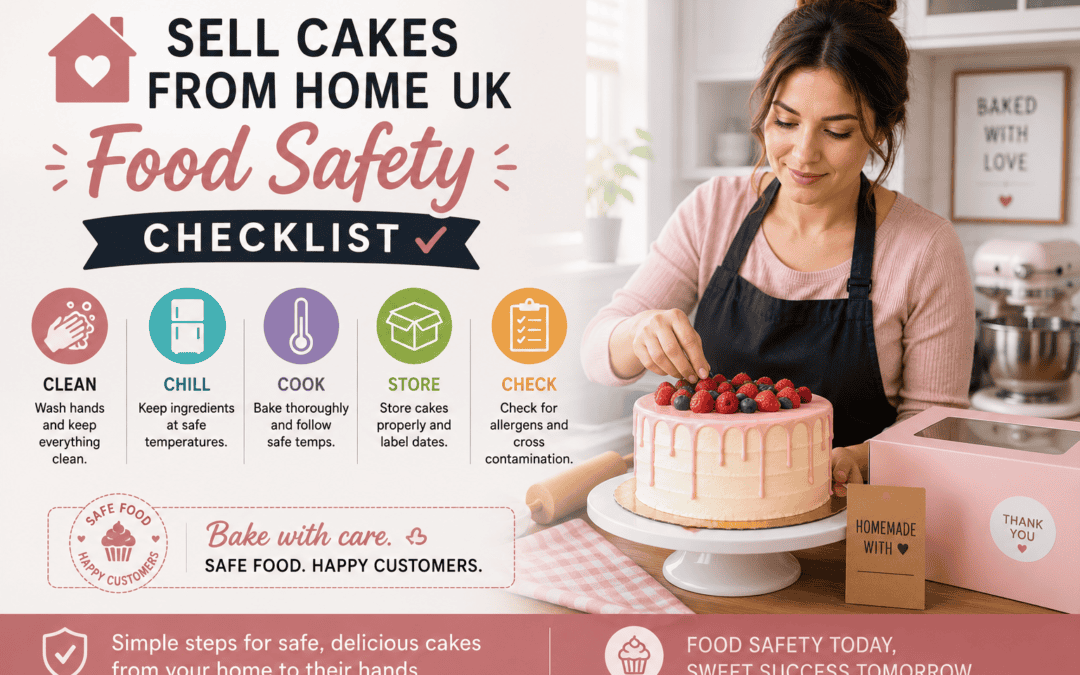
Starting a Home Bakery or Cake Business: A Food Safety Checklist
Baking for money is a very different job from baking for friends. The cakes may be identical, yet the responsibilities are not.
Most new home bakers handle the food safely already. What catches them out instead is labelling, decorations and paperwork, because nobody mentions any of it until an officer does.
So here is the checklist, written specifically for cakes rather than for kitchens in general.
Three things before your first order
First, register with your local council at least 28 days before you start trading. It is free, it cannot be refused, and trading without it is a criminal offence. Our guide to registering a food business walks through the form.
Second, train to Level 2. No law names a certificate; however, officers expect one and customers increasingly ask.
Third, sort your allergen information before you sell anything rather than afterwards. That is where most of this article goes.
For the wider setup, including insurance and your home kitchen, read our guide on selling food from home.
The labelling rule that splits home bakers in two
Everything depends on one question. Did you pack the cake before the customer chose it?
Cakes made to order
A celebration cake baked for a specific customer, decorated to their brief and handed over, is not prepacked for direct sale. Therefore, you do not need a full ingredients label on the box.
You must still give accurate allergen information, though. Provide it in writing where you can, and never guess.
Cakes you box up in advance
Cupcakes boxed ready for a market stall, brownie slices bagged before anyone orders, traybakes wrapped and put on a table. All of these count as prepacked for direct sale, so PPDS labelling applies.
That means a full ingredients list with the fourteen allergens emphasised, usually in bold. Miss it, and you are non-compliant, however small the batch.
What a PPDS label actually needs
Keep this list to hand when you design your labels.
- The name of the food, so Lemon Drizzle Cake rather than just Cake
- A full ingredients list in descending order of weight
- The fourteen allergens emphasised within that list
- A use-by or best-before date
- Storage instructions where they matter, such as keep refrigerated
- Your business name and address
Work from your suppliers’ ingredient lists rather than memory, and keep the packaging until the batch has sold.
The GOV.UK allergen guidance for food businesses sets out the requirements in full.
The allergens hiding in a baker’s cupboard
Baking involves more of the fourteen than most people realise.
Wheat flour, eggs, butter and milk are obvious. Meanwhile, marzipan brings nuts, some sprinkles and chocolate contain soya, and tahini or seeded toppings bring sesame.
Two things catch people out repeatedly. Dried fruit often carries sulphites, so a fruit cake may need declaring. Lupin appears in some gluten-free flour blends, and almost nobody checks for it.
Also watch out for “may contain” warnings on your ingredients, since those tell you about your supplier’s factory rather than your kitchen.
Glitter, wires, and things that are not food
Cake decorating brings a hazard that ordinary catering does not.
Non-toxic is not the same as edible. Craft glitter labelled non-toxic must not go on food that will be eaten, so use products clearly marked edible or food-grade instead.
Sugar flowers usually sit on floral wire. Dowels support tiers. Ribbon wraps around boards. Toppers, picks and cocktail sticks hold things upright. None of that is food.
Therefore, tell the customer in writing what must come out before cutting, and remove anything you can remove yourself. For fresh flowers, check that the variety is not toxic, and never place stems directly into cake without a food-safe barrier.
What needs a fridge, and what does not
A plain sponge with buttercream sits happily at room temperature. Fresh cream, cream cheese frosting, custard, mousse and fresh fruit fillings do not.
Anything in that second group needs chilling at 8°C or below, and 5°C gives you margin. Say so on the label, and think carefully before sending a fresh cream cake out for a summer wedding.
Cheesecakes, éclairs and cream-filled buns all belong in the fridge too.
Raw egg needs care
Traditional royal icing uses raw egg white, and uncooked egg carries a salmonella risk.
Use pasteurised egg white or meringue powder instead. Similarly, avoid raw egg in buttercreams, mousses and fillings unless the eggs are pasteurised. Lion Mark eggs reduce the risk but do not remove it entirely for vulnerable groups.
Raw cake batter is another one. It is not just the egg, since raw flour carries risk too, so keep tasting spoons away from anything you sell.
Dates, freezing and shelf life
Give every product a realistic date rather than a guess.
Use by applies to anything with a food safety deadline, such as fresh cream products. Best before applies to quality, which covers most sponges and biscuits.
You can freeze cake, and doing it properly is fine. Wrap it well, label it with the date, and remember that freezing pauses bacteria rather than killing them. Defrost in the fridge, then treat the clock as running again.
Keeping track of what went into what
If a customer ever reports a reaction, you need to know what you used.
Keep a simple batch note: date baked, what you made, and which products went in. Photograph ingredient labels on your phone if writing everything down feels heavy.
That habit also protects you if a supplier changes a recipe without telling you, which happens more often than you would like.
Your kitchen, your family and your pets
Keep animals out while you bake, and never wash pet bowls alongside baking equipment.
Store business ingredients separately from the family shopping. Keep cleaning products away from flour and sugar. Tie hair back, cover cuts with a blue plaster, and stay out of the kitchen if you have had sickness or diarrhoea in the last 48 hours.
Officers understand that a home kitchen is also a home. They simply want to see that you work around it deliberately.
Getting cakes to the customer
Boxes should be food-grade, sturdy and clean. Use a non-slip mat in the car boot and drive as though the cake is a passenger.
In warm weather, buttercream softens fast, so travel early and keep chilled items in a cool box. Then hand over storage and decoration removal instructions with the cake rather than mentioning them at the door.
The training is worth having
Level 2 Food Hygiene and Safety covers everything above in structured form: temperature control, cross-contamination, cleaning, storage, allergens and the law.
The course carries CPD accreditation and Highfield quality endorsement, costs £20, and takes around four to five hours as a guide. Your licence lasts twelve months, and you receive the certificate the same day you pass.
Given how much of a cake business rests on allergen accuracy, it is worth taking the time on that section rather than skimming it.
Not sure what applies to your setup? Ring us for free
Home bakers often have one specific worry, usually about labelling.
Tell us what you bake and how you sell it, at markets, to order, or online. Then we will tell you honestly what applies and which course fits.
Call our landline on 02034884930 for free advice, or email info@gvec.co.uk.
Questions home bakers ask
Do I need a full ingredients label on a birthday cake?
Not if you made it to order for that customer. You must still give accurate allergen information.
Can I use craft glitter if it says non-toxic?
No. Only use glitter clearly marked edible or food grade.
Do I need a separate kitchen?
Rarely. You do need business ingredients stored separately and the kitchen kept properly clean.
Will my home get a food hygiene rating?
Yes, once the council inspects, and it appears on the public FSA database.
Can I sell cakes containing alcohol?
Yes, though declare it clearly, and be careful with cakes intended for children.
How long does my certificate last?
Renew every three years, which is the accepted industry standard.
Your checklist, in order
Register with the council. Book Level 2. Build your allergen information from supplier labels. Decide which products need a fridge. Sort labels for anything you box in advance. Write down what goes into each batch. Then check your insurance.
Seven steps, and only two of them cost anything.
Browse our food hygiene courses, or call 02034884930 before your first order goes out.