
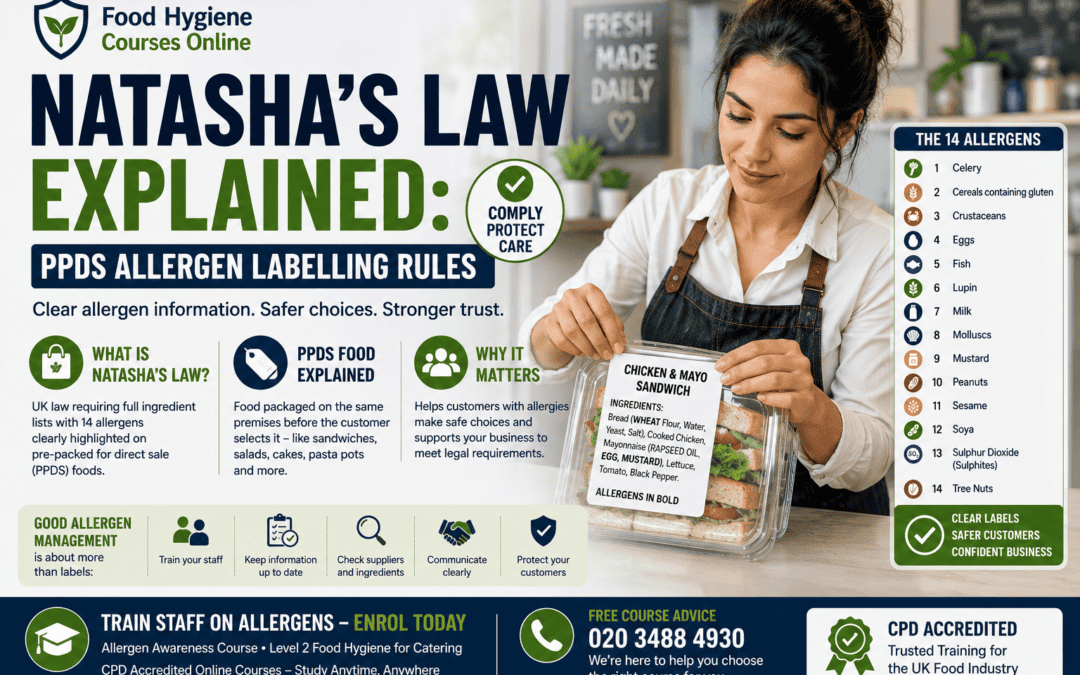
Natasha’s Law Explained: PPDS Allergen Labelling Rules
“Does this sandwich contain sesame?”
It seemed like a simple question.
The assistant behind the counter glanced at the label, looked back at the customer and hesitated.
“I’m not completely sure… I think it’s okay.”
For someone with a food allergy, “I think” simply isn’t good enough.
Every year, thousands of people in the UK rely on food labels to help them make safe choices. For most of us, reading an ingredient list is a matter of preference. For someone living with a severe food allergy, it can be the difference between enjoying lunch and suffering a life-threatening allergic reaction.
That’s why food allergen information is one of the most important responsibilities for any food business.
Whether you run a café, bakery, deli, sandwich shop, supermarket counter or takeaway, providing clear and accurate allergen information isn’t just good customer service—it’s a legal obligation.
One of the biggest changes to UK food labelling in recent years came with the introduction of Natasha’s Law, which strengthened the rules for certain foods prepared and sold on the same premises.
Although many businesses have heard of the law, there’s still plenty of confusion.
- Does it apply to my business?
- What exactly is pre-packed for direct sale (PPDS)?
- Which foods need full ingredient labels?
- What information must appear on the packaging?
- How can I make sure my staff are following the rules?
If you’ve asked any of these questions, you’re in the right place.
In this guide, we’ll explain Natasha’s Law in straightforward UK English, helping you understand the requirements, avoid common mistakes and protect your customers with confidence.
What Is Natasha’s Law?
Natasha’s Law is the name commonly given to the UK legislation that introduced stricter allergen labelling requirements for pre-packed for direct sale (PPDS) foods.
The law came into force on 1 October 2021 across England, Wales, Scotland and Northern Ireland.
Its purpose is simple:
To ensure customers with food allergies receive clear, consistent and accurate information about the food they buy.
Before the law was introduced, many foods prepared and packaged on the same premises where they were sold did not have to list all ingredients.
Instead, customers often had to ask staff about allergens.
While many businesses provided excellent advice, relying solely on verbal information created the risk of misunderstandings and human error.
Natasha’s Law changed that.
Now, many PPDS foods must display:
- The name of the food.
- A full ingredients list.
- Clear identification of any of the 14 regulated allergens within that ingredients list.
The aim is to help customers make informed choices without needing to ask for allergen information every time they make a purchase.
Why Is It Called Natasha’s Law?
The legislation is named in memory of Natasha Ednan-Laperouse, a teenager who tragically died after suffering a severe allergic reaction to a sandwich purchased before boarding a flight.
The sandwich contained sesame, one of the UK’s recognised allergens.
At the time, the product did not carry a full ingredients list because it had been prepared and packaged on the same premises where it was sold.
Natasha’s family campaigned tirelessly for stronger food labelling rules, encouraging greater transparency for consumers with food allergies.
Their efforts led to significant changes in UK food labelling legislation, helping improve the information available to millions of people living with allergies.
Today, Natasha’s Law stands as an important reminder of why accurate allergen information matters.
For food businesses, it’s not simply about complying with legislation.
It’s about helping customers make safe, informed decisions every day.
What Does PPDS Mean?
One of the terms that causes the most confusion is PPDS.
It stands for Pre-Packed for Direct Sale.
In simple terms, PPDS food is food that:
- is packed before the customer orders it,
- is packaged on the same premises where it is sold,
- and is offered directly to customers from that business.
The key point is that the food is already packaged before the customer chooses it.
Examples of PPDS Food
Many businesses are surprised to discover that they sell PPDS food every day.
Examples may include:
- Sandwiches made in the morning and placed in a refrigerated display.
- Fresh salads packaged before lunchtime.
- Filled baguettes prepared in advance.
- Cakes boxed before being placed on the counter.
- Pasta pots made on-site and displayed in a chilled cabinet.
- Wraps prepared each morning for customers to pick up throughout the day.
If these foods are packaged before the customer selects them and are sold from the same premises where they were prepared, they are likely to fall within the PPDS labelling rules.
Foods That Are Usually Not PPDS
Not every item sold by a food business is considered PPDS.
For example, food is generally not PPDS if it is:
- prepared only after the customer places an order,
- packaged in front of the customer,
- served on a plate,
- wrapped after purchase,
- or delivered in packaging prepared after the order has been received.
For instance, a sandwich made to order after a customer requests it at the counter would usually not be classed as PPDS.
Likewise, a takeaway meal packed after the order has been placed is generally treated differently from food that has already been packaged and displayed for sale.
Understanding this distinction is one of the first steps towards complying with allergen labelling UK requirements.
Why Natasha’s Law Matters
For many customers, reading a food label is simply part of choosing what to eat.
For someone with a food allergy, it can be much more significant.
Even a tiny amount of an allergen may trigger a serious reaction in some individuals.
That’s why accurate PPDS labelling helps customers make informed decisions before purchasing food.
It also benefits businesses.
Clear labels can:
- reduce confusion,
- improve customer confidence,
- support staff by providing consistent information,
- minimise the risk of misunderstandings,
- and demonstrate a commitment to good food safety practices.
Good allergen management isn’t just about avoiding legal problems.
It’s about building trust.
Customers are more likely to return to businesses that provide clear, accurate and reliable allergen information.
Natasha’s Law Is Only One Part of Good Allergen Management
It’s important to remember that labels alone cannot guarantee food safety.
A perfectly printed ingredient label won’t protect customers if ingredients are substituted without updating the packaging.
Likewise, a correctly labelled sandwich can still become unsafe if cross-contamination occurs during preparation.
That’s why successful food businesses combine accurate PPDS labelling with:
- well-trained staff,
- effective allergen procedures,
- good communication,
- regular reviews,
- and strong food hygiene practices.
Training helps employees understand not only what the law requires, but also why those requirements matter.
When everyone understands their responsibilities, businesses are far better equipped to protect customers and maintain confidence in their products.
The 14 Allergens Every Food Business Must Know
One of the most important parts of Natasha’s Law is ensuring customers can clearly identify whether a product contains one or more of the UK’s 14 regulated allergens.
These allergens are responsible for the majority of serious allergic reactions and must be declared whenever they are present in food.
The 14 regulated allergens are:
- Celery
- Cereals containing gluten (such as wheat, barley, rye and oats)
- Crustaceans (such as prawns, crab and lobster)
- Eggs
- Fish
- Lupin
- Milk
- Molluscs (such as mussels, oysters and squid)
- Mustard
- Peanuts
- Sesame
- Soya
- Sulphur dioxide and sulphites (above permitted levels)
- Tree nuts (including almonds, hazelnuts, walnuts, cashews, pecans, Brazil nuts, pistachios and macadamia nuts)
Under Natasha’s Law, these allergens must be clearly highlighted within the ingredients list on pre-packed for direct sale (PPDS) food.
Many businesses use bold text, CAPITAL LETTERS or another clear style to make allergens stand out.
The important point is that customers should be able to identify allergens quickly and easily.
What Information Must Appear on a PPDS Label?
Many business owners ask,
“Can I simply add an allergen sticker?”
Unfortunately, that’s not enough on its own.
For food covered by PPDS labelling rules, the label should generally include:
- The name of the food.
- A complete ingredients list.
- All regulated allergens clearly emphasised within that ingredients list.
For example, instead of writing:
Chicken Sandwich
A compliant label would provide much more detail, such as:
Chicken Sandwich
Ingredients: Bread (WHEAT flour, MILK, yeast, salt), cooked chicken, mayonnaise (EGG, MUSTARD), lettuce, black pepper.
Notice how the allergens are clearly highlighted within the ingredients list.
This allows customers to make informed decisions before purchasing the product.
Real-Life Examples of PPDS Foods
Sometimes the easiest way to understand Natasha’s Law is by looking at everyday situations.
Example 1: A Café
A café prepares fresh sandwiches every morning, wraps them individually and places them in a chilled display cabinet.
Customers simply pick one up and pay at the till.
Because the sandwiches were packaged before the customer selected them and are sold from the same premises, they are likely to be classed as PPDS.
They should carry the required ingredient and allergen information.
Example 2: A Bakery
A bakery prepares slices of cake, boxes them individually and displays them on the counter throughout the day.
Customers choose whichever slice they want.
Again, these products are likely to fall within the PPDS definition and require compliant labels.
Example 3: A Deli
A deli prepares pasta salads, couscous pots and fruit pots each morning before opening.
The containers are sealed and displayed in refrigerated cabinets.
These products are another example of food that may require PPDS labelling.
Example 4: A Made-to-Order Takeaway
A customer orders a chicken wrap.
The staff prepares it immediately after the order is placed and wraps it before handing it over.
In many situations, this would not normally be classed as pre-packed for direct sale, because it wasn’t packaged before the customer ordered it.
Understanding this distinction helps businesses decide which products require full PPDS labels.
Common Mistakes Businesses Make
Since Natasha’s Law came into force, Environmental Health Officers have found that many businesses make similar mistakes.
Fortunately, most are avoidable.
Assuming every packaged food is PPDS
Not all packaged food falls under the PPDS rules.
The timing of when the food is packaged and how it is sold makes all the difference.
Forgetting to update ingredient labels
Imagine changing from one brand of mayonnaise to another because your supplier runs out of stock.
The new product contains an additional allergen.
If the ingredient label isn’t updated, customers could receive incorrect information.
Always review labels whenever recipes or ingredients change.
Relying on memory
Even experienced staff shouldn’t rely solely on memory when providing allergen information.
Written procedures and accurate labels help reduce the risk of mistakes, especially during busy periods.
Inconsistent recipes
One chef adds sesame seeds to a salad.
Another doesn’t.
If recipes vary without updating labels, customers may receive misleading allergen information.
Consistency is essential.
Assuming staff know everything
New employees may not recognise every allergen or understand how serious allergic reactions can be.
Regular allergen training helps ensure everyone follows the same safe procedures.
Preventing Cross-Contamination
Correct labels are only one part of protecting customers.
Businesses also need procedures to reduce the risk of allergen cross-contamination.
Simple steps include:
- Using clean utensils.
- Cleaning work surfaces thoroughly.
- Storing allergenic ingredients separately where possible.
- Washing hands between tasks.
- Using dedicated equipment where appropriate.
- Communicating clearly between kitchen and front-of-house staff.
Imagine preparing a gluten-free sandwich using the same knife that has just been used to cut ordinary bread.
Even if the label is accurate, cross-contamination could still occur.
That’s why allergen awareness training is so important.
Labels inform customers.
Safe working practices help keep them safe.
Why Staff Training Is Essential
No label can answer every customer question.
Customers may ask:
- “Has the recipe changed?”
- “Is there any risk of cross-contamination?”
- “Which dressing contains mustard?”
- “Can this be prepared without dairy?”
Staff need the confidence to answer honestly and accurately.
If they’re unsure, they should know exactly where to find the correct information rather than guessing.
One incorrect answer could have serious consequences.
That’s why food businesses should make allergen awareness part of their regular staff training—not just something discussed during induction.
When everyone understands the importance of allergen labelling UK requirements, businesses become safer, customers feel more confident, and teams work more consistently.
Good allergen management isn’t just about complying with Natasha’s Law.
It’s about creating a culture where every member of staff understands that accurate information can protect lives.
Frequently Asked Questions About Natasha’s Law
Does Natasha’s Law apply to every food business?
Not necessarily.
Natasha’s Law specifically affects foods that are pre-packed for direct sale (PPDS). Whether the law applies depends on how and when the food is prepared, packaged and sold.
If you’re unsure whether your products are classed as PPDS, it’s worth seeking professional advice or consulting the official guidance from the Food Standards Agency.
What happens if I change an ingredient?
Any time you change a recipe or substitute an ingredient, you should review your labels immediately.
For example, changing to a different brand of pesto, mayonnaise or curry paste could introduce a new allergen such as milk, mustard, sesame or tree nuts.
Even a small recipe change can affect allergen information, so labels should always reflect the ingredients actually being used.
Can staff tell customers about allergens instead of using labels?
For food covered by PPDS labelling rules, verbal advice alone is not enough.
Customers should be able to see:
- the name of the food,
- a full ingredients list,
- and any of the 14 regulated allergens clearly emphasised within that list.
Staff should still be trained to answer questions accurately, but clear labelling forms an essential part of complying with Natasha’s Law.
What if I only sell a few packaged sandwiches each day?
The number of products sold does not determine whether the rules apply.
If the food meets the definition of pre-packed for direct sale, the relevant labelling requirements still apply.
Whether you prepare five sandwiches or five hundred, accurate allergen information is equally important.
How often should allergen information be reviewed?
Good practice is to review your allergen information whenever:
- recipes change,
- suppliers change,
- ingredients change,
- new menu items are introduced,
- packaging changes,
- or allergen risks are identified.
Regular reviews help ensure your labels remain accurate and up to date.
Common Myths About Natasha’s Law
There are still plenty of misunderstandings surrounding Natasha’s Law. Let’s separate fact from fiction.
Myth 1: It only affects large supermarket chains.
False.
The law applies to businesses of all sizes, including independent cafés, bakeries, sandwich shops, delicatessens, farm shops and many other food businesses selling PPDS food.
Myth 2: A warning notice saying “Ask staff about allergens” is enough.
Not for foods covered by PPDS labelling requirements.
Eligible products must carry the required ingredient list with allergens clearly highlighted.
Myth 3: Once labels are printed, there’s nothing else to do.
Incorrect.
Labels should be updated whenever recipes or ingredients change.
Accurate allergen management is an ongoing process, not a one-off task.
Myth 4: Only chefs need allergen training.
Food safety is everyone’s responsibility.
Front-of-house staff, supervisors, managers, delivery teams and anyone communicating with customers should understand allergen procedures appropriate to their role.
A customer may ask a question at the till rather than in the kitchen, so every member of the team needs to know how to respond appropriately.
How Good Allergen Management Protects Your Business
Many people think allergen management is simply about following legislation.
In reality, it offers much wider benefits.
Businesses with effective allergen procedures often experience:
- greater customer confidence,
- fewer misunderstandings,
- better communication between staff,
- improved consistency,
- stronger food safety culture,
- and greater confidence during Environmental Health inspections.
Customers appreciate honesty and clarity.
If staff know exactly where to find allergen information and understand the procedures they should follow, they’re far more likely to provide accurate advice.
That builds trust, encourages repeat business and demonstrates professionalism.
Continue Learning About Food Safety
Understanding Natasha’s Law is just one part of creating a safer food business.
If you or your team would like to strengthen your knowledge further, these courses are an excellent next step.
Allergen Awareness Course
Learn how to identify allergens, communicate accurate information to customers and reduce the risk of allergen-related incidents in your food business.
https://www.foodhygienecoursesonline.co.uk/
Level 2 Food Hygiene for Catering
Ideal for chefs, café staff, restaurant teams, takeaway workers and anyone handling food as part of their daily role.
https://www.foodhygienecoursesonline.co.uk/product/food-hygiene-safety-level-2/
These courses complement one another and help businesses build a stronger food safety culture.
Official Sources of Information
For the latest official guidance on Natasha’s Law, PPDS labelling and allergen labelling UK, we recommend the following trusted resources:
Food Standards Agency (FSA)
Food Information Regulations and UK Legislation
https://www.legislation.gov.uk/
These sources provide up-to-date guidance and legal information for food businesses operating throughout the UK.
Conclusion:
Food allergies affect millions of people across the UK, and for some, even a tiny amount of the wrong ingredient can have serious consequences.
That’s why Natasha’s Law represents far more than a change to food labelling requirements.
It reflects a commitment to transparency, accuracy and customer safety.
Understanding when PPDS labelling applies, maintaining accurate ingredient information and ensuring staff know how to manage allergen enquiries are all essential parts of running a responsible food business.
Good allergen management isn’t achieved through labels alone.
It depends on knowledgeable staff, consistent procedures and a culture where food safety is taken seriously every single day.
Whether you run a small café, an independent bakery, a sandwich shop, a takeaway or a growing catering company, investing time in allergen awareness helps protect both your customers and your reputation.
At Food Hygiene Courses Online, we make food safety training simple, practical and relevant for today’s food businesses.
Our courses are written in clear UK English, designed by experienced professionals and recognised as CPD Accredited, helping individuals and businesses build confidence in food safety and allergen management.
If you’re not sure which course is most suitable for you or your staff, we’re here to help.
Why Choose Food Hygiene Courses Online?
- CPD Accredited online training
- Learn anytime, anywhere at your own pace
- Suitable for individuals, cafés, restaurants, bakeries, takeaways and catering businesses
- Instant access to course materials
- Friendly UK-based support
- FREE advice on choosing the right course
- Practical training focused on real-life food businesses
Website
https://www.foodhygienecoursesonline.co.uk/
📞 FREE Course Advice
020 3488 4930
Train staff on allergens, enroll today.
Not sure whether you need an Allergen Awareness Course, Level 2 Food Hygiene for Catering, or both? Give our team a call on 020 3488 4930 for free, friendly advice. We’ll help you choose the right training for your role or business, so you can protect your customers, support your staff and stay confident in meeting UK food safety requirements.