
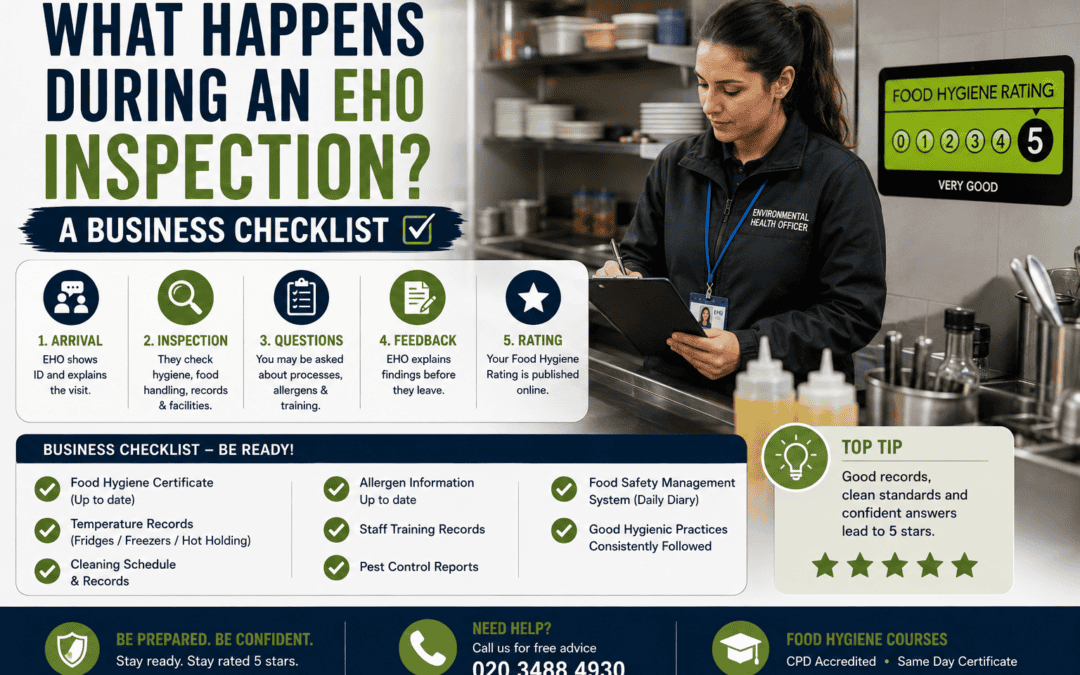
What Happens During an EHO Inspection? A Business Checklist
Nobody enjoys looking up from service and seeing an unfamiliar person with a lanyard and a clipboard. The stomach drops a little even when you have nothing to hide.
Most of that anxiety comes from not knowing what is about to happen. So here is the whole thing, start to finish, along with a checklist you can work through before the day arrives.
Who is actually visiting you?
An environmental health officer works for your local council, not for the Food Standards Agency. They are qualified professionals, usually registered through the Chartered Institute of Environmental Health, and they enforce food hygiene law across the businesses in their area.
Their job is not to catch you out. Most officers spend the majority of their time advising businesses rather than punishing them. Treating the visit as a conversation rather than a confrontation genuinely serves you better.
Yes, they can turn up unannounced
They can, and they usually will.
Officers have a right of entry to commercial premises at all reasonable hours, without an appointment and without warning. That includes evenings and weekends if that is when you trade.
The reasoning is simple. An announced inspection shows how well you prepare. An unannounced one shows how you actually operate. As GOV.UK confirms in its guidance on food inspections, you will normally not be told an inspection is going to happen.
They should introduce themselves, show identification, and explain why they are there, whether that is a routine visit or a response to a complaint.
How often should you expect one?
Inspection frequency is risk-based rather than fixed to a calendar.
Higher risk businesses, meaning those handling lots of high-risk food or with a history of problems, might see an officer every six or twelve months. Lower risk businesses with a strong record might go two or three years between visits.
Your last rating feeds into this. A poor result usually means you will be seen again sooner.
What they look at, step by step
The visit generally follows a familiar shape.
A walk through the premises.
Storage areas, fridges and freezers, preparation surfaces, equipment, the wash up area, staff facilities, waste storage and the outside of the building. They will look at the parts of the kitchen you have stopped noticing, behind and under equipment especially.
Watching practice.
How staff handle food, wash hands, use cloths, separate raw and ready-to-eat items, and check temperatures. If you are mid-service, they will watch service.
Temperature checks.
Their own probe, on your fridges, your hot-held food, and sometimes cooked items.
Talking to your team.
Officers frequently ask a member of staff a direct question rather than asking the manager. What temperature should the fridge be? Who do you tell if you are unwell? What do you do for an allergy order? The answers tell them how well training has landed.
Reading your paperwork.
Your food safety management system, daily records, cleaning schedules, temperature logs, allergen information, supplier details and training certificates.
That last part is where many otherwise well-run businesses lose points.
The three things being scored
Everything above feeds into three scored elements.
Food hygiene and safety procedures, meaning how the food is handled. Structural requirements, meaning the condition of the premises. Confidence in management, meaning your systems, records, training and track record.
Confidence in management carries the heaviest weighting, because it predicts whether standards will hold up after the officer leaves. Our guide to how the rating scheme works explains how the three convert into a final score.
The powers an officer actually holds
Worth knowing, because rumours in this area run wild.
An officer can enter at reasonable hours, take photographs, take food samples, inspect and take copies of records, and detain or seize food they suspect is unsafe.
They cannot arrest anyone. They can involve the police if entry is refused, and refusing entry is itself an offence, so it is never the right move.
The notices, from mild to serious
Most visits end with advice and a report. Where problems are found, there is a ladder.
Verbal and written advice comes first for minor issues. You will be told what to fix and by when.
A hygiene improvement notice is a formal legal requirement to fix something specific. It states what is wrong, what the law requires, and a deadline of at least fourteen days. Ignoring one is a criminal offence.
A remedial action notice can stop the use of a particular process or piece of equipment.
A hygiene emergency prohibition notice is the serious one. It is served where there is an imminent health risk, and it closes the premises or bans the process immediately. The officer must then apply to a magistrates court within three days to confirm it as an order.
Prosecution sits at the top of the ladder, usually where there is a pattern of non-compliance rather than a single failing.
Serious infestations, no hot water, sewage problems and dangerous structural conditions are the sorts of findings that trigger the top of that list.
Your checklist before the day arrives
Work through this in your own time, not on the morning of a visit.
Documentation
- Food safety management system written up and based on HACCP principles
- Daily diary completed properly, not filled in retrospectively
- Fridge and freezer temperature records, twice daily
- Cooking and hot holding temperature records for high-risk items
- Cleaning schedules signed and matching what the premises look like
- Allergen information current and matching this week’s menu
- Supplier records and traceability for your main lines
- Training certificates for every member of staff, with dates
The premises
- Handwash basin with hot water, soap and disposable towels, not being used for anything else
- Fridges holding 8°C or below, and hot held food at 63°C or above
- Raw and ready to eat properly separated in storage and preparation
- No gaps under doors, no pest evidence, bait stations in order
- Behind and under equipment cleaned, not just the visible surfaces
- Chipped, cracked or unsealed surfaces repaired
- Waste storage tidy and lidded
Your team
- Everyone handling food trained and certificated
- Staff able to answer a direct question about temperatures, illness reporting and allergens
- A supervisor who understands the system, not just the practice
If you would rather work from a ready-made kit than assemble this yourself, our Food Hygiene 5 Star Pack pulls the documentation and equipment together around the three scored elements. The FSA’s Safer Food, Better Business pack is the free route if you prefer to build it yourself.
On the day itself
Stay calm and stay professional. Do not follow the officer around apologising, and equally do not leave them alone with a junior member of staff and no context.
Answer honestly. If something is wrong, saying so and explaining what you are doing about it lands far better than a defence that falls apart two questions later.
Take notes throughout. Ask what specifically needs to change and by when. Ask for the reasoning if you do not understand a point.
Then act quickly on what you were told, and keep evidence that you acted. That evidence matters at the next visit.
Afterwards
You should receive a report or letter setting out what was found and what needs to happen.
Your rating will be published, and you have a right to appeal within roughly 21 days if you believe it is wrong, a right to reply if you want a statement published alongside it, and a right to request a revisit once improvements are made. Our guide to improving your rating sets out the order to tackle things in.
Inspection due? Talk to us first; it is free
If you know a visit is coming and you are not confident, a conversation costs nothing.
Tell us about your setup and what your last inspection flagged, and we will tell you where the risk probably sits and what training your team needs. If you want someone to go through the premises and paperwork properly, our food hygiene consultancy service does exactly that.
Call our landline on 02034884930 for free advice, or email info@gvec.co.uk. For training, Level 2 Food Hygiene and Safety covers everyone handling food at £20, and Level 3 Food Safety for Supervisors covers whoever runs the kitchen at £170, with a twelve month licence and the certificate issued the same day you pass.
Questions owners ask us
Can I refuse entry to an EHO?
No. Refusing entry is an offence and officers can involve the police.
Can I ask them to come back later because we are busy?
You can explain the situation, but they are entitled to inspect during trading hours and often prefer to.
Do they inspect the whole building?
They inspect areas relevant to the food business, which usually includes storage, staff facilities and waste areas.
What if I disagree with what they found?
Raise it politely on the day, then use the formal appeal route. Keep your own notes and photographs.
How long does an inspection take?
Anything from under an hour for a small operation to several hours for a large or complex one.
The honest summary
Officers are not looking for perfection. They are looking for a business that understands its risks, controls them, and can show evidence of both.
Get the folder in order, get the team trained, and keep the records daily. Do that and an unannounced visit stops being something to dread.
Browse our food hygiene courses, or ring 02034884930 and we will help you get ready.