
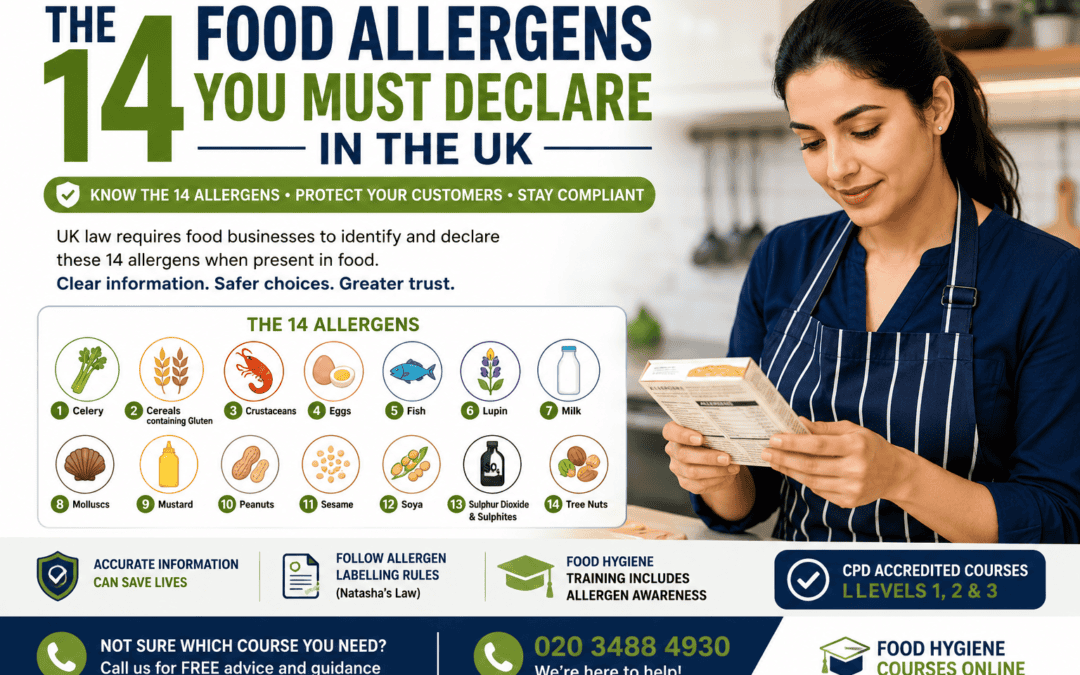
The 14 Food Allergens You Must Declare in the UK
One Label Can Make All the Difference
A customer walks into a busy sandwich shop during the lunch rush.
She orders a chicken baguette, then pauses before paying.
“Does this contain mustard?” she asks.
The member of staff smiles and checks the allergen information before answering.
“Yes, it does. Would you like me to show you another option?”
The customer thanks them and chooses a different sandwich.
It seems like an ordinary conversation.
In reality, that simple question may have prevented a serious allergic reaction.
Across the UK, thousands of people rely on food businesses to provide accurate allergen information every day. Customers place their trust in cafés, restaurants, bakeries, takeaways and catering businesses whenever they buy food.
That is why every food handler should understand the 14 allergens UK food businesses are legally required to declare.
Whether you work behind the counter or in the kitchen, recognising these allergens is an essential part of good food safety.
Why Food Allergens Matter
Food allergies are not simply food preferences.
For some people, eating even a tiny amount of the wrong ingredient can trigger a severe allergic reaction.
Symptoms may develop within minutes.
In serious cases, emergency medical treatment may be needed.
This is why allergen management is such an important part of food safety.
Customers deserve accurate information so they can make safe choices.
Businesses also benefit.
Well-trained staff helps reduce mistakes, improve customer confidence, and support legal compliance.
What Does UK Law Require?
Food businesses must provide information about the 14 allergens whenever they are present in food.
This applies to many different types of food businesses, including:
- Restaurants.
- Cafés.
- Bakeries.
- Takeaways.
- Catering companies.
- School kitchens.
- Care homes.
- Mobile food units.
- Delicatessens.
The information should be accurate, easy to understand and kept up to date whenever recipes or ingredients change.
Following correct allergen labelling procedures helps customers make informed decisions before they eat.
The 14 Allergens Every Food Handler Should Know
Learning the food allergen list is one of the first steps towards safer food handling.
Here are the fourteen allergens recognised under UK food legislation.
-
Celery
Celery includes stalks, leaves, seeds and celeriac.
It is commonly found in soups, sauces, salads and stock cubes.
-
Cereals Containing Gluten
This group includes wheat, rye, barley and oats.
These ingredients are widely used in bread, cakes, pastries, pasta, breakfast cereals and many processed foods.
-
Crustaceans
Crabs, prawns, lobster, crayfish and shrimp all belong to this group.
They are common in seafood dishes, stir-fries and soups.
-
Eggs
Eggs appear in many everyday foods.
Examples include cakes, mayonnaise, pasta, quiches and desserts.
-
Fish
Fish can be present in obvious products such as fillets.
It can also appear in sauces, fish paste, soups and certain flavourings.
-
Lupin
Lupin flour is sometimes used in bread, pastries and gluten-free products.
Although less common than other allergens, it must still be declared.
-
Milk
Milk includes dairy products such as cheese, butter, yoghurt and cream.
It is one of the most common allergens found in catering businesses.
8. Molluscs
This group includes mussels, oysters, clams, squid, octopus and snails.
Molluscs are commonly used in seafood dishes, soups and Mediterranean recipes.
9. Mustard
Mustard is often hidden in sauces, dressings, marinades and sandwiches.
Although it is used in small amounts, it must always be declared when present.
10. Peanuts
Peanuts are one of the best known food allergens.
They can be found in cakes, biscuits, confectionery, sauces and many Asian dishes.
Even small traces may cause a severe allergic reaction in some people.
11. Sesame
Sesame seeds are commonly used on bread, burger buns, crackers and salads.
Sesame oil and sesame paste may also be used in sauces and dips.
12. Soya
Soya is used in many processed foods.
It is commonly found in sauces, vegetarian products, desserts and bakery items.
13. Sulphur Dioxide and Sulphites
These preservatives are often added to dried fruit, wine, cider and some processed foods.
They must be declared when present above the legal threshold.
14. Tree Nuts
This category includes almonds, hazelnuts, walnuts, cashews, pecans, pistachios, Brazil nuts, macadamia nuts and Queensland nuts.
Tree nuts are used in desserts, chocolates, salads, bakery products and many savoury dishes.
Understanding where these allergens may appear helps food handlers provide accurate information and reduce unnecessary risks.
Understanding More Than Ingredients
Knowing the 14 allergens UK list is important.
Understanding where these allergens are hidden is equally valuable.
For example, milk may be found in mashed potatoes, sauces and desserts.
Eggs may be present in dressings, coatings and baked goods.
Mustard can appear in marinades and salad dressings.
Food handlers should never rely on memory.
They should always check ingredient labels and recipes before answering customer questions.
Good Communication Protects Everyone
Customers often ask questions about ingredients before ordering.
The safest response is always an accurate one.
If you do not know the answer, never guess.
Instead:
- Check the ingredient list.
- Read the allergen information.
- Speak with the chef if necessary.
- Confirm the information before serving the food.
These simple habits help build customer confidence and reduce the risk of mistakes.
Good communication is just as important as good cooking.
Food Hygiene Training Supports Allergen Awareness
Many people believe allergen awareness is a completely separate subject.
In practice, it forms part of everyday food safety.
A quality Food Hygiene Level 1, Level 2 or Level 3 course introduces learners to allergen risks, cross-contamination, safe food handling and the importance of providing accurate information to customers.
This knowledge helps food handlers understand their responsibilities and supports safer working practices.
Accurate Information Is Just as Important as Good Food
Customers trust food businesses to give correct allergen information.
That trust should never be taken for granted.
Recipes change.
Suppliers change.
Ingredients change.
Whenever this happens, allergen information should also be reviewed.
Checking labels every time a new delivery arrives is one of the simplest ways to reduce mistakes.
Good records and clear communication also help staff answer customer questions with confidence.
Common Errors That Can Be Avoided
Most allergen incidents happen because basic procedures are missed.
Some of the most common mistakes include:
- Guessing instead of checking ingredients.
- Forgetting to update allergen information after changing a recipe.
- Using an incorrect food label.
- Storing allergen ingredients carelessly.
- Failing to communicate recipe changes to colleagues.
- Giving verbal information without checking written records.
These problems are usually preventable.
Good training and consistent procedures make a significant difference.
Why Food Hygiene Training Matters
Understanding the 14 allergens UK food businesses must declare is only one part of food safety.
Food handlers also need to understand:
- Personal hygiene.
- Cross-contamination.
- Temperature control.
- Cleaning and disinfection.
- Safe food storage.
- Food poisoning bacteria.
- Legal responsibilities.
That is why allergen awareness is included within Food Hygiene Level 1, Level 2 and Level 3 training.
A recognised Food Hygiene course provides practical knowledge that supports safer food handling every day.
If you require more detailed allergen-specific learning, the Food Standards Agency also provides a free Food Allergy and Intolerance Training programme through its official website.
Together, these learning resources help food businesses improve standards and protect customers.
Frequently Asked Questions
Do all food businesses need to declare allergens?
Yes.
Food businesses must provide accurate allergen information whenever one or more of the 14 regulated allergens is present in food.
Why are the 14 allergens important?
These allergens are recognised because they are responsible for many serious allergic reactions.
Providing clear information allows customers to make informed choices.
Is allergen awareness included in Food Hygiene training?
Yes.
Food Hygiene Level 1, Level 2 and Level 3 include essential guidance on allergen awareness, safe food handling and preventing cross-contamination.
Where can I learn more about allergens?
The Food Standards Agency provides a free online Food Allergy and Intolerance Training programme for anyone wishing to develop a deeper understanding of allergen management.
Continue Learning About Food Safety
If you would like to improve your food safety knowledge, these resources may also help.
Suggested Internal Links
Natasha’s Law Explained: PPDS Allergen Labelling Rules
Understand how PPDS food labelling works and why clear allergen information is essential.
Allergen Awareness Training Online: A Guide for Food Handlers
Learn how allergen awareness fits into everyday food safety and why every food handler has an important role.
Trusted Sources
For official guidance, visit:
Food Standards Agency
Official guidance on food safety, allergens and food legislation in the UK.
Food Allergy and Intolerance Training
https://allergytraining.food.gov.uk/
Free online allergen training provided by the Food Standards Agency.
Summery:
Knowing the 14 allergens UK food businesses must declare is an essential part of working safely with food.
Customers depend on accurate information every day.
Taking the time to check ingredients, update allergen records and communicate clearly can help prevent serious incidents.
Food safety is not only about preparing food correctly.
It is also about giving customers the confidence to enjoy their meals safely.
Well-trained staff understand that every question deserves an accurate answer.
That approach protects customers, supports legal compliance and strengthens the reputation of your business.
Build Your Food Safety Knowledge
At Food Hygiene Courses Online, we provide CPD Accredited Food Hygiene Level 1, Level 2 and Level 3 training for individuals and businesses across the UK.
Our courses include essential allergen awareness alongside practical food safety guidance, helping learners understand their responsibilities when preparing and serving food.
If you need more detailed allergen-specific learning, we recommend completing the Food Standards Agency’s free Food Allergy and Intolerance Training alongside your Food Hygiene qualification.
If you are unsure which Food Hygiene course is right for your role, we are happy to help.
Why Choose Food Hygiene Courses Online?
- CPD Accredited training.
- Learn online at your own pace.
- Instant access to your course.
- Suitable for individuals and businesses.
- Essential allergen awareness included.
- Friendly UK-based support.
- Free advice before you enrol.
Website
https://www.foodhygienecoursesonline.co.uk/
Free Course Advice
020 3488 4930
Know the 14 Allergens, Train Your Team
Not sure which Food Hygiene course is suitable for you or your staff?
Call 020 3488 4930 for free advice. We’ll help you choose the right Food Hygiene Level 1, Level 2 or Level 3 course. Every course includes essential allergen awareness to help food handlers work safely and confidently. If you need more specialist allergen training, we’ll also point you to the Food Standards Agency’s free online learning programme.