
Food Hygiene for Retail and Convenience Stores
There is a quiet assumption in food retail that hygiene rules are really a kitchen problem. No hobs, no fryers, no chefs, so surely less to worry about.
Environmental health officers do not see it that way. A convenience store sells sandwiches, milk, cooked meats, bakery items and hot food to go. Every one of those carries risk, and the shop carries the responsibility.
This guide covers what retail food businesses need to get right, and which food hygiene course actually fits shop staff.
Why a shop is not the soft option
Retail risk is different from catering risk, not smaller.
A restaurant cooks food and serves it within minutes. A shop holds food for days, sometimes weeks, and relies entirely on temperature and date control to keep it safe. Nobody is going to cook a bug out of a chilled sandwich at the last moment.
Add high staff turnover, lone working on quiet shifts, and part-timers who were shown the ropes in ten minutes, and you have a real exposure. Most retail enforcement action traces back to one of those three.
Who in the shop counts as a food handler?
More people than owners usually expect.
Anyone who handles open or unwrapped food is clearly a food handler. That means the deli counter, the bakery, the hot food unit, anyone slicing, weighing, portioning or filling.
Staff who only handle sealed and wrapped products still need a grounding. They stock chillers, rotate dates, spot damaged packaging and answer customer questions about allergens. Getting any of that wrong causes harm.
Delivery drivers and anyone unloading chilled stock count too, because temperature abuse during unloading is one of the most common failures in retail.
Five things that trip convenience stores up
These come up again and again during inspections.
Chilled cabinets running warm
High-risk chilled food must be held at 8°C or below in England, and most retailers target 5°C to give themselves headroom. Open-fronted display chillers drift, especially in summer or when overfilled above the load line.
Check and record temperatures at least twice a day. A cabinet that has been quietly running at 11°C for a fortnight is an easy score against you.
Date codes and stock rotation
Use by dates are a legal line, not a suggestion. Selling food past its use by date is an offence.
Best before is about quality and can legally be sold after the date, though many retailers choose not to. Make sure every member of staff knows which is which, because they are constantly confused.
The deli or service counter
Once you slice, weigh or portion food, you are doing exactly what a kitchen does. Separate equipment, cleaning between products, handwashing and protective clothing all apply.
Loose bakery and hot food to go
Self-service bakery cabinets, rotisserie chicken and hot food counters need proper controls. Hot held food must be kept at 63°C or above.
Goods in
Check chilled and frozen deliveries on arrival and record the temperature. Reject what arrives warm. Once it is in your chiller, the problem is yours.
Allergens are a bigger deal in retail than people think
Convenience stores sit right in the middle of allergen law, and many do not realise it.
If you pack food on site for direct sale- sandwiches made in the back, salad boxes, bakery items bagged in store- that is prepacked for direct sale. PPDS rules apply, which means a full ingredients list with allergens emphasised on the label.
Get it wrong, and it is not just a fine. It is somebody’s child in hospital. The GOV.UK allergen guidance for food businesses sets out exactly what labelling is required.
Staff also need to answer allergen questions at the counter confidently, or know exactly who to ask.
Which course does a shop worker actually need?
Here is the simple version.
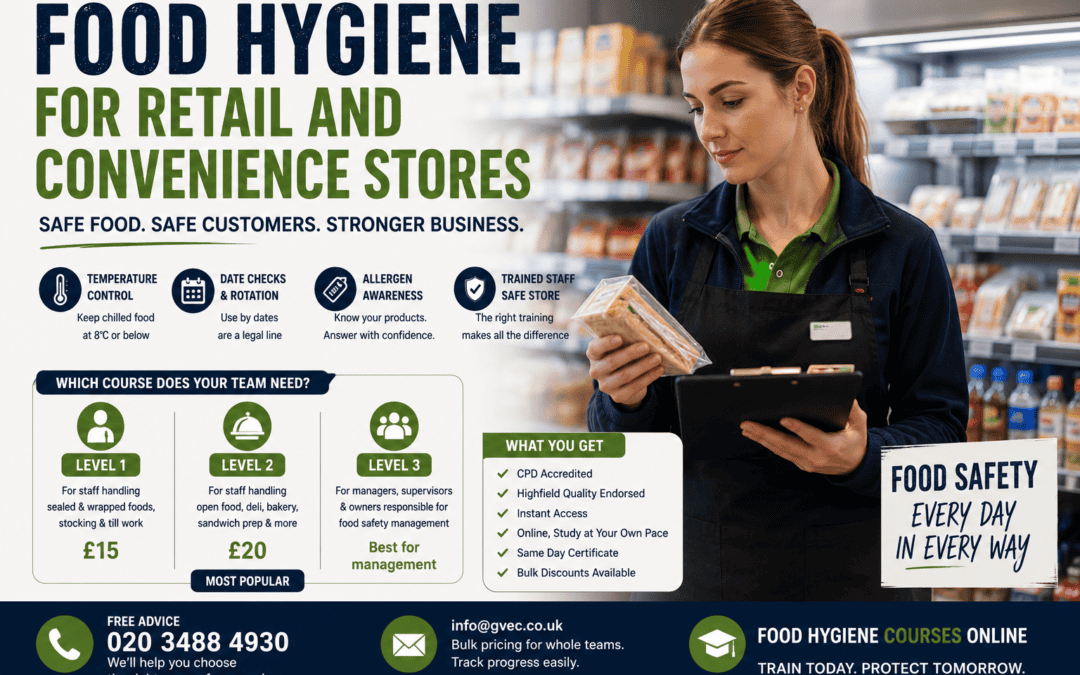
Staff handling only sealed and wrapped food, stocking shelves and working the till can start with Level 1 Food Safety. It costs £15 and covers the basics properly.
Anyone handling open food, working a deli or bakery counter, or preparing food on site needs Level 2. Our Level 2 Food Hygiene and Safety course is CPD accredited, Highfield quality endorsed, and covers retail settings alongside catering. It costs £20 and takes most people under two hours.
In practice, many store owners simply put everyone on Level 2. It removes the guesswork, it looks better on inspection, and at £20 a head it is not a difficult decision. If you want the full breakdown of what Level 2 involves, read our complete guide to the Level 2 certificate.
If you manage the store, go a level higher
Whoever is responsible for the food safety management system needs more than Level 2.
Level 3 covers building procedures, monitoring them, training staff and keeping the documentation that proves it all happened. For a store manager or owner, that is the difference between a system that survives an inspection and one that falls apart under questions.
Paperwork that props up your rating
Your food safety management system needs to be written down. The FSA publishes a free Safer Food, Better Business pack for retailers aimed specifically at convenience stores and corner shops.
Alongside it, keep temperature records, cleaning schedules, delivery checks and a training file with every certificate and date. Inspectors score confidence in management as a third of your rating, and that folder is most of the evidence.
Not sure which level your staff needs? Ring us; it is free
Shops vary enormously. A newsagent with a chilled cabinet is not the same as a store with a deli, a bakery and hot food to go.
Tell us what you sell and who does what, and we will tell you which course each person needs. If half your team only needs Level 1, we will say that rather than sell you eight Level 2 courses.
Call our landline on 02034884930 for free advice, or email info@gvec.co.uk. Bulk pricing is available for whole teams, with tracking so you can see who has completed what.
Questions shop owners send us
Do I need a certificate to sell only prepacked food?
Not strictly, but staff still need instruction appropriate to their role. A Level 1 certificate is the tidiest way to evidence it.
Are online retail food hygiene certificates accepted?
Yes, provided the course is properly accredited. Ours are CPD accredited and issued the same day you pass.
How often should shop staff retrain?
Every three years is the accepted standard. Sooner if your product range or procedures change.
Does a franchise head office cover this for me?
Sometimes, though the legal duty sits with the operator of the premises. Check what is actually provided rather than assuming.
A sensible plan for this month
Work out who touches open food and put them on Level 2. Put everyone else on Level 1. Put yourself or your manager on Level 3.
Then start writing down your fridge temperatures twice a day. That single habit fixes more inspection findings than anything else on this page.
See all our food hygiene courses online, or call 02034884930 and we will match the right course to your shop.