
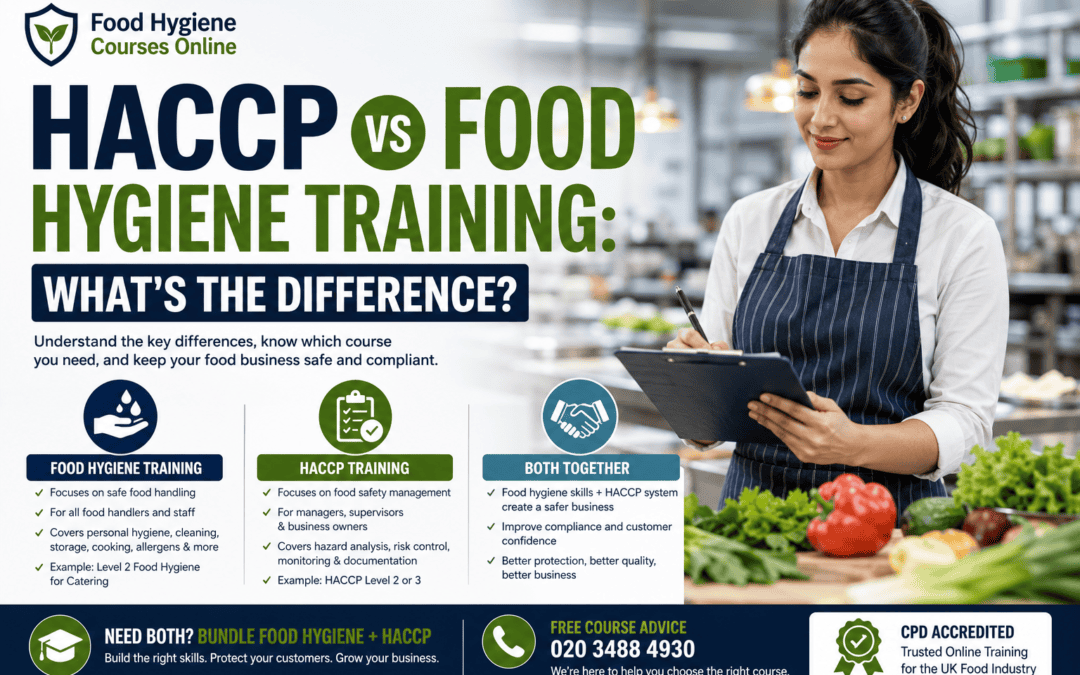
HACCP vs Food Hygiene Training: What’s the Difference?
“I’ve already got my Food Hygiene Certificate, so I don’t need HACCP training… do I?”
The manager of a busy takeaway looked genuinely puzzled. His staff had recently completed their Level 2 Food Hygiene training, and he assumed that covered everything needed to keep the business compliant.
A week later, during a discussion about updating the kitchen’s food safety procedures, someone mentioned HACCP. Suddenly, there were more questions than answers.
“Is HACCP another food hygiene course?”
“Do all staff need it?”
“Is it only for factories?”
“Which course should I take?”
If you’ve ever found yourself asking similar questions, you’re not alone.
Many people use the terms HACCP and food hygiene training interchangeably, but they are not the same thing. Although they are closely connected, they serve different purposes within a food business.
Understanding the difference is important whether you’re starting a café, managing a restaurant, running a takeaway, supervising a catering team or opening your first food business.
In this guide, we’ll explain the difference between HACCP vs food hygiene in plain English, helping you understand what each covers, who needs which training and why many businesses benefit from both.
Why Do People Get Confused?
It’s easy to understand why these two subjects are often mixed up.
Both focus on keeping food safe.
Both are regularly mentioned during Environmental Health inspections.
Both are important for complying with UK food safety requirements.
And both involve preventing foodborne illness.
Because they share the same goal, many business owners assume they’re simply different names for the same course.
They’re not.
Think of it like learning to drive and maintaining a car.
Learning to drive teaches you how to operate the vehicle safely.
Maintaining the car helps ensure it remains safe to use.
Both are essential, but they focus on different responsibilities.
The relationship between HACCP and food hygiene is very similar.
What Is Food Hygiene Training?
Food hygiene training teaches people how to handle food safely during everyday work.
It’s practical, straightforward and relevant to almost everyone who prepares, handles or serves food.
A typical food hygiene course covers subjects such as:
- Personal hygiene.
- Hand washing.
- Cleaning and sanitising.
- Preventing cross-contamination.
- Safe food storage.
- Temperature control.
- Cooking and reheating food safely.
- Food allergens.
- Pest awareness.
- Good housekeeping practices.
In other words, food hygiene training focuses on the actions staff take every day while preparing and serving food.
Whether someone is making sandwiches, cooking curries, baking cakes or serving meals in a care home, these practical skills help reduce the risk of food becoming unsafe.
For most food handlers in the UK, Level 2 Food Hygiene for Catering is the most commonly recommended course.
It provides the knowledge needed to work safely in cafés, restaurants, takeaways, bakeries, schools, care homes and many other food businesses.
What Is HACCP?
HACCP stands for Hazard Analysis and Critical Control Points.
Unlike food hygiene training, HACCP is not primarily about teaching people how to wash their hands or clean work surfaces.
Instead, it’s a structured food safety management system that helps businesses identify potential hazards before they become problems.
Rather than reacting after something goes wrong, HACCP encourages businesses to ask questions like:
- What could go wrong at this stage?
- What food safety hazards exist?
- How can we prevent them?
- How will we monitor the controls?
- What should we do if something isn’t working?
Instead of concentrating on individual tasks, HACCP looks at the entire food production process—from receiving deliveries to serving customers.
It helps businesses create procedures that reduce food safety risks before they occur.
That’s why HACCP plays such an important role in many food businesses, particularly those with more complex food preparation processes.
HACCP or Food Safety, Which Is More Important?
This is another question we hear regularly.
The honest answer is that it’s the wrong question.
Asking whether HACCP or food safety training is more important is a bit like asking whether brakes are more important than seatbelts.
They do different jobs.
Food hygiene training gives staff the practical knowledge to work safely every day.
HACCP provides the management system that identifies, controls and monitors food safety risks across the business.
One supports the people.
The other supports the system.
When combined, they create a much stronger food safety culture.
The Biggest Difference Between HACCP and Food Hygiene
If you only remember one thing from this article, remember this:
Food hygiene training teaches people how to work safely.
HACCP helps businesses manage food safety risks systematically.
Here’s a simple comparison.
| Food Hygiene Training | HACCP |
| Focuses on everyday safe food handling | Focuses on identifying and controlling food safety hazards |
| Designed mainly for food handlers | Often needed by supervisors, managers and business owners |
| Covers practical working practices | Covers food safety management procedures |
| Helps staff work safely | Helps businesses develop safe systems |
| Usually includes Level 1, 2 or 3 qualifications | Usually includes HACCP principles and food safety management |
Neither replaces the other.
In many businesses, they work hand in hand.
A Real-Life Example
Imagine you’re running a busy restaurant kitchen.
Your chefs know how to wash their hands properly, store raw meat safely, prevent cross-contamination, and check food temperatures.
That’s the result of good food hygiene training.
Now imagine introducing a new menu that includes vacuum-packed cooked meat prepared in advance.
Someone needs to assess the potential food safety hazards, identify critical control points, decide how temperatures will be monitored, and record the procedures.
That’s where HACCP comes in.
The staff still need their food hygiene knowledge.
The business also needs an effective HACCP system.
Together, they help protect customers and support legal compliance.
It’s Not About Choosing One or the Other
One of the biggest misconceptions is that businesses must choose between HACCP and food hygiene training.
They complement each other.
Food hygiene training provides the practical skills employees use every day.
HACCP provides the framework that helps managers organise, monitor and improve food safety procedures.
The strongest food businesses don’t rely on one alone; they understand how both fit together to create a safer working environment.
Who Needs Food Hygiene Training?
Almost everyone who works with food should receive appropriate food hygiene training. The level of training depends on their role and responsibilities.
For example:
- Kitchen assistants preparing salads or sandwiches need to understand safe food handling.
- Chefs need to know how to cook, cool, reheat and store food safely.
- Waiting staff should understand allergens, personal hygiene and preventing cross-contamination.
- Delivery staff transporting food need to know how to maintain food safety during transit.
- Business owners and managers should understand food hygiene to ensure safe working practices across the business.
For most cafés, restaurants, takeaways, bakeries and catering businesses, Level 2 Food Hygiene for Catering is the ideal starting point for food handlers.
It provides practical knowledge that employees can apply immediately during every shift.
Who Needs HACCP Training?
HACCP training is generally more relevant for people responsible for managing food safety systems rather than simply following them.
This often includes:
- Restaurant owners
- Café owners
- Food business operators
- Kitchen managers
- Head chefs
- Catering managers
- Food production supervisors
- Quality assurance staff
- Anyone responsible for developing or reviewing food safety procedures
If you’re responsible for deciding how food safety risks are controlled, HACCP training can help you understand how to identify hazards, establish controls and monitor them effectively.
For many small businesses, managers benefit from HACCP training while food handlers complete an appropriate Food Hygiene course.
Which Course Should You Choose?
One of the questions we’re asked most often is:
“Which course do I actually need?”
The answer depends on your role.
If you’re a food handler…
You mainly need practical knowledge about preparing and serving food safely.
A Level 2 Food Hygiene for Catering course is usually the most appropriate option.
If you’re a supervisor or manager…
You may need food hygiene knowledge and a good understanding of HACCP principles to help manage your food safety procedures.
Many managers choose to complete both.
If you’re opening a new food business…
Starting with food hygiene training gives you a solid foundation.
As your business develops, learning HACCP helps you understand how to build and maintain an effective food safety management system.
If you own the business…
Understanding both subjects puts you in a much stronger position.
You’ll be able to support your staff, review procedures confidently and improve food safety across the business.
Common Myths About HACCP and Food Hygiene
There are plenty of misconceptions surrounding food safety training. Let’s clear up a few of the most common ones.
Myth 1: HACCP is only for food factories
Not true.
While HACCP originated in food manufacturing, its principles are used across many sectors, including restaurants, cafés, catering businesses and takeaways.
Myth 2: Food Hygiene training includes everything about HACCP
Food Hygiene training introduces important food safety concepts, but it does not replace dedicated HACCP training.
The two courses have different objectives and complement one another.
Myth 3: Small businesses don’t need HACCP
Every food business should have suitable food safety management procedures based on HACCP principles.
For many smaller businesses, the Safer Food, Better Business (SFBB) pack provides a practical way to implement those principles.
Myth 4: Once you’ve completed a course, you’re finished
Food safety isn’t something you learn once and forget.
Menus change.
Equipment changes.
Legislation evolves.
New staff join your business.
Regular refresher training helps ensure knowledge stays current and food safety standards remain high.
Why Many Businesses Choose Both
Think about your own workplace.
Your team may be excellent at washing hands correctly, checking temperatures and preventing cross-contamination.
That’s exactly what good Food Hygiene training supports.
At the same time, someone needs to review food safety risks, update procedures when menus change, investigate problems and ensure the business has an effective management system.
That’s where HACCP knowledge becomes invaluable.
Rather than replacing each other, the two forms of training work together.
One develops confident food handlers.
The other supports confident food safety management.
For many successful food businesses, combining both creates a stronger food safety culture and helps everyone understand their responsibilities.
Frequently Asked Questions
Is HACCP the same as Food Hygiene training?
No.
Food Hygiene training focuses on safe day-to-day food handling, while HACCP focuses on identifying, controlling and monitoring food safety hazards within a business.
Can I complete both courses online?
Yes.
Many recognised providers offer online Food Hygiene and HACCP training, allowing you to study at your own pace.
Which course should I take first?
If you’re new to the food industry or work as a food handler, Level 2 Food Hygiene is usually the best place to start.
If you’re managing food safety systems or supervising staff, HACCP training is an excellent next step.
Do managers need both?
In many cases, yes.
Managers often benefit from understanding practical food hygiene as well as the principles behind effective food safety management.
Continue Your Food Safety Journey
If you’d like to build your knowledge further, these courses are a great next step:
HACCP Course
Learn how HACCP principles help businesses identify and control food safety hazards through a practical, easy-to-follow course.
https://www.foodhygienecoursesonline.co.uk/product/food-safety-level-3/
Level 2 Food Hygiene for Catering
Ideal for chefs, kitchen assistants, café staff, restaurant employees, takeaways and catering businesses handling food every day.
https://www.foodhygienecoursesonline.co.uk/product/food-hygiene-safety-level-2/
Recommended External Resources
For trusted guidance and the latest food safety information, visit:
Food Standards Agency (FSA)
Food Safety and Hygiene Legislation (UK Government)
https://www.legislation.gov.uk/
Conclusion:
The debate around HACCP vs food hygiene isn’t really about deciding which one is better.
It’s about understanding that each serves a different purpose.
Food Hygiene training equips people with the practical skills needed to handle food safely every day.
HACCP provides the structured approach that helps businesses identify hazards, manage risks and maintain effective food safety systems.
Together, they create a safer workplace, protect customers and help businesses meet their food safety responsibilities with confidence.
At Food Hygiene Courses Online, we make learning straightforward, practical and relevant for today’s food businesses.
Our online courses are CPD Accredited, easy to follow and designed for everyone—from first-time food handlers to experienced managers and business owners.
If you’re unsure which course is right for you or your team, we’re happy to help.
Why Choose Food Hygiene Courses Online?
- CPD Accredited online training
- Learn at your own pace
- Suitable for individuals and businesses across the UK
- Instant course access
- Friendly UK-based support
- FREE advice on choosing the right course
- Practical training written in clear UK English
Website
https://www.foodhygienecoursesonline.co.uk/
📞 Free Course Advice
020 3488 4930
Need both? Bundle Food Hygiene + HACCP.
Not sure where to start? Call us today for free advice, and we’ll help you choose the right combination of courses for your role, whether you’re a food handler, supervisor, manager or food business owner.