
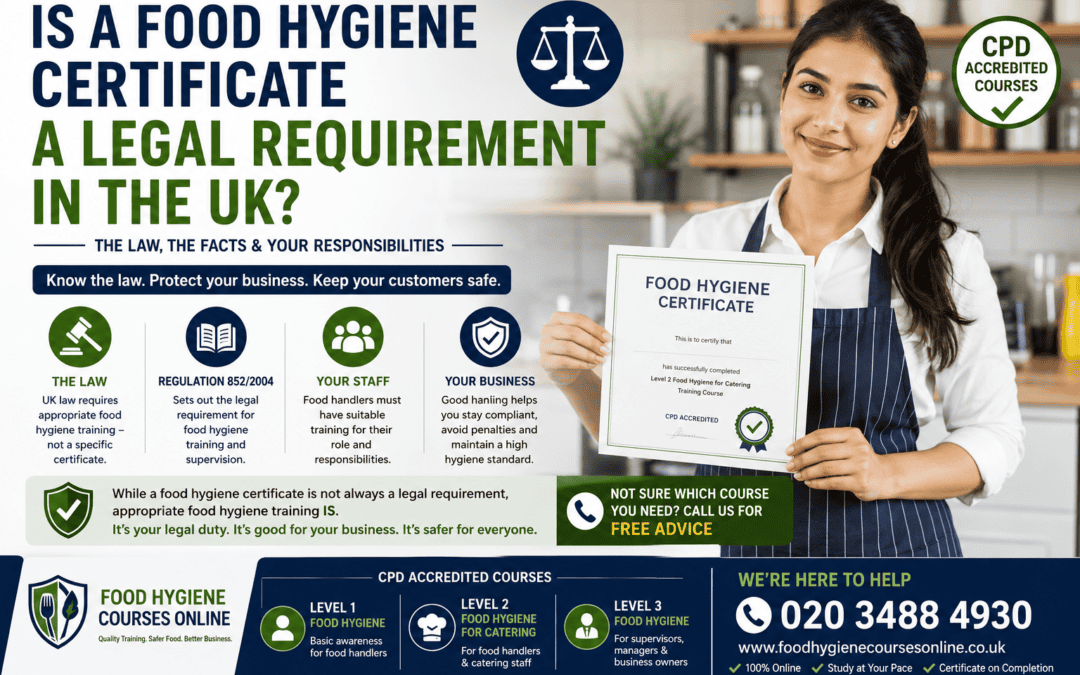
Is a Food Hygiene Certificate a Legal Requirement in the UK?
If you are planning to work in catering, open a café, start a home bakery or employ staff in a food business, one of the first questions you may ask is:
“Is a food hygiene certificate a legal requirement in the UK?”
It is a sensible question because there is a lot of conflicting information online. Some websites suggest that every food handler must hold a food hygiene certificate by law, while others claim that certificates are optional.
The truth is slightly more nuanced.
In most cases, UK law does not specifically state that every food handler must possess a food hygiene certificate. Instead, food businesses are legally responsible for ensuring that anyone who handles food receives appropriate food hygiene training, supervision and instruction for the work they carry out.
In practice, this means that completing a recognised food hygiene course is one of the easiest and most effective ways to demonstrate that staff have received suitable training.
At Food Hygiene Courses Online (https://www.foodhygienecoursesonline.co.uk/), we provide CPD-accredited online food hygiene courses for food handlers, supervisors and food business owners throughout the UK.
If you are unsure which course is suitable for your role, our friendly team offers free course selection advice before you enrol.
What Does UK Law Actually Say?
One of the biggest misconceptions is that the law requires every person working with food to hold a specific certificate.
In reality, UK food hygiene legislation focuses on knowledge and competence, rather than a particular certificate.
Food businesses must ensure that food handlers are properly trained for the work they perform.
This requirement comes from retained UK food hygiene legislation, including provisions that originated from Regulation (EC) No. 852/2004 on the Hygiene of Foodstuffs, together with guidance published by the Food Standards Agency (FSA).
The emphasis is on ensuring staff understand how to handle food safely and protect public health.
A certificate is not a legal requirement in itself; it is commonly used as evidence that appropriate training has been completed.
Food Standards Agency (FSA)
What Is Regulation (EC) No. 852/2004?
You may have seen Regulation 852/2004 mentioned when researching food hygiene laws.
Although the UK has left the European Union, many food hygiene rules originating from this regulation continue to apply through retained UK legislation.
The regulation requires food businesses to ensure that food handlers are:
- Supervised appropriately.
- Given suitable food hygiene instruction.
- Trained in food hygiene matters relevant to their job.
The level of training should always match the individual’s responsibilities.
For example, someone preparing meals in a restaurant kitchen will require more detailed food hygiene knowledge than someone who simply serves packaged snacks.
This is why choosing the correct level of training is so important.
Does Every Food Handler Need Training?
Yes.
Anyone who handles food as part of their work should receive training that is appropriate for their role.
Food handlers include people working in:
- Restaurants
- Cafés
- Hotels
- Takeaways
- Bakeries
- Supermarkets
- Delicatessens
- Care homes
- Schools
- Nurseries
- Home food businesses
- Mobile catering units
- Market stalls
Whether you prepare food, cook meals, package products or serve customers, understanding safe food handling practices is essential.
Training helps reduce the risk of food poisoning, cross-contamination and allergen-related incidents.
What Is Considered Appropriate Food Hygiene Training?
Appropriate training depends on what you actually do at work.
For example, someone who only handles wrapped food may need a different level of training from someone preparing raw meat or managing a commercial kitchen.
Food hygiene courses are commonly divided into three levels.
Level 1 Food Hygiene
Level 1 provides basic food safety awareness.
It is suitable for people with limited food handling responsibilities, including:
- Front-of-house staff.
- Volunteers
- Delivery staff
- New employees require basic awareness.
Level 2 Food Hygiene for Catering
Level 2 is the most widely recognised course for food handlers.
It is suitable for:
- Chefs
- Kitchen assistants
- Catering staff
- Restaurant workers
- Café employees
- Takeaway staff
- Bakery workers
- Home food businesses
Most people working directly with food will benefit from Level 2 Food Hygiene training.
Explore our Level 2 Food Hygiene Course for Catering:
https://www.foodhygienecoursesonline.co.uk/product/food-hygiene-safety-level-2/
Level 3 Food Hygiene
Level 3 is designed for supervisors, managers, and business owners responsible for overseeing food safety systems and supervising staff.
Choosing the correct level helps ensure your training matches your workplace responsibilities.
Why Do Employers Ask for a Food Hygiene Certificate?
If the law does not specifically require every food handler to hold a certificate, why do so many employers ask for one?
There are several practical reasons.
A food hygiene certificate provides evidence that you have completed recognised food safety training.
For employers, certificates help demonstrate that staff have received appropriate instruction.
This can support staff training records, recruitment processes and internal compliance procedures.
It also gives employers confidence that new employees understand important food safety principles before they begin handling food.
Many businesses include food hygiene certificates as part of their standard induction process.
What Might an Environmental Health Officer (EHO) Look For?
Environmental Health Officers are primarily interested in whether food businesses operate safely.
During an inspection, they may consider:
- Staff food safety knowledge
- Personal hygiene practices
- Cleaning procedures
- Temperature control
- Cross-contamination prevention
- Food safety management systems
- Staff training records
A certificate alone is not enough.
Staff should also be able to demonstrate that they understand and apply good food hygiene practices in their day-to-day work.
Keeping training up to date helps businesses demonstrate a positive approach to food safety.
Why Choose CPD Accredited Food Hygiene Training?
When selecting a food hygiene course, it is sensible to choose a trusted training provider.
At Food Hygiene Courses Online, all of our food hygiene courses are CPD Accredited, giving learners confidence that the training supports recognised Continuing Professional Development standards.
Our online courses are designed to be flexible, practical and suitable for busy learners.
Benefits include:
- Study anywhere in the UK
- Learn at your own pace.
- Instant course access
- Certificate after successful completion
- Suitable for individuals and businesses
- Free course selection advice
Whether you are beginning your career in catering or managing an established food business, we can help you choose the most appropriate training.
Do Home Food Businesses Need a Food Hygiene Certificate?
If you’re starting a home bakery, cake business, catering service or any other home-based food business, you may wonder whether the rules are different.
The legal responsibilities are broadly the same whether you operate from commercial premises or your own kitchen. If you are preparing, storing or selling food to the public, you are responsible for ensuring that food is safe.
Although the law does not specifically require every home food business owner to hold a food hygiene certificate, you must have appropriate food safety knowledge for the activities you carry out.
Completing a recognised food hygiene course is one of the simplest ways to demonstrate that you understand your responsibilities and are committed to producing safe food.
Many local authorities also expect food business operators to understand food safety management, cleaning procedures, allergen controls and temperature management before trading.
Can a Business Be Penalised for Inadequate Food Hygiene Training?
Yes.
Food businesses have a legal duty to ensure employees receive appropriate food hygiene instruction, supervision and training.
If staff do not understand safe food handling practices, this may increase the risk of:
- Food contamination
- Food poisoning outbreaks
- Cross-contamination
- Allergen incidents
- Poor hygiene standards
Where poor food safety management contributes to breaches of food hygiene legislation, enforcement action may be taken by the relevant authority.
Training alone will not guarantee compliance, but it forms an important part of a business’s overall food safety management system.
For this reason, many employers include food hygiene training as part of every employee’s induction and ongoing professional development.
How Does Food Hygiene Training Support a Good Food Hygiene Rating?
Consumers increasingly pay attention to Food Hygiene Ratings before choosing where to eat or buy food.
A well-trained team is more likely to follow safe food handling procedures consistently, helping businesses maintain high standards during inspections.
Environmental Health Officers assess a range of factors during inspections, including:
- Hygienic food handling
- Cleanliness and condition of the premises
- Food safety management procedures
Staff training is one element that supports these wider food safety systems.
Businesses should also ensure that training is refreshed whenever necessary so that employees remain confident and up to date.
Why Is Ongoing Food Hygiene Training Important?
Food safety is not static.
Guidance, workplace procedures, and business operations can change over time.
Regular refresher training helps food handlers:
- Refresh their knowledge.
- Understand updated best practices.
- Maintain confidence.
- Reduce the likelihood of mistakes.
- Demonstrate continuing competence.
Many employers recommend refreshing food hygiene training approximately every three years, even though there is generally no fixed legal expiry date for a certificate.
Keeping knowledge current benefits both employees and customers.
How Can Employers Demonstrate Compliance?
Employers should maintain clear records showing that staff have received suitable food hygiene training.
Good practice includes keeping copies of:
- Food hygiene certificates
- Training dates
- Refresher training records
- Internal training sessions
- Staff induction records
These records can help demonstrate that the business takes food safety seriously and invests in staff development.
Choosing the Right Food Hygiene Course
Choosing the correct course depends on your responsibilities.
Level 1 Food Hygiene
Suitable for people with limited food handling duties or those requiring basic food safety awareness.
Level 2 Food Hygiene for Catering
Suitable for most food handlers working in:
- Restaurants
- Cafés
- Hotels
- Takeaways
- Catering businesses
- Bakeries
- Home food businesses
This is the most popular course for individuals who prepare, cook, handle or serve food.
Explore our Level 2 Food Hygiene Course for Catering:
https://www.foodhygienecoursesonline.co.uk/product/food-hygiene-safety-level-2/
Level 3 Food Hygiene
Designed for supervisors, managers, and business owners responsible for implementing and monitoring food safety procedures.
Choosing the correct course helps ensure your training reflects your role and responsibilities.
Learn More About Food Hygiene Training
If you’re still deciding which course is right for you or your team, visit our Food Hygiene Training Hub, where you’ll find information about our complete range of online food hygiene courses.
Food Hygiene Training Hub:
https://www.foodhygienecoursesonline.co.uk/food-hygiene/
Whether you’re an individual learner or a business training multiple employees, we can help you select the most suitable course.
Where Can You Find Official Guidance?
It’s always a good idea to rely on trusted sources when researching food safety law.
The following organisations provide reliable information for food businesses operating in the UK.
Food Standards Agency (FSA)
UK Government – Food Safety for Businesses
https://www.gov.uk/food-safety-your-responsibilities
These resources explain legal responsibilities, food hygiene guidance and food business obligations.
Why Choose Food Hygiene Courses Online?
At Food Hygiene Courses Online, we understand that choosing the right course can sometimes feel confusing.
That’s why we focus on providing practical, easy-to-understand training for learners across the UK.
When you choose us, you’ll benefit from:
✓ CPD Accredited Food Hygiene Courses
✓ 100% Online Learning
✓ Study at Your Own Pace
✓ Suitable for Individuals and Businesses
✓ Instant Course Access
✓ Certificate on Successful Completion
✓ Affordable Training Options
✓ Friendly UK-Based Support
✓ Free Course Selection Advice
Whether you’re taking your first food hygiene course or arranging training for an entire team, we’re here to help.
Frequently Asked Questions
Is a food hygiene certificate legally required in the UK?
A specific food hygiene certificate is not generally required by law. However, food businesses must ensure that food handlers receive appropriate food hygiene training, supervision, and instruction for their role.
Do all food handlers need food hygiene training?
Yes. Anyone who prepares, handles, stores or serves food should receive training appropriate to their responsibilities.
Is Level 2 Food Hygiene enough?
For most food handlers, Level 2 Food Hygiene for Catering is the most suitable course.
Do managers need additional training?
Managers and supervisors often benefit from Level 3 Food Hygiene, as they are responsible for overseeing food safety procedures and supervising staff.
Can I complete food hygiene training online?
Yes. Online food hygiene training provides a flexible way to gain food safety knowledge and complete recognised training from home or work.
Meet Your Legal Duty – Train Your Staff with Confidence
Understanding your legal responsibilities is an important part of running a successful food business.
Although UK law does not require every food handler to hold a specific food hygiene certificate, it does require food businesses to ensure staff receive appropriate food hygiene training.
At Food Hygiene Courses Online, we provide CPD-accredited online food hygiene courses designed to help individuals and businesses meet these responsibilities with confidence.
Whether you’re looking for Level 1, Level 2 Food Hygiene for Catering, or Level 3 Food Hygiene, our experienced team can help you choose the right course.
🌐 Website:
https://www.foodhygienecoursesonline.co.uk/
📞 Free Course Advice:
020 3488 4930
Not sure which course is right for you or your staff?
Call our friendly team today for FREE advice, and we’ll recommend the most suitable training based on your role, business, and legal responsibilities.
Meet your legal duty – train your staff with confidence today.