
What Is HACCP? The 7 Principles Explained for UK Food Businesses
“Can you show me how you know your food is safe?”
Imagine you’re halfway through a busy Friday lunch service. The orders are flying into the kitchen, your chefs are working at full speed, deliveries are arriving at the back door, and your team barely has time to stop for a cup of tea.
Then someone walks through the door, introduces themselves as an Environmental Health Officer (EHO) and asks a simple question.
“Can you explain how you manage food safety in your business?”
Many business owners immediately think about cleaning schedules, food hygiene certificates or their latest inspection rating. Those things are all important, but they’re only part of the bigger picture.
What an inspector really wants to know is whether your business has a reliable system for identifying food safety risks before they become problems.
That’s where HACCP comes in.
Whether you run a neighbourhood café, a busy takeaway, a catering company, a school kitchen or a food manufacturing business, HACCP helps you move away from reacting to problems and towards preventing them altogether.
It isn’t about creating endless paperwork or making life more difficult. In fact, when HACCP is understood properly, it often makes running a food business simpler, safer and more organised.
In this guide, we’ll explain what HACCP is, break down the seven HACCP principles in plain English and show how they can help protect your customers, your reputation and your business.
So, What Exactly Is HACCP?
HACCP stands for Hazard Analysis and Critical Control Points.
At first glance, it sounds like one of those complicated technical phrases that only food scientists or large manufacturers need to understand. In reality, the idea behind HACCP is surprisingly simple.
Instead of waiting for something to go wrong, HACCP encourages businesses to ask a series of practical questions:
- What could go wrong?
- Where could it happen?
- How can we stop it?
- How do we know our controls are working?
- What should we do if something isn’t right?
Think of it like planning a long car journey.
Before setting off, most people check the fuel, tyres, weather and route. They don’t wait until they’re stranded on the motorway before thinking about those things.
Food safety works in much the same way.
HACCP encourages businesses to identify potential risks before they affect customers.
That’s why HACCP is recognised around the world as one of the most effective approaches to food safety management.
Why Was HACCP Created?
Interestingly, HACCP didn’t begin in restaurants or supermarkets.
The system was originally developed in the 1960s for the American space programme. NASA needed absolute confidence that astronauts’ food would be safe because even a minor foodborne illness could have had serious consequences during a space mission.
Scientists worked with food safety experts to develop a system that focused on prevention rather than detection.
The idea proved so successful that it was later adopted across the food industry and is now recognised internationally as best practice.
Today, HACCP forms the foundation of modern food safety management and influences food hygiene requirements throughout the UK.
Whether you’re preparing sandwiches in a café or producing ready meals in a factory, the same basic principles apply.
HACCP Isn’t Just for Big Food Factories
One of the biggest misconceptions about HACCP is that it’s only relevant to large manufacturers with hundreds of employees.
That simply isn’t true.
Every food business faces risks.
A takeaway needs to control cooking temperatures.
A bakery needs to prevent allergen cross-contamination.
A coffee shop preparing sandwiches must keep chilled ingredients at safe temperatures.
A care home kitchen must protect vulnerable residents from foodborne illness.
The scale of the business may be different, but the need to identify and control hazards remains exactly the same.
This is why HACCP is relevant to:
- Restaurants
- Cafés
- Takeaways
- Hotels
- Caterers
- Food manufacturers
- School kitchens
- Nurseries
- Care homes
- Mobile food businesses
- Home-based food businesses
The system should always be proportionate to the type of food you prepare and the level of risk involved.
The Seven Principles of HACCP
Although HACCP may seem technical, it’s built around seven logical principles that work together.
Think of them as seven questions every food business should be able to answer.
We’ll explore each one in detail, but let’s start with the first two.
Principle 1: Identify the Hazards
Every food business has hazards.
The important question isn’t whether hazards exist—it’s whether you’ve identified them before they cause harm.
A hazard is anything that could make food unsafe.
These hazards generally fall into three categories:
Biological hazards
These include harmful bacteria, viruses, moulds and parasites such as:
- Salmonella
- E. coli
- Listeria
- Campylobacter
For example, storing raw chicken above ready-to-eat food in a fridge could allow harmful bacteria to contaminate food that won’t be cooked again.
Chemical hazards
Chemical hazards might include:
- Cleaning chemicals
- Pest control products
- Food allergens
- Incorrect food additives
Imagine a spray bottle of sanitiser accidentally being stored next to cooking oil. Without proper controls, mistakes can happen.
Physical hazards
These are foreign objects that could accidentally end up in food, including:
- Broken glass
- Pieces of plastic
- Metal fragments
- Jewellery.
- Packaging materials
The first HACCP principle asks businesses to identify every realistic hazard before deciding how it should be controlled.
Principle 2: Identify the Critical Control Points (CCPs)
Once you’ve identified the hazards, the next step is deciding where they can be controlled.
These points are known as Critical Control Points, often shortened to CCPs.
A CCP is a stage in your process where losing control could result in unsafe food.
For a restaurant, examples might include:
- Cooking chicken thoroughly.
- Chilling cooked food quickly.
- Keeping refrigerated food below safe temperatures.
- Preventing allergen cross-contamination.
- Reheating food correctly before serving.
Think of a CCP as a safety checkpoint.
If that checkpoint fails, the risk to customers increases significantly.
Understanding where these critical points exist allows businesses to focus their attention where it matters most instead of trying to monitor everything equally.
And that’s one of the biggest strengths of HACCP—it helps you work smarter, not simply harder.
Principle 3: Set Critical Limits
Imagine you’re grilling chicken during a busy Saturday evening service.
You know it needs to be cooked properly—but what does “properly cooked” actually mean?
“It’s piping hot” isn’t enough.
“Looks cooked” isn’t enough either.
This is where critical limits come in.
A critical limit is a measurable value that tells you whether food is safe.
For example, a critical limit could be:
- A minimum cooking temperature.
- A maximum refrigeration temperature.
- A specific cooling time.
- A required pH level in food production.
- A safe concentration for disinfectant solutions.
Instead of relying on guesswork, HACCP encourages businesses to use objective measurements wherever possible.
Think of it as replacing opinion with evidence.
For many catering businesses, temperature control becomes one of the most important critical limits.
A calibrated food probe, regular monitoring and trained staff all help ensure these limits are met consistently.
Principle 4: Monitor Your Critical Control Points
Having critical limits is only useful if someone actually checks them.
Monitoring is the process of making sure your Critical Control Points remain under control throughout the day.
Let’s imagine a café opens at 7:00 am.
Before customers arrive, a member of staff checks the display fridge.
Instead of simply looking to see if it feels cold, they record the temperature using a calibrated thermometer.
Later in the day, another member of staff repeats the check.
If the temperature begins to rise unexpectedly, the problem can be identified before food becomes unsafe.
That’s the real purpose of monitoring.
It’s not about completing paperwork.
It’s about spotting problems early enough to prevent unsafe food reaching customers.
Depending on your business, monitoring might include:
- Recording fridge and freezer temperatures.
- Checking cooking temperatures.
- Monitoring hot holding equipment.
- Inspecting cleaning standards.
- Confirming allergen controls are being followed.
- Checking food deliveries.
Consistent monitoring helps businesses demonstrate that food safety is managed proactively rather than reactively.
Principle 5: Decide What Happens When Something Goes Wrong
Even the best-run kitchens experience problems.
A refrigerator might stop working overnight.
A delivery may arrive above the recommended temperature.
A chef could accidentally use the wrong ingredient.
HACCP accepts that mistakes and equipment failures can happen.
What’s important is knowing exactly what to do next.
These planned responses are known as corrective actions.
For example:
If cooked chicken hasn’t reached the required temperature, the corrective action may simply be to continue cooking until it does.
If chilled food has been stored above a safe temperature for too long, the safest decision may be to dispose of it.
If an allergen has accidentally contaminated a prepared meal, that food should never be served to a customer.
Planning corrective actions in advance allows staff to respond quickly and consistently rather than making rushed decisions under pressure.
Principle 6: Check That Your HACCP System Actually Works
One of the most overlooked parts of HACCP is verification.
Many businesses assume that because they’ve completed a few temperature records, everything must be working perfectly.
Good food safety management goes a step further.
It asks:
“Is our system genuinely doing what we expect it to do?”
Verification might include:
- Reviewing temperature records.
- Observing staff practices.
- Checking cleaning standards.
- Auditing food safety procedures.
- Calibrating temperature probes.
- Reviewing customer complaints.
- Analysing inspection findings.
Think of verification as giving your food safety system its own health check.
It’s an opportunity to identify weaknesses before they become serious problems.
Many successful food businesses schedule regular internal reviews rather than waiting for an Environmental Health Officer to identify issues.
Principle 7: Keep Records
If someone asked you tomorrow to prove your business manages food safety properly, what evidence could you produce?
For many businesses, this is where HACCP becomes especially valuable.
Good record keeping demonstrates that food safety isn’t simply discussed—it is actively managed.
Depending on your business, records may include:
- Temperature logs.
- Cleaning schedules.
- Staff training certificates.
- Delivery records.
- Pest control reports.
- Equipment maintenance records.
- Corrective action reports.
- Internal audits.
- Food safety management documentation.
Some business owners worry that HACCP means endless paperwork.
In reality, good records should be practical, organised and proportionate to the size of the business.
The purpose isn’t to fill folders.
It’s to provide evidence that your procedures are working.
HACCP in Action, A Real-Life Example
Let’s leave the theory for a moment.
Imagine a busy takeaway preparing grilled chicken wraps.
The raw chicken is delivered in the morning and immediately placed in refrigerated storage.
Staff check and record the fridge temperature before the lunch rush begins.
When preparing the chicken, separate chopping boards and utensils are used to reduce the risk of cross-contamination.
The chicken is cooked to the required internal temperature and checked with a calibrated probe thermometer.
Once cooked, it is either served immediately or held safely at the correct temperature.
Throughout the day, staff wash their hands regularly, clean food preparation areas between tasks and follow allergen procedures when preparing customer orders.
At the end of the shift, cleaning schedules are completed, temperature records reviewed, and any problems documented.
Individually, these may seem like small tasks.
Together, they form a practical HACCP system.
The goal isn’t perfection, it’s consistency.
When everyone understands their role and follows the agreed procedures, food safety becomes part of the business’s everyday routine rather than an extra task to think about during inspections.
Why Training Makes HACCP Work
A beautifully written HACCP plan is of little value if nobody understands it.
Food safety management is only as effective as the people putting it into practice.
That’s why staff training is one of the most important investments a food business can make.
When employees understand why temperatures matter, why allergens must be managed carefully and why records are important, they’re far more likely to follow procedures consistently.
Managers and supervisors also play a vital role by setting standards, checking compliance and supporting their teams.
In many businesses, effective HACCP isn’t driven by paperwork.
It’s driven by knowledgeable people who understand how their everyday decisions protect customers.
HACCP, Food Law and Why It Matters
By now, you can probably see that HACCP isn’t simply a list of seven principles to memorise. It’s a practical way of thinking about food safety every single day.
One question we’re often asked is:
“Is HACCP actually a legal requirement?”
The answer is that UK food businesses are generally required to have food safety management procedures based on HACCP principles, where appropriate to the nature and size of their business. The exact approach will depend on the type of food operation you run, and many smaller businesses use recognised food safety management systems, such as the Food Standards Agency’s Safer Food, Better Business (SFBB) pack, to help meet these responsibilities.
The important point is this:
Whether you run a small sandwich shop or a large food manufacturing business, you should understand where food safety risks exist and have suitable procedures to control them.
HACCP provides the framework for doing exactly that.
The Most Common HACCP Mistakes
After years of supporting food businesses, certain mistakes appear again and again. The good news is that most of them are entirely avoidable.
Treating HACCP as paperwork
Some businesses spend hours completing forms without understanding why they are doing it.
HACCP should guide everyday decisions in the kitchen—not simply fill folders in an office.
Copying someone else’s HACCP plan
Every food business is different.
The hazards in a bakery are not the same as those in a takeaway, and neither are the same as a care home kitchen.
Your HACCP procedures should reflect your business.
Forgetting staff training
Even the best HACCP system won’t work if employees don’t understand it.
Training should never be viewed as a one-off event. New employees need induction, experienced staff need refresher training, and supervisors need a deeper understanding of food safety management.
Poor record keeping
Temperature checks, cleaning schedules and corrective actions only provide value if they are recorded accurately and consistently.
Clear records help identify recurring issues and provide evidence that food safety is actively managed.
Failing to review procedures.
Food businesses change.
Menus change.
Equipment changes.
Staff change.
Customer expectations change.
Your HACCP system should evolve too.
Reviewing your procedures regularly helps ensure they remain suitable for the way your business operates today—not the way it operated three years ago.
HACCP Myths You Should Ignore
There are plenty of misconceptions surrounding HACCP. Let’s clear up a few of the most common.
Myth: HACCP is only for food factories.
Reality: Restaurants, cafés, takeaways, caterers, schools, care homes and many other food businesses use HACCP-based procedures every day.
Myth: HACCP means endless paperwork.
Reality: Good HACCP is about managing risks effectively. Documentation should support your system, not become the system itself.
Myth: Once you’ve written a HACCP plan, you’re finished.
Reality: HACCP is an ongoing process that should be reviewed whenever your business, menu, equipment or procedures change.
Myth: Staff doesn’t need to understand HACCP.
Reality: Every member of the team contributes to food safety. The more your employees understand the reasons behind your procedures, the more consistently they are likely to follow them.
Preparing for an Environmental Health Inspection
One of the biggest benefits of HACCP is the confidence it gives you during an Environmental Health inspection.
Inspectors don’t expect perfection.
They expect businesses to understand their food safety risks and show that suitable controls are in place.
They may ask questions such as:
- How do you prevent cross-contamination?
- How do you know your refrigeration is operating correctly?
- What happens if cooked food doesn’t reach the required temperature?
- How are allergens managed?
- How are staff trained?
- Can you show your food safety records?
If your team understands HACCP principles and your records are organised, answering these questions becomes much easier.
Strengthen Your Food Safety Knowledge
Understanding HACCP is valuable for every food handler, but it becomes especially important for supervisors, managers and business owners responsible for overseeing food safety systems.
If you are responsible for implementing or monitoring HACCP procedures, structured training can help you apply the principles correctly and with confidence.
Learn more about our HACCP Training Course:
https://www.foodhygienecoursesonline.co.uk/
Managers and supervisors may also benefit from more advanced food safety training.
Explore our Level 3 Food Hygiene Course:
https://www.foodhygienecoursesonline.co.uk/product/food-safety-level-3/
Both courses are designed to help businesses improve food safety standards while supporting legal compliance.
Frequently Asked Questions
What does HACCP stand for?
HACCP stands for Hazard Analysis and Critical Control Points. It is a systematic approach to identifying, evaluating and controlling food safety hazards.
Is HACCP compulsory in the UK?
Food businesses are generally expected to have food safety management procedures based on HACCP principles, where appropriate to their activities. The exact requirements depend on the type of food business.
What are the seven HACCP principles?
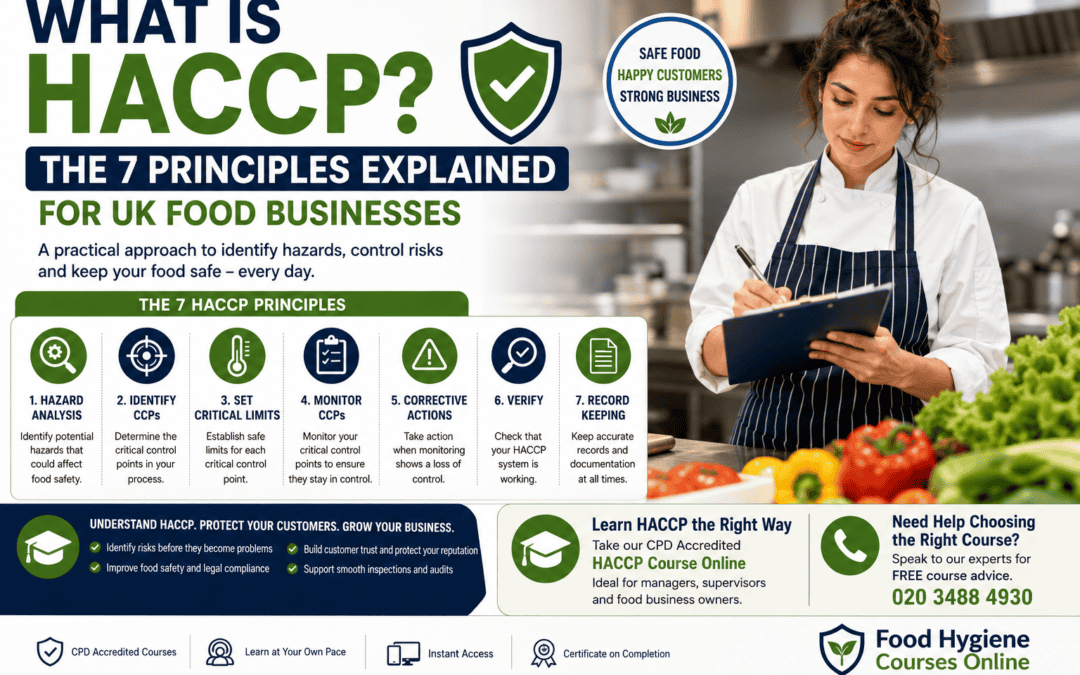
The seven principles are:
- Conduct a hazard analysis.
- Identify Critical Control Points (CCPs).
- Establish critical limits.
- Monitor Critical Control Points.
- Establish corrective actions.
- Verify that the system works.
- Keep appropriate records and documentation.
Is HACCP only for large businesses?
No. HACCP principles apply to businesses of all sizes, although the complexity of the system should reflect the nature and size of the operation.
Which course should I take to learn HACCP?
If you are responsible for implementing or supervising food safety systems, a dedicated HACCP course or Level 3 Food Hygiene course is often the most appropriate choice.
Official Sources of Information
For reliable guidance on HACCP and food safety management, visit:
Food Standards Agency (FSA)
Food Safety and Hygiene legislation
https://www.legislation.gov.uk/
These official sources provide up-to-date guidance on food safety responsibilities and UK food law.
Final Summary:
Great food businesses don’t rely on luck.
They rely on systems.
HACCP gives you a practical framework for identifying risks before they become problems, protecting your customers and improving the way your business operates.
Whether you’re serving breakfasts in a local café, preparing school meals, running a busy takeaway or managing a food production facility, the principles remain the same: understand the risks, control the hazards and keep improving.
At Food Hygiene Courses Online, we’re here to help you build that confidence.
We offer CPD Accredited online food safety training designed for food handlers, supervisors, managers and business owners throughout the UK.
If you’re unsure which course is right for you or your team, our experienced advisers are happy to help.
Why Choose Food Hygiene Courses Online?
- CPD Accredited online courses.
- Learn at your own pace.
- Suitable for individuals and businesses
- HACCP and Level 3 Food Hygiene training
- Instant access to course materials
- Friendly UK-based support
- FREE course selection advice
🌐 Website
https://www.foodhygienecoursesonline.co.uk/
📞 FREE Course Advice
020 3488 4930
Learn HACCP properly, take the online course.
Whether you’re starting a new food business, preparing for an Environmental Health inspection or looking to strengthen your existing food safety management system, we’re here to help you choose the right training with free, friendly advice.