
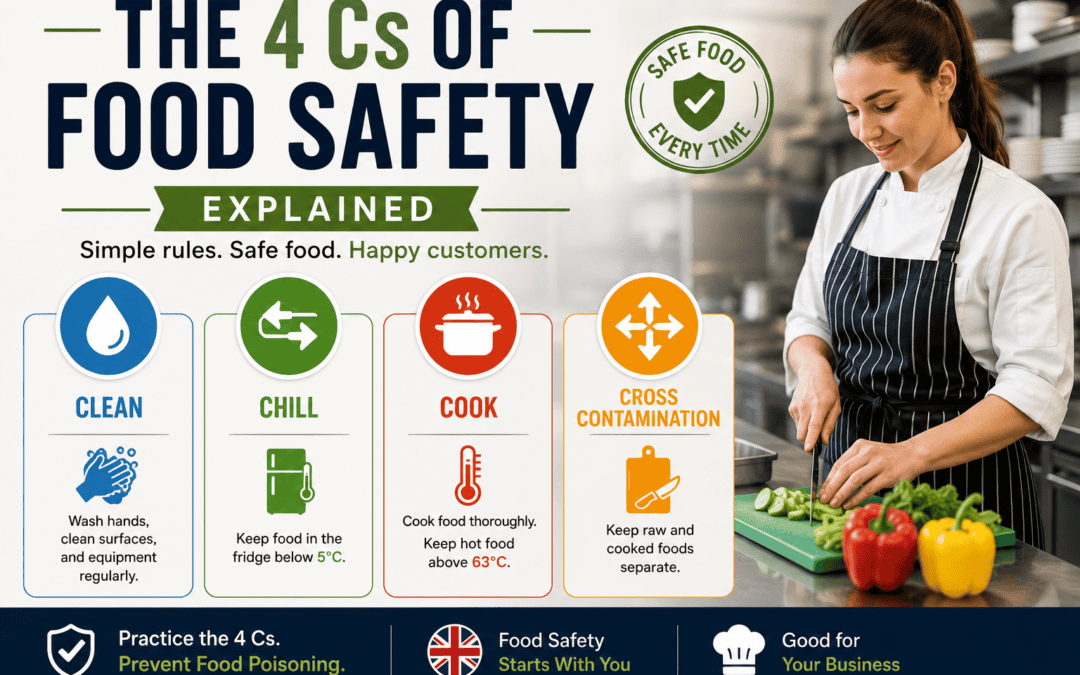
The 4 Cs of Food Safety: Cleaning, Cooking, Chilling and Cross-Contamination
Food safety feels like an enormous subject until somebody organises it for you. That is really all the 4 Cs do. Together, four headings cover almost every way food makes people ill in this country.
Cleaning, cooking, chilling and cross-contamination. Learn what sits under each one, and you have the working knowledge that a food hygiene course builds on.
So here is each of the four, with the actual numbers and the habits that make them stick.
Why these four, and not five or ten
The Food Standards Agency built its Safer Food, Better Business packs around the 4 Cs. That is why the framework turns up in kitchens all over Britain.
It is not marketing shorthand, though. Instead, it reflects a genuine attempt to make food safety memorable for busy people.
Most cases of foodborne illness trace back to a failure in one of the four. For example, someone did not wash something, did not cook something through, did not chill something quickly enough, or let raw food touch ready-to-eat food.
In short, fix those four, and you remove most of your risk.
Cleaning
Everybody thinks they clean properly. Meanwhile, inspectors find this the weakest of the four more often than any other.
First, understand the difference between cleaning and disinfecting. Cleaning removes visible dirt and grease. Disinfecting reduces bacteria to a safe level. A surface can look spotless while it still carries enough bacteria to make somebody ill, so food contact surfaces need both.
Next, use a sanitiser meeting BS EN 1276 or BS EN 13697, and watch the contact time. Most products need to sit wet on the surface for several minutes. Spraying and wiping straight away achieves very little, and it remains the most common cleaning error in professional kitchens.
Handwashing belongs here too. Warm water, soap, twenty seconds, then a proper dry. Alcohol gel supplements that, but it never replaces it, and it does almost nothing against norovirus.
Finally, there is the clean as you go principle. It sounds like advice for a home kitchen. In practice, though, it is the reason a busy service does not end in chaos. You change cloths, you wipe spills immediately, and the deep clean at the end stays manageable.
Cooking
Cooking kills bacteria, provided the heat reaches the middle of the food.
The UK working standard is a core temperature of 75°C, or an equivalent such as 70°C held for two minutes. Check it with a clean probe, in the thickest part, away from bone.
Some foods deserve particular care. Poultry, minced meat, burgers, sausages and rolled joints all need cooking right through, because mincing and rolling move surface bacteria into the middle. A whole steak behaves differently, since bacteria never reached the inside. That is exactly why a rare steak passes and a rare burger does not.
Reheating gets its own rule. Reheat to 75°C or above, and only once. Food that goes through a heat cycle twice accumulates risk quickly.
Also, do not overlook probe hygiene. Wipe and sanitise the probe between uses, or you turn a safety tool into a contamination route.
Chilling
Bacteria multiply fastest between 8°C and 63°C. That range is the danger zone, and chilling keeps food out of it.
In England, the law requires chilled high-risk food at 8°C or below. However, most kitchens target 5°C, because the door opens all day and the temperature drifts. Freezers should sit at around minus 18°C.
Cooling cooked food is where mistakes cluster. Chill it within roughly ninety minutes of cooking. Otherwise, a large pot of stock or bolognese sits in the danger zone for hours. Instead, split it into shallow trays, use an ice bath, or move it to a blast chiller.
Defrosting is the other trap. Always defrost in the fridge rather than on the counter, since the outside of a joint reaches room temperature long before the middle thaws.
Hot holding runs the other way. Keep hot food at 63°C or above until it reaches the customer.
Above all, record your temperatures twice a day and write them down. That single habit does more for your hygiene rating than almost anything else.
Cross contamination
This one causes the most serious illnesses, because it moves bacteria from raw food into food nobody will cook again.
- coli O157 explains why the guidance is so strict. It takes very few organisms to cause serious illness; it survives refrigeration and freezing, and you cannot see it or smell it. The GOV. UK E. coli cross-contamination guidance is the reference document, and following it also controls Salmonella and Campylobacter.
Separation is the core requirement. Keep separate work areas, separate equipment, and separate storage. Where you cannot separate fully, you can separate by time with thorough cleaning and disinfection in between. That route carries more risk, though, so you need to do it properly rather than casually.
Complex equipment is the strict part. Never use vacuum packers, slicers, or mincers for both raw and ready-to-eat food during a normal working day. Nobody can clean them reliably enough between uses.
In storage, raw meat always goes at the bottom of the fridge, so nothing drips onto anything below. Colour-coded boards help. So do colour-coded knives, tongs and cloths, which are the items people forget.
Allergens travel the same way; therefore, the same separation thinking applies.
Where the 4 Cs show up in real life
An officer inspecting your business essentially checks the 4 Cs, then checks whether you can prove you do them consistently. Our guide to what happens during an EHO inspection walks through how that visit unfolds.
The FSA’s Safer Food, Better Business pack follows the same four headings. So if you are building your food safety management system, you are effectively documenting how your business handles each C.
Learn the whole framework properly
The 4 Cs take a minute to state and rather longer to understand, which is what a course is for.
Level 2 Food Hygiene and Safety covers all four in depth, alongside allergens, personal hygiene, pest control and food safety law. The course carries CPD accreditation and Highfield quality endorsement, costs £20, and takes around four to five hours as a guide. Your licence lasts twelve months, and you receive the certificate the same day you pass.
If you handle only wrapped food, Level 1 Food Safety covers the essentials for £15 in around two to three hours.
Not sure which level fits? The advice is free
Two minutes on the phone usually settles it.
Tell us what you or your staff actually do with food, and we will tell you honestly whether Level 1 or Level 2 suits you. If you are training a team, we will quote bulk pricing with tracking so you can watch completions.
Call our landline on 02034884930 for free advice, or email info@gvec.co.uk.
Quick answers on the 4 Cs
What are the 4 Cs of food safety?
Cleaning, cooking, chilling and cross-contamination. Together they cover the main causes of foodborne illness.
What core temperature should you cook food to in the UK?
75°C, or an equivalent such as 70°C for two minutes.
What is the danger zone?
Between 8°C and 63°C, where bacteria multiply fastest.
How quickly should you cool cooked food?
Within about ninety minutes, then straight into the fridge.
Can I use one board for raw and cooked food if I wash it?
Separate boards are far safer. Above all, never share complex equipment such as slicers during a working day.
A bit worth remembering.
Clean properly rather than quickly. Cook to 75°C and check it. Then keep food out of the danger zone in both directions, and never let raw food meet ready-to-eat food.
Everything else in food safety hangs off those four.
Browse our food hygiene courses, or ring 02034884930, and we will point you to the right level.