
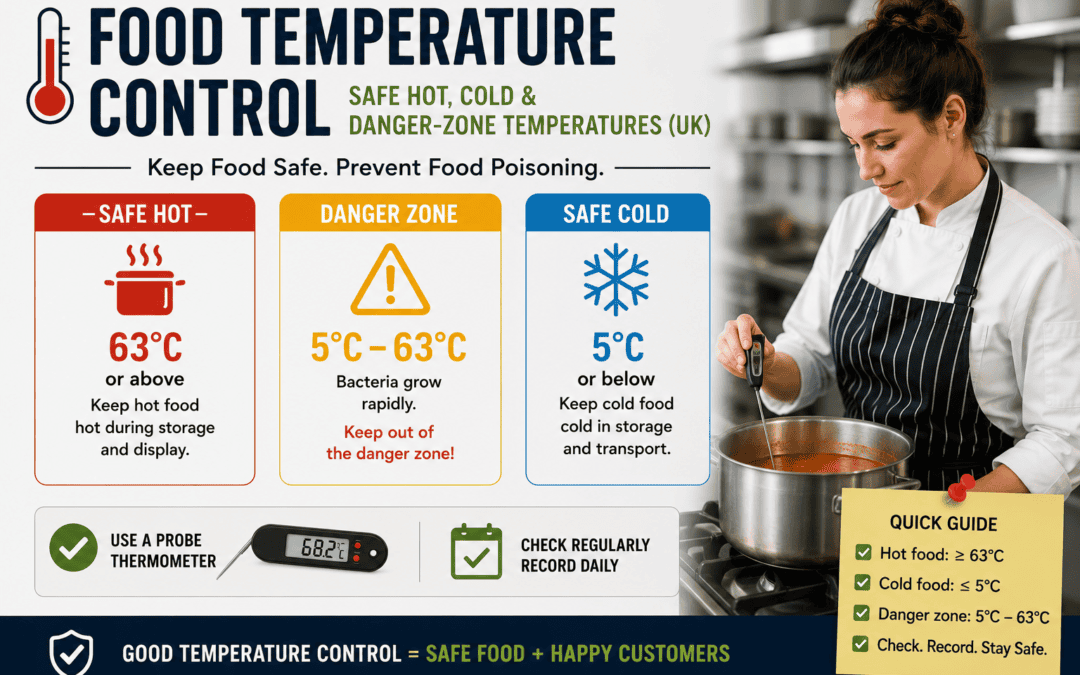
Food Temperature Control: Safe Hot, Cold and Danger-Zone Temperatures (UK)
Ask three chefs what temperature a fridge should run at, and you will often get three answers. One says 8, one says 5, and one shrugs.
They are not all wrong, though. One number comes from the law, and another comes from practical sense, so both matter for different reasons.
Here is every temperature a UK food business needs, where each figure comes from, and how to keep records that stand up at inspection.
Two numbers frame everything else
Temperature control in this country hangs off 8°C and 63°C.
Below 8°C, harmful bacteria multiply slowly. Above 63°C, they stop multiplying altogether. Between those two figures sits the danger zone, where bacteria double roughly every twenty minutes at the warmer end.
So the whole job comes down to one idea. Keep food below 8°C or above 63°C, and move it through the middle as fast as you can.
Schedule 4 of the Food Safety and Hygiene (England) Regulations 2013 sets both figures out, and breaching either one is a criminal offence rather than merely poor practice.
The chilled rule, and why 5°C beats 8°C
The law says food likely to support bacterial growth must not stay above 8°C.
However, 8°C is a legal ceiling rather than a target. Set your fridge to 8 and a busy Saturday with the door opening constantly will push you over it. Set it to 5°C instead, and you build in three degrees of margin before a normal day turns into an offence.
The Food Standards Agency recommends exactly that. In practice, most commercial fridges run between 1°C and 5°C, and that is what an officer expects to see.
Worth knowing, too, that the rule targets food which actually needs chilling. Unopened cans do not, since processing already removed the risk. Raw meat destined for cooking sits in a different category as well, although you should still chill it properly for quality and cross-contamination reasons.
Freezers and frozen storage
Freezers should hold around minus 18°C.
Freezing does not kill bacteria, though. Instead, it pauses them. So anything that goes into the freezer contaminated comes out contaminated, and defrosting simply restarts the clock.
Label and date everything going in, then rotate properly.
Hot holding at 63°C
Once you cook or reheat food and hold it for service, you must keep it at or above 63°C. Bain maries, heat lamps, hot cabinets and carveries all fall under this.
Preheat the equipment before you load it, because a cold bain-marie will drag hot food down through the danger zone while it warms up. Then check the food itself rather than trusting the unit’s own display.
One important limitation: hot holding equipment maintains temperature; it does not cook. Never use it to bring cold food up to heat.
The tolerance periods nobody explains properly
The regulations allow limited flexibility, and this is where most kitchens get confused.
Chilled food may sit above 8°C for a single period of up to four hours, typically during service or display. Hot food may sit below 63°C for a single period of up to two hours.
The phrase that matters is single period. You cannot use two hours, return the food to the fridge, then start counting again tomorrow. Once that window closes, you either use the food, return it to proper temperature control where the rules permit, or throw it away.
Therefore, record when the period started. Otherwise, you have no way to prove which side of the line you were on.
Cooking and reheating figures
Cook to a core temperature of 75°C, or an equivalent such as 70°C held for two minutes. Check the thickest part with a clean probe, away from bone.
For reheating in England, Wales and Northern Ireland, no single figure appears in law. Still, the practical standard that officers expect is 75°C for thirty seconds, and reheating once only.
Poultry, minced meat, burgers, sausages and rolled joints all need cooking right through, because processing moves surface bacteria into the middle.
Cooling cooked food down quickly
Cooling causes more problems than cooking in most kitchens.
FSA guidance points to cooling food to below 8°C within about ninety minutes where practicable. It is a working target rather than a hard legal deadline, but officers use it as the benchmark.
A stockpot left on the side will hold heat for hours, so it fails that target badly. Instead, split food into shallow trays, use an ice bath, stir it, or run a blast chiller if you have one. Then refrigerate it.
Defrosting deserves the same care. Always defrost in the fridge on the bottom shelf, covered, because the outside of a joint warms up long before the centre thaws.
Deliveries and goods in
Check chilled and frozen deliveries as they arrive, and probe between packs rather than piercing them.
If something arrives warm, reject it. Once it goes into your fridge, the problem belongs to you rather than the supplier.
Calibrate your probe, or the records mean nothing
Every temperature you write down depends on the probe telling the truth.
Check it in ice water, where it should read close to 0°C, and in boiling water, where it should read close to 100°C. Do that regularly, then note the result.
Also, sanitise the probe between uses. Otherwise, a safety tool becomes a contamination route.
Writing it down is half the job
Doing the checks matters. Meanwhile, proving you did them is what lifts your hygiene rating.
Record fridge and freezer temperatures at least twice a day. Record hot holding and cooking temperatures for high-risk items. Record delivery checks. Above all, write down what you did when something read wrong, because corrective action impresses an officer far more than a page of perfect numbers.
Our Food Hygiene 5 Star Pack includes the record-keeping side of this if you would rather not build the forms yourself. Alternatively, the FSA’s Safer Food, Better Business pack is free and covers the same ground.
Scotland works differently
If you trade north of the border, do not assume the same figures apply.
Scottish regulations set no specific 8°C chill temperature. Instead, they require food to sit in a refrigerator or cool ventilated place, or above 63°C. Scotland also specifies 82°C for reheating, which England, Wales and Northern Ireland do not.
Get your team confident with these numbers
Temperatures only work when everyone knows them without checking a poster.
Level 2 Food Hygiene and Safety covers temperature control alongside the rest of the 4 Cs of food safety. The course carries CPD accreditation and Highfield quality endorsement, costs £20, and takes around four to five hours as a guide. Your licence runs for twelve months, and you receive the certificate the same day you pass.
Tell us your setup, and we will advise for free
Different businesses need different levels, so a quick call usually saves money.
Tell us who handles food and what they do with it. Then we will tell you honestly which course each person needs, and quote bulk pricing with tracking if you are training a team.
Call our landline on 02034884930 for free advice, or email info@gvec.co.uk.
Quick temperature answers
What temperature should a commercial fridge be in the UK?
Set it to 5°C or below. The legal maximum for chilled food is 8°C, so 5°C gives you margin.
What is the food danger zone?
Between 8°C and 63°C. Bacteria multiply fastest in that range.
How long can hot food sit below 63°C?
A single period of up to two hours. After that, use it, reheat and return it to hot holding, or discard it.
How long can chilled food sit above 8°C?
A single period of up to four hours during service or display.
What temperature should I reheat food to?
75°C for thirty seconds in England, Wales and Northern Ireland. Scotland requires 82°C.
Pin this above the fridge
Chilled at 5°C, legal limit 8°C. Frozen at minus 18°C. Cooked to 75°C. Hot-held at 63°C. Cooled within ninety minutes. Reheated once to 75°C.
Six figures, checked twice a day and written down. That is temperature control.
Browse our food hygiene courses, or ring 02034884930 and we will help you pick the right level.